
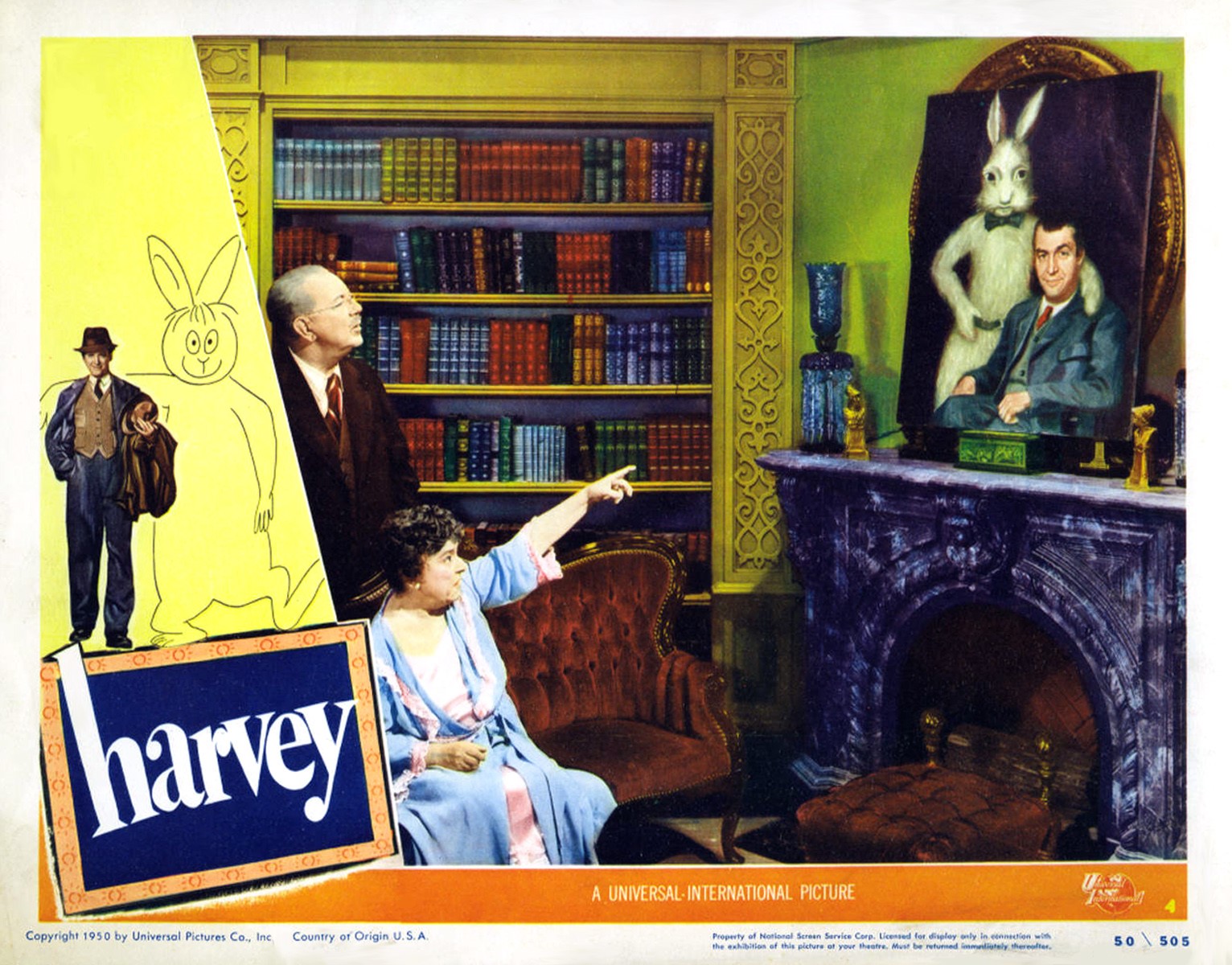
If you are not familiar with them, let me introduce you to Mr. Elwood P. Dowd and his best friend Harvey. What? You say you don’t see Harvey? Well, that is because he is an invisible six-foot-three-and-a-half-inch rabbit. Elwood sees him though, and Harvey accompanies him everywhere he goes. Harvey is a pooka, a creature from Irish, Celtic, and Nordic myth and folklore that can take the form of a large animal. Generally, the pooka is friendly and helpful. Elwood P. Dowd has found him to be very much so.
Elwood’s relationship with Harvey does bring some concern to his sister Veta and his niece Myrtle Mae. They reside with the eccentric Elwood in his large home. Elwood spends most of his time going around town and visiting bars accompanied by his best friend Harvey. He introduces Harvey to everyone he meets. This creates some awkward social situations, and Veta and Myrtle Mae have found themselves to be social outcasts. Though some of Elwood’s friends accept Harvey, most people whom Elwood comes into contact with are puzzled and dismayed.
Thus the stage is set for Veta to try to have her brother committed to a psychiatric facility. Needless to say, Elwood takes Harvey along with him for this new adventure. Elwood tells the doctor “Well, I’ve wrestled with reality for 35 years, doctor, and I’m happy to state I finally won out over it.”
The role of Elwood P. Dowd is played by the marvelous actor James Stewart. The role of his sister Veta is played by Josephine Hull. Both were nominated for Oscars for their performances with Josephine Hull winning Best Supporting Actress. The role of the niece, Myrtle Mae Simmons, was played by Victoria Horne. The film was directed by Henry Koster.
Elwood’s stay in the psychiatric facility introduces us to the staff there, where we find romance blossoming. Elwood and Harvey are the catalysts, not the participants. There we meet Dr. Chumley (Cecil Kellaway), Dr. Sanderson (Charles Drake), Miss Kelly (Peggy Dow), and staff member Martin Wilson (Jesse White). Even if the names don’t sound familiar, I’m sure the faces will be so. An interesting note here — Fess Parker (later to be known for roles as Davy Crockett and Daniel Boone) made his first film engagement (uncredited) as the voice of Leslie, the chauffeur.
Harvey was originally a Broadway play that opened in 1944. It was written by Mary Chase and ran for over 1700 performances. It won the Pulitzer Prize in 1945. Mary Chase was also involved in writing the screenplay for the film. Prior to appearing in the movie James Stewart played the role of Elwood P. Dowd on the stage when he filled in for the vacationing actor Frank Fay.

James Stewart reportedly suggested that the director change some of the shots to widen them so Harvey would be included in the frame. The cast and crew jokingly set a chair at the table for Harvey at lunchtime — and even ordered him food. Harvey makes a special appearance (well, sort of) at the end of the film with the credits. He opens a door, and the words appear “Harvey as Himself.”
Harvey was released in 1950. It was well-received by critics of the time. Variety magazine stated that the play “loses little of its whimsical comedy charm in the screen translation” and James Stewart “would seem the perfect casting for the character, so well does he convey the idea that escape from life into a pleasant half-world existence has many points in its favor.”
A review in The Washington Post called Harvey “one of the most beguiling comedies possible... I’m certain you’ll admire the able playing of Stewart and the marvelous out-of-this-world perplexity of the superb Mrs. Hull. Both are Academy Award performances.”
The American Film Institute listed Harvey at #35 in their list of Top 100 Funniest American Movies, and in their Top 10 in the genre of fantasy films.
Reportedly a number of well-known actors were considered for the role of Elwood P. Dowd. Those identified include Bing Crosby, Cary Grant, Rudy Vallee, Joe E. Brown, Gary Cooper, Jack Benny, Jack Haley, and James Cagney. I personally don’t think any of those named could have done a better job than James Stewart. In interviews later in his life he often identified this role as one of his favorites.

In 1958 there was a television version produced starring Art Carney as Elwood, and included in the cast were Marion Lorne, Elizabeth Montgomery, Fred Gwynne, and Jack Weston. (Note: You can find that version on the streaming channel Tubi).
In 1970 James Stewart took on the role of Elwood once again in a stage production that co-starred Helen Hayes. They both appeared in a television version for Hallmark Hall Of Fame in 1972 that included Madeline Kahn and Arlene Francis. Harvey was resurrected once more for television in 1996, this time starring Harry Anderson (Night Court) and Swoosie Kurtz as Elwood and Veta. Leslie Nielsen portrayed Dr. Chumley.
I think that a quote from a review I found from Brian Webster of “Apollo Film Guide” sums up what I think is special about this movie. “What makes Harvey great is the fact that it’s equally enjoyable as a piece of comedic fluff and as slyly intelligent social commentary aimed squarely at people who try to enforce conformity, judge those who are different, and define what’s sane behavior and what isn’t.”
Never miss a thing with our FREE weekly newsletter.
Elwood P. Dowd said: “I always have a wonderful time, wherever I am, whoever I’m with.”
The Internet Movie Data Base (IMDb) rated Harvey at 7.9 of 10. Rotten Tomatoes gave the film a critics score of 86% and an audience score of 93%.
In my usual search for free streaming, I found only one free site for Harvey. It is located on the Fawesome site. A copy of the DVD is also available on the shelves of the Clark County Public Library.
Information for this Reel Classic review was gathered from Internet Movie Data Base (IMDb), Rotten Tomatoes, Turner Classic Movies (TCM), and Wikipedia.
Please join me next time for the Reel Classic review where we will take a look at one of my favorite Christmas movies. In the meantime, enjoy the trailer below.
