
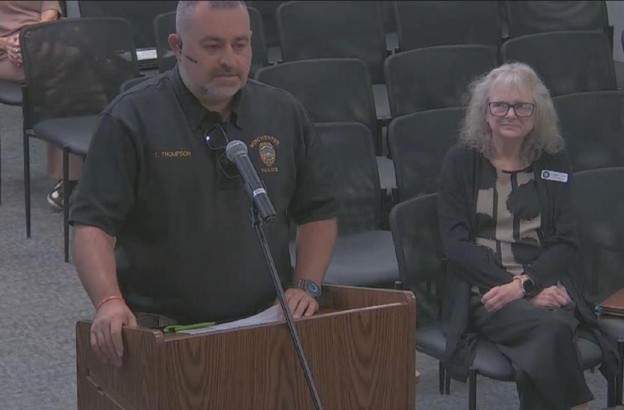
By John Chaney | The Winchester Sun

WINCHESTER — Winchester City Commissioners heard updates Tuesday evening on two key community resources: the public library’s growing reach and the police department’s use of automatic license plate readers.
Angela Turner of the Winchester-Clark County Public Library opened the presentations with a year-in-review packed with numbers. The library circulated more than 276,000 digital materials and held over 93,000 digital items. More than 39,000 people came through the doors or attended events and bookmobile programs. Staff delivered over 14,000 books to children enrolled in the Dolly Parton Imagination Library and offered more than 1,600 programs. Outreach teams still make 20 to 25 stops each week.
Turner zeroed in on the Dolly Parton program. Roughly 2,000 local children under age 5 are eligible, yet only 59 percent currently participate. “I want to challenge all of you all to think of somebody that you know that has a child, grandchild, whatever, that’s under age five and tell them about this program,” she said. Registration is simple via QR code, online form or a quick stop at the library. More than 900 children have already graduated from the program.
She also highlighted the Library of Things, where cardholders can borrow fishing poles, baking pans, blood pressure cuffs and passes to the children’s museum or Shaker Village. Commissioners praised the staff’s friendliness, the clean children’s area and popular programs such as the seed library. City Commissioner Shannon Cox noted he never complains about the library’s special tax district funding because “I see what you do.”
Police Chief Travis Thompson then walked commissioners through a new standard operating procedure required by recent state legislation governing automatic license plate readers. The department already uses the Flock Safety system and has trained every authorized user.
Never miss a thing with our FREE weekly newsletter.
“Only properly trained and authorized personnel are allowed to access the automatic license plate reader system,” Thompson said. Every search leaves an auditable digital footprint. The technology may be used solely for official law-enforcement purposes such as criminal investigations or locating missing or endangered persons. Officers must independently verify any alert before taking action.
Bottom of Form
Thompson stressed privacy limits. The cameras, placed on public right-of-way with Transportation Cabinet approval, capture only a vehicle and its license plate. “They don’t take a picture of your face. They don’t have facial recognition,” he said. The system cannot be used for personal reasons, harassment, or to target protected groups.
Every detection and inquiry now requires an associated case or incident number and a documented reason—an internal rule Thompson put in place earlier this year. Audits of at least 10 random searches will occur every 90 days.
Asked how the cameras have helped, Thompson replied, “They’re (a) tremendous help… missing persons, endangered persons, wanted persons, stolen vehicles, stolen plates, shoplifters… Many, many ways.” He also noted the first vandalism of a camera two weeks earlier; detectives are following leads.