
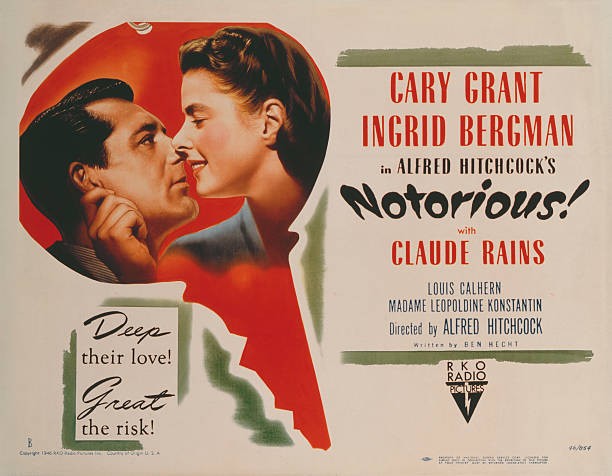

With today’s Reel Classic, we present another classic Alfred Hitchcock film starring two of Hollywood’s biggest stars, Cary Grant and Ingrid Bergman. Both Bergman and Grant appeared in multiple Hitchcock films. Today’s feature is Notorious, released in 1946. Also starring was Claude Rains who had appeared with Bergman in the classic film Casablanca.

The story is set in the year 1946 during the post-war era. Alicia Huberman (Ingrid Bergman) is the daughter of a convicted German spy. Government agent T. R. Devlin (Cary Grant) has been assigned the task to recruit her to infiltrate a group of former Nazis who escaped Germany and now reside in Rio de Janeiro, Brazil. The U.S. Government officials suspect that members of this group are plotting against America and its allies. One of the leaders of this group, Alexander Sebastian (Claude Rains), was a friend of Alicia’s father and once loved Alicia. Though she first resists the plan to be a spy, she eventually agrees with the encouragement of Devlin.
While plans are being developed, Alicia and Devlin spend time together and fall in love. Devlin is informed by his superiors that the plan is for Alicia to seduce Sebastian to gain his trust and information. Devlin tries to persuade them that asking her to do so is asking too much, but they persist. With this task in hand, Devlin takes a cooler approach with Alicia, and she sees this change in behavior as evidence that he was manipulating her feelings to get her to agree to the task.
In Brazil, Devlin arranges for Alicia and Sebastian to meet at a riding club. Sebastian recognizes her and still has feelings for her. He invites her to a dinner party at his home which he tells her will also be attended by some business acquaintances. She agrees and is instructed by Devlin to memorize the names and nationalities of all those in attendance.
At the dinner party, one of the guests becomes quite upset at the sight of a particular wine bottle. He is quickly taken from the room and later, when he tries to leave, he is told he will be driven home by one of Sebastian’s associates. Alicia’s impression is that he will not return home but instead will be killed.
Alicia continues in her role and eventually Sebastian proposes to her. When she informs Devlin of the proposal, she is disappointed in his apparent indifference and she accepts the proposal.
Upon returning from her honeymoon, she is presented with a set of keys to the house. However, she notes that a key to the wine cellar is not included. Devlin convinces her to throw a party and invite him as a guest, and he will investigate the wine cellar. She does so and on the evening of the party manages to get the key for the wine cellar from Sebastian’s key ring and gives it to Devlin.
What Devlin and Alicia discover in the wine cellar is more than just wine, and Sebastian discovers that the key is missing from his key ring. He discovers Alicia and Devlin together and becomes suspicious of his new wife. What is the secret in the cellar? What will come from Sebastian’s suspicions? And what will come of Alicia and Devlin’s relationship?

Notorious was an adaptation of a short story published as a two-part serial in the Saturday Evening Post in 1921. The story, “The Song of the Dragon” was written by John Taintor Foote and was initially brought to the screen as a silent film, Convoy, in 1927. It was set in New York during World War I.
The screenplay for Notorious was written by Ben Hecht, who had also worked on the screenplay of Hitchcock’s Spellbound (also starring Ingrid Bergman).
The role of Sebastian’s mother was played by Leopoldine Konstantin who had been one of pre-war Germany’s great actresses. It was her only appearance in an American film and her efforts were well applauded and described as “one of the unforgettable portraits in Hitchcock’s films.” Others considered for that role included Ethel Barrymore and Mildred Natwick.
Alfred Hitchcock was adamant that he wanted Cary Grant for the role of Devlin. The head of the studio, David O. Selznick, had Joseph Cotten under contract and worked to get Hitchcock to have him in the role. However, Hitchcock stuck with Grant and eventually Selznick gave in. Selznick also wanted Vivien Leigh to play the role of Alicia but the role went to Bergman.
Notorious was the official selection of the 1946 Cannes Film Festival. It premiered at Radio City Music Hall in New York City in August 1946 with Alfred Hitchcock, Ingrid Bergman and Cary Grant all in attendance.
The film was a box office success and was one of the highest grossing films of the year. The critics’ response was also very positive. Bosley Crowther, critic for The New York Times, wrote “Mr. Hecht has written, and Mr. Hitchcock has directed in brilliant style, a romantic melodrama which is just about as thrilling as they come — velvet smooth in dramatic action, sharp and sure in its characters, and heavily charged with the intensity of warm emotional appeal.” Critic Pauline Kael wrote “The suspense is terrific . . . Great trash, great fun.”
Later critics also praised the film. Roger Ebert included it on his list of “Ten Greatest Films of All Time” and described it as “the most elegant expression of the master’s visual style.” He also wrote that Notorious had “some of the most effective camera shots in his — or anyone’s — work.” Ebert identified it as his favorite Hitchcock film.
In 1999 Entertainment Weekly listed Notorious at number 66 on their list of “The Greatest Films of All Time” and in the same year The Village Voice listed it as number 77 in their “Best Films of the Century.” In 2000 it was selected for preservation in the United States Film Registry by the Library of Congress.
Notorious was adapted twice for radio, in 1948 for “Lux Radio Theater” and again in 1949 for “The Screen Guild Theater.” Both adaptations had Ingrid Bergman reprising her role as Alicia Huberman. In 1992 it was remade for a television movie with the story line revised from Nazi conspirators to Communist conspirators. The remake has a rating of only 4.4 on IMDB.

An interesting story revolves around the key to the wine cellar. Cary Grant kept the key used in the film and, years later, presented it to Ingrid Bergman telling her that it had given him good luck. He told her he hoped it would do the same for her. In March 1979 the American Film Institute honored Alfred Hitchcock with a Life Achievement Award. At the dinner in his honor Ingrid Bergman presented Hitchcock with the key given to her by Cary Grant. She told him that she was hopeful it would provide good luck for him as well. Reportedly he was quite surprised and very delighted to receive the gift.
In a conversation with famous French film director Francois Truffaut, Hitchcock described Notorious as a story of classic conflicts:
“The story of Notorious is the old conflict between love and duty. Cary Grant’s job — and it’s rather an ironic situation — is to push Ingrid Bergman into Claude Rains’ bed. One can hardly blame him for seeming bitter throughout the story, whereas Claude Rains is a rather appealing figure, both because his confidence is being betrayed and because his love for Ingrid Bergman is probably deeper than Cary Grant’s. All these elements of psychological drama have been woven into the spy story.”
Rotten Tomatoes gives the film a Critics Score of 96% and an Audience Score of 91%. The site’s Critics Consensus states “Sublime direction from Alfred Hitchcock, and terrific central performances from Ingrid Bergman and Cary Grant make this a bona-fide classic worthy of a re-visit.” The Internet Movie Database (IMDB) rates it at 7.9 of 10.
Never miss a thing with our FREE weekly newsletter.
In searching my Roku device I found Notorious available on two free streaming sites — Fawesome and Plex. There is also a copy of the DVD on the shelf at the Clark County Public Library.

If you are a regular follower of Reel Classics, you may have noticed that I have reviewed a number of Alfred Hitchcock films, including such classics as Rear Window, Rebecca, and Vertigo (to name a few). Hitchcock was a prolific filmmaker, beginning his career in the days of silent films and lasting until the 1970s.
And let us not forget his efforts with his two television shows Alfred Hitchcock Presents and The Alfred Hitchcock Hour which ran in the 1950s and 60s (and still do today on various streaming sites). He is one of my favorites, so I can safely promise that you will see more of his work here. He was indeed a master of his craft.
Information for this Reel Classic review was gathered from sources including the Internet Movie Data Base (IMDB), Rotten Tomatoes, Turner Classic Movies (TCM), and Wikipedia.
Ron Kibbey’s Comedy Classics
If you enjoy these classic movies, please join Ron on the second Tuesday of each month at 6 PM at the Clark County Public Library for “Ron Kibbey’s Comedy Classics.” The evening features a classic comedy film, usually accompanied by a vintage cartoon. Popcorn and drinks are provided. More information about the next film is available on the library’s website and Facebook page, as well as WinCity Voices Facebook page.
