
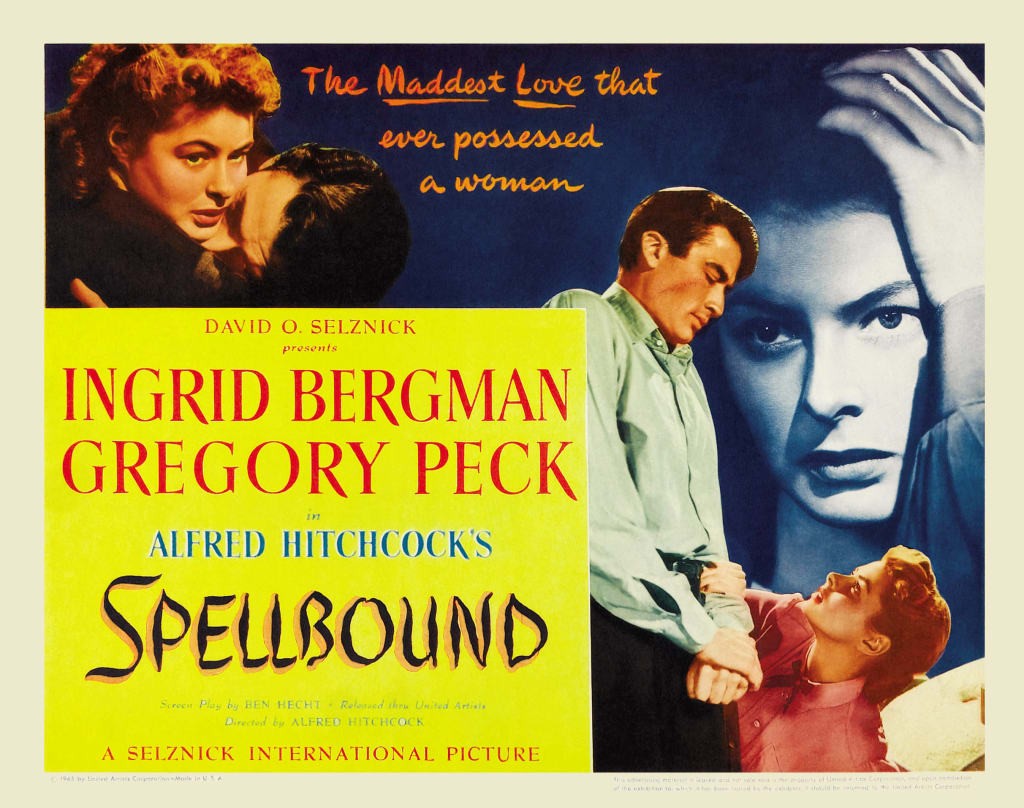

The Internet Movie Database lists the following terms for this Reel Classic film: film noir, psychological drama, psychological thriller, mystery, and romance. It is all of those with an outstanding cast including Ingrid Bergman, Gregory Peck, Leo G. Carroll, and Rhonda Fleming.
Our film is Alfred Hitchcock’s Spellbound.
The setting is a mental hospital in Vermont known as Green Manors. We are quickly introduced to several of the attending psychiatrists, including Dr. Constance Petersen (Ingrid Bergman). The hospital’s director, Dr. Murchison (Leo G. Carroll), is being replaced after being forced to leave due to an absence related to nervous exhaustion. His replacement is a young Dr. Anthony Edwardes (Gregory Peck). It does not take long for a mutual attraction to develop between Dr. Petersen and Dr. Edwardes. It turns out that Dr. Petersen has been a fan of the writings of Dr. Edwardes and has a book he wrote on her library shelf.

As they get to know each other better, it is not long before she notices concerning behavior on his part. One is a peculiar reaction to parallel lines on a white background she has made on a tablecloth, demonstrating a design, and another time with the lines on her robe. She comes to learn that he is not who he says he is when she compares his signature on a note to an autograph in one of his books.
She confronts him, and he admits he is not Dr. Edwardes and does not know who he is — he is suffering from amnesia. He believes he has killed Dr. Edwardes and has assumed his identity. Dr. Petersen believes him to be innocent and suffering from a guilt complex. He disappears overnight from the hospital, and Dr. Edwardes’ assistant shows up to inform the hospital staff that the man who claimed to be Dr. Edwardes is an impostor and the real Dr. Edwardes is missing. Dr. Murchison resumes his role as director.
Meanwhile, Dr. Petersen has tracked down the missing man, who is staying at a hotel in New York City under the name John Brown. She is adamant that psychoanalysis can help him regain his memory and convinces him to travel with her to upstate New York to visit her friend and mentor, Dr. Alexander Brulov (Michael Chekhov).

Dr. Brulov agrees to let them stay and offers to assist Dr. Petersen in her efforts to restore the memory of who is now John Brown. Brown has a very disturbed and troubling night, and the next day, he explains to the two psychoanalysts that he had a very disturbing dream. The dream included bizarre scenes where he was in a club playing cards, and the club was decorated with huge eyeballs. His card partner is accused of cheating and is threatened by the masked owner of the club. A woman resembling Dr. Petersen is going around kissing everyone, and suddenly he sees his card partner fall from a sloping roof. It ends with him being chased down a slope by a pair of wings.
Dr. Brulov and Dr. Petersen surmise that the older man falling from the slope was Dr. Edwardes and that Brown’s reaction to the parallel lines were ski tracks in the snow. By interpreting the symbols in the dream, they surmise that Brown and Edwardes were together at a local ski resort, and Dr. Petersen accompanies Brown there to continue working on restoring his memory.
Upon their arrival, they decide to ski the slope to see if that brings back any more memories. Upon doing so, his memory begins to return, including his own name, John Ballantyne, and his relationship with Dr. Edwardes. He remembers the incident in which Dr. Edwardes dies and is accompanied by Dr. Petersen to the police, and, with Ballantyne’s assistance, they find the body and learn he had been murdered. However, this is far from the end of the story. There are several twists and turns yet to be experienced, but with the thought of no spoilers, I will stop the story here.
Remember, this is Alfred Hitchcock; twists and turns are guaranteed.
Producer David Selznick had worked with Hitchcock in the past and wanted him to make a film dealing with psychoanalysis. Selznick had been to a psychoanalyst and was eager to share the positive experience. In fact, he brought his therapist on and gave her screen credit as a consultant. At Hitchcock’s suggestion, Selznick had bought the rights to the 1927 novel The House of Dr. Edwardes, and in December 1943 Hitchcock and his wife, Alma Reville, began to work on adapting the novel. In January 1944, they brought on Angus MacPhail to assist them with the adaptation. MacPhail had worked with Hitchcock previously. Their completed effort was then given to screenplay writer Ben Hecht. Hecht worked with Hitchcock on several films, including Notorious and Rope.
Rhonda Fleming played Mary Carmichael, a patient at the mental hospital. Carmichael was portrayed as a violent nymphomaniac. A number of her scenes were cut from the movie due to objections from the Production Code Administration (Hay’s Office). That wasn’t her only cut in the film. The movie’s theme had lyrics and was sung by Fleming. However, Hitchcock and Selznick chose to cut that as well.
One of the more interesting and bizarre scenes from the film was the dream sequence. Alfred Hitchcock was a big fan of the surrealist artist Salvador Dali. Dali was hired to develop John Brown’s bizarre dream, and the sequence ran for 20 minutes. It eventually was pared down to about two minutes. Dali was paid $4,000 for his efforts. Selznick was initially opposed to spending that much but realized that Dali’s name could serve as a marketing device for the film.

David Selznick was notorious for his involvement in the production of the films he produced. Alfred Hitchcock was adamant that he wanted no interference in his filmmaking. When Selznick showed up on the set, interestingly enough, the cameras often failed to work properly. Fortunately, they resumed functioning again after the producer left.
This was one of Gregory Peck’s earliest films. He appeared in his first film only a year earlier, and this was his fourth. He had not been Hitchcock’s first choice, however. Hitchcock had hoped to get Cary Grant, and Joseph Cotten was his second choice. Fortunately for Peck, those two did not end up with the role.
The connection between Gregory Peck and Ingrid Bergman worked very well on screen and, reportedly, off screen as well. In a 1987 interview, five years after Ingrid Bergman’s death, he implied that he and Bergman had a brief affair. In the interview appearing in People Magazine, he said, “All I can say is that I had a fiery kinda love for her, and I think that’s where I ought to stop...I was young. She was young. We were involved for weeks in close and intense work.”
Spellbound received positive reviews from critics and viewers alike. It grossed almost $8 million and was the third-highest-grossing film of 1945. The critic for Newsweek described it as “a superior and suspenseful melodrama.” In describing Hitchcock’s efforts, the reviewer for The New Yorker wrote, “Fortunately, the English expert hasn’t forgotten any of his tricks. He still has a nice regard for supplementary characters, and he uses everything from train whistles to grand orchestral crescendos to maintain excitement at a shrill pitch...All in all, you’d better see this one.”
Spellbound was nominated for six Oscars, including Best Picture, Best Director, Best Supporting Actor (Michael Chekhov), and Best Original Score (which it won). The soundtrack to the film, composed by Miklos Rozsa, sold well, and Rozsa later developed the “Spellbound Concerto” for piano and orchestra.
The film was later adapted twice for radio, first in 1948 on Lux Radio Theatre (starring Joseph Cotten and Alida Valli) and again in 1951 on NBC’s Screen Director’s Playhouse (starring Joseph Cotten and Mercedes McCambridge). Both were directed by Alfred Hitchcock. An adaptation was brought to television in 1962 on NBC’s Theatre ’62. This film starred Hugh O’Brien, Oscar Homolka, and Maureen O’Hara.

The success of Spellbound led to a reuniting of Hitchcock, screenwriter Ben Hecht, and actress Ingrid Bergman the following year in the film Notorious (also starring Cary Grant and Claude Rains). Another interesting note is that Leo G. Carroll was apparently a favorite of Hitchcock’s, as he appeared in six of his films. The others were Rebecca (1940), Suspicion (1941), The Paradine Case (1947), Strangers On A Train (1951), and North By Northwest (1959).
The Internet Movie Database rates Spellbound at 7.5 out of 10. Rotten Tomatoes gives it a Critics Score of 86% and an Audience Score of 82%. In searching my Roku device, I could find no free streaming sites, but there is a copy of the DVD on the shelf at the Clark County Public Library.
Never miss a thing with our FREE weekly newsletter.
I will end with a quote from well-known film critic Roger Ebert.
“Hitchcock...remains not only the Master of Suspense but a grandmaster of the cinema, whose films are so distinctive that anyone familiar with his work can spot one after just a few shots.”
—Roger Ebert in 2012
Though Hitchcock began his career during the period of silent films, he churned out many masterpieces and made films into the 1970s. He was a master, and Spellbound is an excellent example of his art.
Information for this Reel Classic review was gathered from sources including the Internet Movie Database (IMDb), Rotten Tomatoes, Turner Classic Movies (TCM), and Wikipedia.
Ron Kibbey’s Comedy Classics
If you enjoy these classic movies, please join Ron on the second Tuesday of each month at 6 PM at the Clark County Public Library for “Ron Kibbey’s Comedy Classics.” The evening features a classic comedy film, usually accompanied by a vintage cartoon. Popcorn and drinks are provided. More information about the next film is available on the library’s website and Facebook page, as well as WinCity Voices Facebook page.
