
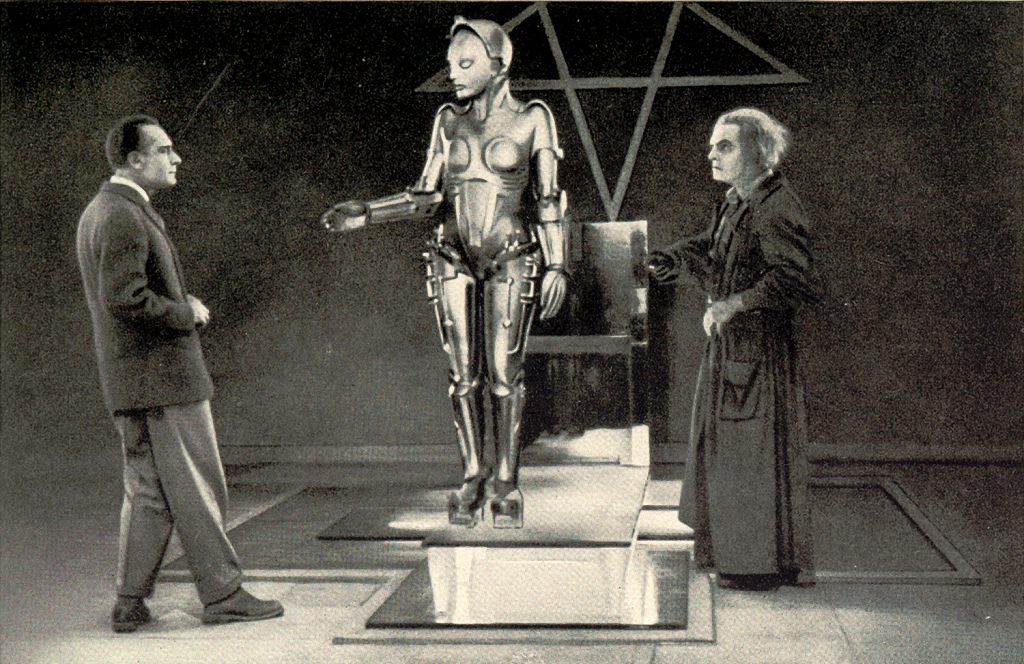


In 1927, German director Fritz Lang brought forth a film that combined the concepts of religious analogies, political undercurrents, the plight of laborers versus the wealthy, and science fiction. An epic film nearly two and a half hours long, it fascinated and mesmerized the viewing public. Today, it is praised as one of the greatest films of the silent era and as one that had a great influence on films to come.
Our Reel Classic is Metropolis.
The story was based on a 1925 novel written by Lang’s wife, Thea von Harbou. She then adapted it into the screenplay. It stars Alfred Abel as Joh Fredersen (the master of Metropolis), Gustav Frohlich as Freder (Joh Fredersen’s son), and Rudolf Klein-Rogge as Rotwang (the inventor). Brigitte Helm plays a dual role — that of Maria (Freder’s love interest) and the Machine Human.
The story is set far in the future, and though there is some uncertainty about what year, a 1927 English reprint of the original novel sets the story in the year 2026. As the story opens, we find a huge city with skyscrapers, sports arenas, beautiful gardens, elevated rails, and roads, and see the wealthy business owners and their families enjoying the benefits of their pleasant environment.
However, we also see the multitude of laborers who live beneath the city’s surface and operate the machinery that keeps the city above functioning. Joh Fredersen is the master of the city, and his son Freder spends much of his time in idle pleasures at the sports arenas and pleasure gardens.
His life is about to change when he sees a beautiful woman suddenly appear, escorting a group of children of the workers below the surface. She has brought them to the surface to see the lifestyle of their rich “brothers.” Maria is told to leave and does so, but Freder is quite taken by her. He decides to violate the city’s strict rules and enter the lower levels to search for her.
Below the surface, he witnesses the struggles of the workers laboring at the various machines that keep the city above operating. While there, he is a witness to an explosion of a machine that kills and injures many workers. He heads back to the world above to inform his father of the tragic accident and the plight of the laborers.
Meanwhile, one of Joh Fredersen’s assistants brings him copies of maps found in the pockets of the dead laborers. He reacts indifferently to what his son tells him of the conditions faced by the workers below the city. Freder decides to help the laborers and returns underground, taking the place of one of the machine laborers.
Meanwhile Fredersen, wanting to understand the meaning of the maps, takes them to Rotwang, a great inventor, to help him determine their meaning. We learn that Rotwang had been deeply in love with a woman named Hel. However, she left him, married Fredersen and died giving birth to their son, Freder.
Rotwang shows Fredersen his latest invention — a robot he has built to “resurrect” Hel. He interprets the maps and finds they illustrate various catacombs under the city, and the two set out to investigate them. They see Maria addressing a gathering of workers, saying that a mediator will come to unite the workers and the ruling class.
Fredersen sees his son in the crowd approaching Maria, telling her of his love for her and that he will serve as the mediator.

Fredersen’s response is to order Rotwang to kidnap Maria and create the robot in her likeness so that her actions can be made to discredit her with the workers. Rotwang agrees to do so, but he has other plans. He seeks vengeance for the loss of his beloved Hel and plans to use the robot to destroy Metropolis and kill Freder. We see Rotwang successfully kidnap Maria and create her image in the robot.
The robot — as Maria — is released back into the underworld and exhibits a very different persona to the workers. She speaks of revolting against the privileged above and stirs the workers to act.
Will Freder find the real Maria? Will the workers revolt and destroy Metropolis? Will Rotwang be successful in achieving his vengeance? No spoilers.
Many of the cast members were not known actors at the time.
Gustav Frohlich was a journalist. He had previously worked in vaudeville and was hired as an extra before being offered the role of Freder at the recommendation of Lang’s wife, von Harbou.
This film was also the feature-film debut of Brigitte Helm, who was only nineteen years old at the time.
Thousands of extras were employed, including 500 children who were brought in from the poorest section of Berlin. They endured difficulties in the scenes depicting flooding in the underground city, but otherwise were well cared for.
Thea von Harbou, in a 1927 interview with Metropolis Magazine, said that the children were provided with warm, clean rooms, time for play, toys, and hot meals four times a day.
“No film ever had more enthusiastic and willing collaborators than these little children....”
Unfortunately for them, after filming, they had to return to the destitute circumstances they lived in.
The film took almost a year and a half to complete and premiered in Berlin in January 1927. One of the features that entertained audiences was the special effects.
Eugen Schufftan was the expert behind the special effects utilized, which included miniatures of the city, a camera on a swing, and a technique called the Schufftan process, in which mirrors are used to create the appearance of actors on the miniature sets. Famous director Alfred Hitchcock used this special effect in his 1929 film Blackmail.
Reportedly Lang was not an easy director to work with. He would often insist on multiple shootings of the same scene.
One scene involving Freder collapsing at Maria’s feet took two days to complete and satisfy Lang.
Another example was with Brigitte Helm. She played the roles of both Maria and the robot. A costume was developed for the robot scenes that appeared metallic yet allowed for some movement. Helm asked that a double be used for the robot scenes, but Lang refused, insisting that Helm be in the body suit. Because of the rigidity of the suit, she suffered cuts and bruises.

As mentioned above, there are various references to religion and political beliefs. The film references biblical images such as the Tower of Babylon and the Whore of Babylon riding a multi-headed dragon.
Also, a reference to Buddha can be drawn. Buddha was brought up in luxury and went into the world, where he discovered the plight of the poor. He renounced his privileged life and ventured into the world to seek enlightenment and compassion. We witness this transformation in Freder.
Also, we see the perceived exploitation of the underground workers, whose toil at the machines benefits the rich and privileged above. These concepts were perceived as socialist and communist by critics at the time.
Soon after the film’s release, the studio was taken over by a German nationalist businessman, Alfred Hugenberg, who demanded the film be edited down to under two hours and that references to what he perceived to be “inappropriate” references to communism and religion be removed. As the Nazis gained more power and influence in Germany, more cuts by Nazi censors were demanded.
A similar fate awaited the film before its American debut. An American playwright, Channing Pollock, was hired to create a pared-down version of Metropolis. He shortened the film, changed some of the title cards, and edited out all references to the character Hel. He stated that the name sounded like the word “Hell,” thereby deleting Rotwang’s motivation for creating the robot. He said that the “symbolism ran such a riot that people who saw it couldn’t tell what the picture was about. ...I have given it my meaning.”
In response, Fritz Lang was quoted as saying, “Their experts have slashed my best film.”
Several edited versions of the film survived, but the original was thought to be lost. In 1984, Giorgio Moroder restored an 80-minute version of the film with a new pop soundtrack he wrote. It was performed by various artists including Pat Benatar, Adam Ant, Billy Squier, and Freddie Mercury. Color tinting was utilized, and title cards were eliminated and replaced with subtitles.
Though this version has become somewhat of a cult favorite, it was criticized at the time and nominated for two Razzies — Worst Original Song and Worst Musical Score.

In 2008 a copy of the original film was discovered in a film museum in Buenos Aires, Argentina. Work began to restore the film that included approximately 25 minutes of footage not seen since 1927. The newly restored version premiered in Berlin in February 2010 with the original score performed by the Berlin Radio Symphony Orchestra. The American première was at the TCM Classic Film Festival in Los Angeles in April 2010.
The reviews were very positive.
The New York Daily News wrote, “It took the German restorers four years to ready this print.... Their work speaks for itself. Each frame of this classic is drop-dead stunning....”
The reviewer for the San Francisco Chronicle wrote “Seeing it is a time-bending experience, a way of visiting the past and glimpsing the past’s idea of the future. A masterpiece of art direction, the movie has influenced our vision of the future ever since....”
In his review, Roger Ebert wrote: “Generally considered the first great science-fiction film, ‘Metropolis’ (1927) fixed for the rest of the century the image of a futuristic city as a hell of scientific progress and human despair.”
Fritz Lang, who was Jewish, later left Germany as Hitler and the Nazis gained power. He eventually arrived in Hollywood and had a successful career as a director, writer, and producer. Another of his famous films is M (1931) starring Peter Lorre.
The Internet Movie Database rates Metropolis at 8.2 out of 10. Rotten Tomatoes gives it a Critics Score of 97% and an Audience Score of 91%.
Never miss a thing with our FREE weekly newsletter.
In searching my Roku device, I found multiple sites that offer the film for streaming. These sites include Roku Channel, Plex, Fawesome, Classic Movies and TV, and Tubi. Two streaming sites that are free with your Clark County Public Library card, Kanopy and Hoopla, also offer it. Hoopla also offers the Giorgio Moroder version. It appears the library does not have a DVD copy of the film, but I am sure they would be willing to obtain one if asked.
This film is indeed a work of art, a movie that influenced our science-fiction films yet to come, with themes that continue to resonate in 2026.
One of the film’s major themes, as relevant today as it was then, is a quote from Maria: “The mediator between head and hands must be the heart!”
Information for this Reel Classic review was gathered from sources including the Internet Movie Data Base (IMDb), Rotten Tomatoes, Turner Classic Movies (TCM) and Wikipedia.
Ron Kibbey’s Comedy Classics
If you enjoy these classic movies, please join Ron on the second Tuesday of each month at 6 PM at the Clark County Public Library for “Ron Kibbey’s Comedy Classics.” The evening features a classic comedy film, usually accompanied by a vintage cartoon. Popcorn and drinks are provided. More information about the next film is available on the library’s website and Facebook page, as well as WinCity Voices Facebook page.
