
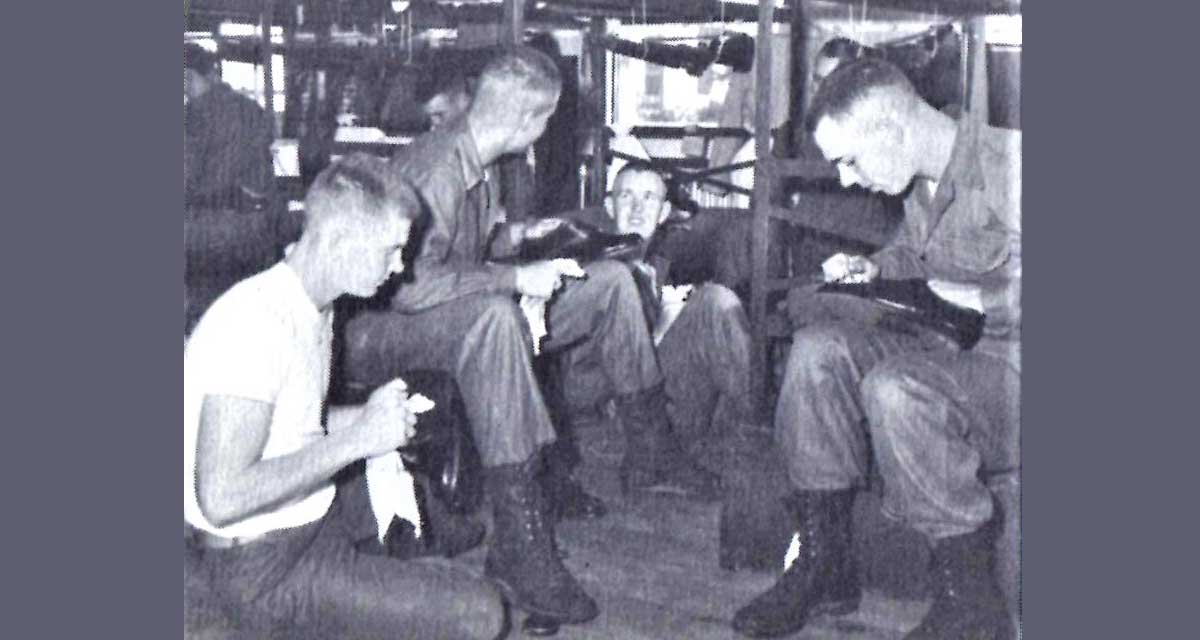
The barracks for Platoon 195, First Battalion, Recruit Training Regiment was a two-storey wood-framed and wood-clad, H‑shaped building located adjacent to a vast bituminous-paved parade field with which we would become intimately familiar.
The center portion of the “H” housed the offices for the training staff and, on the back side, the toilets, hereafter to be referred to as “the head.” Each leg of the “H” housed the platoon sleeping spaces which we came to call the “squad bay” despite the fact that it was housing a platoon. There was one platoon on each floor and four platoons per building. 195 was housed on the second floor. Each platoon consisted of approximately 80 individuals and the racks were positioned along each side of the bay, double-stacked, with an aisle about three feet wide between each double rack, with the center section of the squad bay about 10 feet clear running from the front to the back of the building.
A rack, very appropriately named, consisted of a metal frame on which was stretched a metal mesh “net” which supported a mattress of approximately three inches thickness, almost sufficiently thick to cushion one’s backside from the metal mesh below. Each recruit was issued two white sheets, a white pillowcase, and one woolen blanket of some non-describable color that could only have been developed for the military.
Each double rack also came with two footlockers, one for each rack occupant, hinged-topped wooden boxes approximately 32” wide by 16” high by 16” deep, with an internal tray for small personal items. There were two cords looped onto each side of the upper rack. These held our rifles . . . except for the times when someone might be required to sleep with his for perhaps referring to it as a “gun.”
There were no lockers; everything not being worn or attached to the rack was kept in the locked footlocker. These were stored on the floor under the head and foot sections of the lower rack. They could be used for sitting on those rare occasions when we were allowed to sit. Sitting on a rack was never allowed. All the heads of the racks were positioned against the walls, with the foot of each pointing to the center of the bay. Across the top rail of the bottom of the rack was looped a towel for each recruit. The towels were tri-folded lengthwise and hung so that the bottom edges were perfectly aligned with each other.
Shortly after arriving at our barracks, we were ordered to assemble everything that we had arrived on the island with to be sent home. The Marine Corps policy was that everything we needed would be supplied, and this was obviously one way to make the separation from our civilian life more of a reality.
As if the fact that we were little more than a milling sea of olive drab-clad, shaven head oneness wasn’t already evident enough.
Before items due for home were sent out, the drill instructors (always referred to by us as D.I.s, but never to their face) went through everything in our possession to make sure there were no drugs or weapons being held out.
Perhaps there is some incongruity in the fact that all of us were issued with rifles and 10-inch bayonets but there was some concern that an errant pocket knife might be hidden somewhere.
Never miss a thing with our FREE weekly newsletter.
Now that platoon 195 was formed and situated in barracks we were introduced to the three D.I.s who would shepherd us through basic training.
There was a senior D.I. and two junior D.I.s. The senior was Staff Sergeant R.P. LaCoursiere and the juniors were Sergeant R.C. Temple and Sergeant B.L Tracy.
LaCoursiere was a short, dark individual who we believed was of Canadian ancestry although we never were privy to the past or private lives of the D.I.s. He had a volatile temper and though shorter than nearly every member of the platoon, there was never any doubt as to who the predominant character was in any confrontation. D.I.s have a tendency to want to get nose to nose with a recruit when making a point. With LaCoursiere’s vertical deficiency it was usually nose to Adam’s apple which worked out just fine, since a recruit was never supposed to look directly into the eyes of a D.I. anyway.
“Are you trying to eye‑f**k me, maggot?” was the usual question when a recruit erred and looked directly at one.
Yes, for several weeks to come we would be “maggots,” “shitheads” or any of a number of other lowly sobriquets designed to remind us of our lowly status.
