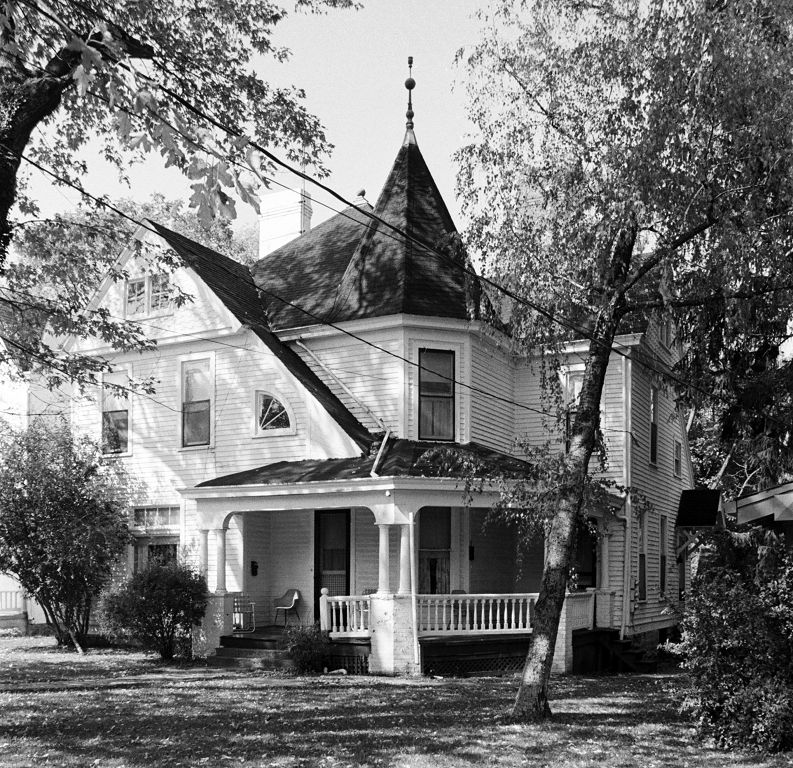

Albert Rand “A. R.” Baldwin (1867−1914) grew up in Winchester. His father died when he was nine years old, and his mother raised five children alone. Rand was the youngest.
As a young man he and his brother Lee entered business with George Richter, a long-established jeweler in Winchester. After Richter retired from the business in 1891, the brothers partnered for a brief time with J. R. Martin before forming their own firm.
Their shop, located in the Citizen’s National Bank at the “Sign of the Big Clock,” was a downtown fixture for years. Creative businessmen, they sold novelties, toys in season, “optical goods,” held art exhibits, and offered diamond rings priced from $2 to $150. Those were the days!
In 1889 Rand married Edith Wheeler in Wabash, Indiana. They returned to Winchester, and in 1896 Rand built a new house for his growing family. In a timeline almost beyond imagining today, he obtained a building permit in early April and held a housewarming party in late July.
The two-story, frame Queen Anne-style house has an octagonal tower topped with a tall iron finial. The wraparound porch is supported by two double columns and the front façade features a single quarter arch window.
A salesman friend of Rand presented him with a handsome pug dog that became a beloved family pet. As the story goes, “Trixie” immediately became a favorite with the neighborhood children.
One weekend, while the family was away, Trixie disappeared. There was weeping and wailing when they returned to find their animal friend gone. The next day Rand went to the newspaper office to put a notice in the paper and offered a reward for her return. By the time he got back home, the dog had been found.
A week later the paper reported that, as of that writing, twenty-seven lost dogs had been brought to him by those seeking the reward.


Edith must have been a scholarly-minded woman, as she helped found and served as president of the Mental Culture Club. At their monthly meetings, they read from the classics and delivered original papers on a wide range of literary topics.
In addition to his business, Rand participated in the Commercial Club, served as treasurer of the school board, got elected to two terms on the city council, and was chosen Esteemed Loyal Knight of the local Elks lodge.
He served for many years as a director of the Winchester Savings, Loan and Building Association. His special interest was Winchester’s volunteer fire department. In 1890, he was elected captain of the #2 hose wagon, then in 1906 when Chief W. A. Attersall took the mayor’s office, Rand became the new fire chief. Under his leadership the fire department acquired its first motorized hose wagon.
In 1902, Rand traveled east to take a special course at one of the best optical schools in New York City. Upon his return he took the title of “Practical Optician,” and the Baldwin Brothers’ “Jewelers and Opticians” began running optical-related ads, such as “What About Your Eyes . . . Frequent examinations are necessary to strengthen and preserve your eyesight.”

In a cruel twist of fate, Rand soon began experiencing problems with his own vision. The Daily Democrat reported that “The many friends of A. R. Baldwin will regret to know that he is still suffering with his eyes [and is] in Louisville undergoing treatment by a noted specialist.” In 1914 he traveled to Johns Hopkins Hospital in Baltimore, where he underwent radium treatment for cancer of the face and throat. After suffering for nine months, the paper announced that “Death Comes as a Great Relief to A. R. Baldwin.”
Never miss a thing with our FREE weekly newsletter.
Five months after Rand’s death, the tragedy was compounded when Edith, overcome with grief over the death of her husband, took her own life.
The location of today’s “mystery house” will be revealed in next week’s article.
Here’s the answer to last week’s mystery house: The James L. B. White House is located at 10 Euclid Avenue. When White erected the house, Euclid was called Haggard Street, which was laid out in 1890 as part of the Witherspoon Addition. Today the exterior is in need of maintenance.