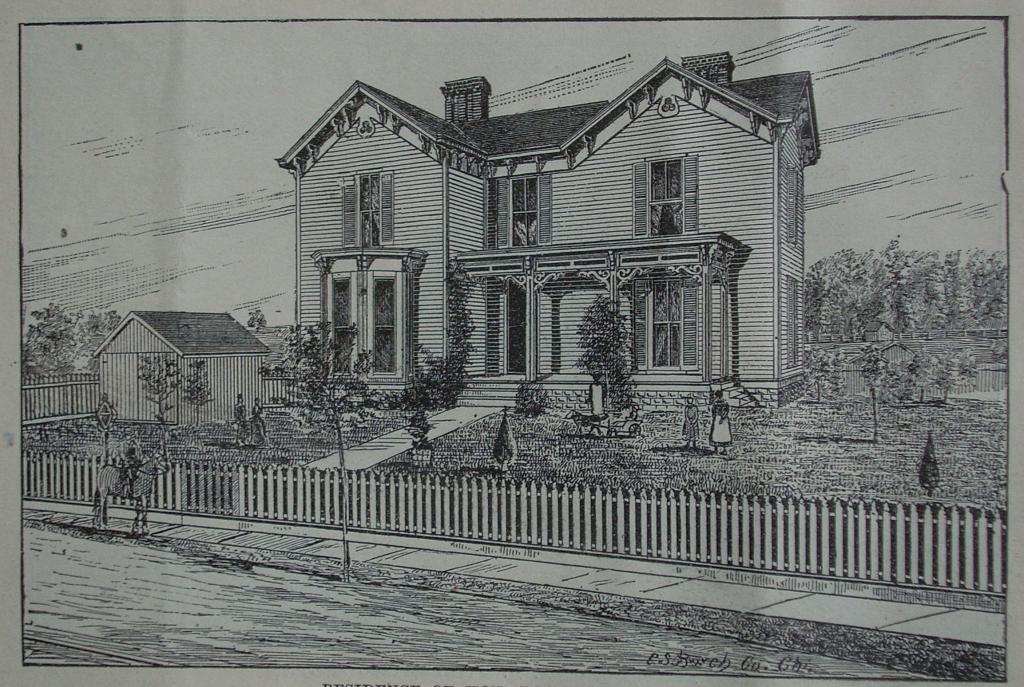

This week Harry Enoch begins a series on “Mystery Houses” in Clark County. The location of today’s “mystery house” will be revealed in next week’s column.
Rodney Haggard (1844−1901) was a larger-than-life figure in 19th century Winchester. He belonged to the largest family in Clark County, the Haggards who settled here before Kentucky was admitted into the Union.
Upon graduating from Winchester High School, Haggard began teaching school himself. When the Civil War broke out, he enlisted in Gen. Simon Bolivar Buckner’s Guards at age 17. He was commissioned an officer and raised a company for Col. David Chenault’s 11th Calvary Regiment under John Hunt Morgan’s command. Haggard fought in engagements in Tennessee at Hartsville and Kentucky at Richmond, Green River Bridge, Mill Springs, West Liberty and Lebanon. Captured during Morgan’s Ohio raid, Haggard was sent to Johnson’s Island where he remained a prisoner until the close of the war.
Returning to Winchester after the war, Haggard ran for sheriff on the Democratic ticket and won. At age 21, he became the youngest person ever elected to that office in Kentucky. He gained a reputation for efficiency, being the first sheriff to settle accounts each year with the state auditor. After winning re-election Haggard began the study of law under Chief Justice James Simpson. He subsequently graduated from the University of Louisville law school and was admitted to the bar in 1873. He served as an attorney for the Chesapeake & Ohio and Louisville & Nashville railroads.

In 1880 Haggard was elected without opposition to the Kentucky Senate. He introduced a number of important bills that became law, the most significant being creation of a state board of equalization. The board was responsible for ensuring that property taxes were assessed and collected fairly, uniformly, and equitably. In 1893 he was elected county judge.
Haggard married Mary Eliza Baldwin. A story was told of his romancing the young lady. “When he was scarcely more than a lad he happened to see his wife, then a girl about ten years of age and instantly announced that that girl was to be his wife. The war intervened, years elapsed and finally the young lawyer succeeded in winning the hand of the fatherless girl.” She was the daughter of Lt. W. W. Baldwin who was killed at the Battle of Green River Bridge.
Rodney Haggard died by his own hand in September 1844. He was laid to rest in Winchester Cemetery following lengthy tributes by the United Confederate Veterans and the Winchester Lodge of Elks and a eulogy by Col. W. C. P. Breckinridge. His obituary stated that “the funeral was probably more largely attended than any funeral ever held in this city.”
Rodney Haggard’s T‑plan house was built in 1883 (date carved over the cellar door). A spring on the property supplied water for Haggard and nearby neighbors. In architectural speak, the two-story frame house featured fine bracketed cornices, a pair of trefoil gable ventilators, filigree sawn porch decoration, and a bay window. The main staircase was constructed of walnut, oak, cherry, rosewood and mahogany. With the exception of the roof brackets, the house has retained these decorative elements.