
- Arrival
- Getting ‘geared up’
- Settling in to a new home
- Morning routine
- Women Marines, and more
- Weapons familiarization
- Close-order drills and hand-to-hand combat
- Swimming — and tear gas!
- ‘Snapping in’ and ‘pulling butts’
- Photos and graduation
- Goodbye, Parris Island
- Training at Camp Geiger
- Grenades
- The big guns!
- The End
As we continued training five days a week, weekends free with passes and leisure times spent at the slop chute or off base at the USO, more specialized training took place. We were exposed to map reading utilizing the compass, even at night. Escape and evasion. Ambush.
Even serious training can contain an occasional humorous event. While training at night during a compass course I was attempting to read the compass direction on the dimly-glowing dial while one of my mates backed away from me as I motioned him away, correcting his direction as he went. Suddenly he disappeared! Had he been snatched away by some forest-dwelling creature? Taken by aliens? As it turned out he had tumbled backward into a depression in the ground and vanished from sight. As I moved to his last seen spot I found him lying very comfortably in the depression, taking advantage of a brief respite from our endeavor as we both laughed at his misadventure.

While every Marine is considered a rifleman, he must also be acquainted with a plethora of other weapons, and those weapons were far less complicated in the 1960s than they are today. The ability of a Marine to utilize a variety of weapons at his disposal has been a hallmark of his training and his success in combat.
One of the largest weapons with which we would become familiar was the 75 mm recoilless rifle. It’s capable of destroying tanks and fortified positions at distance. It is usually operated by more than one person but can be operated by an individual once it’s set in place. It is loaded from the rear and, when fired, exhausts gases out the rear. Training showed us that we must not be behind the weapon when it is fired!

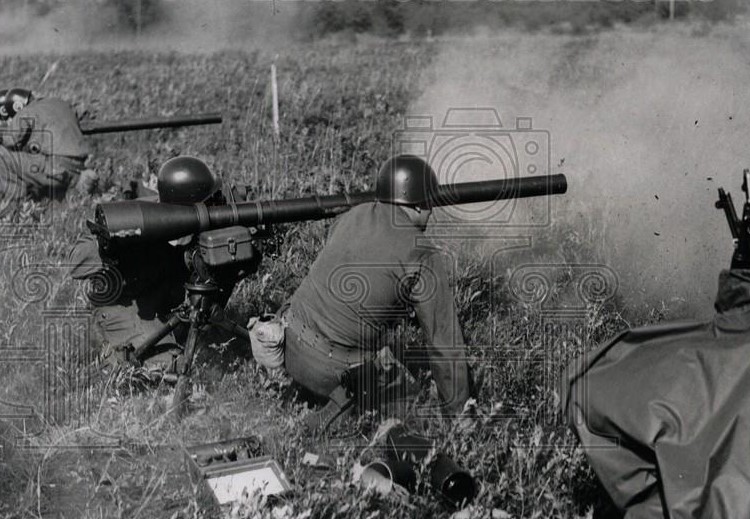
We also fired the bazooka — whose technical name is the 3.5‑inch rocket launcher. This weapon was first used in World War II when it was introduced as the 2.36-inch launcher and was upgraded when larger and larger tanks (its primary target) were routinely being built. It got the name bazooka from a popular cartoon of the era and also a bubble gum from the same period. It, too, is a weapon loaded from the rear and also exhausts gasses as it’s fired so the loader must be to the side during firing.
I was unusually terrified on the day I fired the bazooka. It was a very cold day and the guys who were firing before me were coming back from the firing range with red welts on their faces. The problem was that it was so cold that the propellant charge was not being fully consumed as the round left the tube and embers were blowing back into the faces of the operator. I was naturally concerned about being burned and I can recall quite clearly that my knees were literally – literally – shaking as I shouldered it, aimed and pulled the trigger. Fortunately, I was not severely affected by unconsumed propellant.

We also got to fire the 81 mm mortar, another crew-served weapon, typically requiring a two-man crew, one of whom carried the tube and one carrying the base plate, which was the heavier of the two loads. It is also common for most members of supporting troops to carry extra ammunition for this weapon. It works on a very simple principle. A stationary firing pin in the bottom of the tube causes a round dropped into the tube to fire just like the round from a rifle or pistol.
One hairy operation of this weapon is in the event of a misfire, when the round doesn’t immediately come flying out of the tube. The first remedy is to kick the bottom of the tube! After waiting a reasonable period of time, the tube is disconnected from the base (a simple operation) and, with one crew member holding his hands around the tube outlet, upend the tube in an attempt to get the round to slide out. The one holding his hands around the tube outlet must form an opening with his hands so that the nose of the round does not touch and is caught between his fingers and thumbs forming an opening. Safe enough as long as the round doesn’t hit the ground and explode!
Safety is something that is constantly emphasized during training on every weapon, and I cannot recall any member of our company ever being hurt by a training accident due to improper use of a weapon.
