

In the hills, water has always known how to bless.
Long before anyone poured it from a silver bowl or guarded it behind church doors, water moved freely through these mountains — springing from rock, carving hollers, running cold and clear over bare feet.
When Christianity took root in Appalachia, baptism felt familiar rather than foreign. Water was already woven into daily life. People depended on it, respected it, and understood its power long before it became a sacrament.
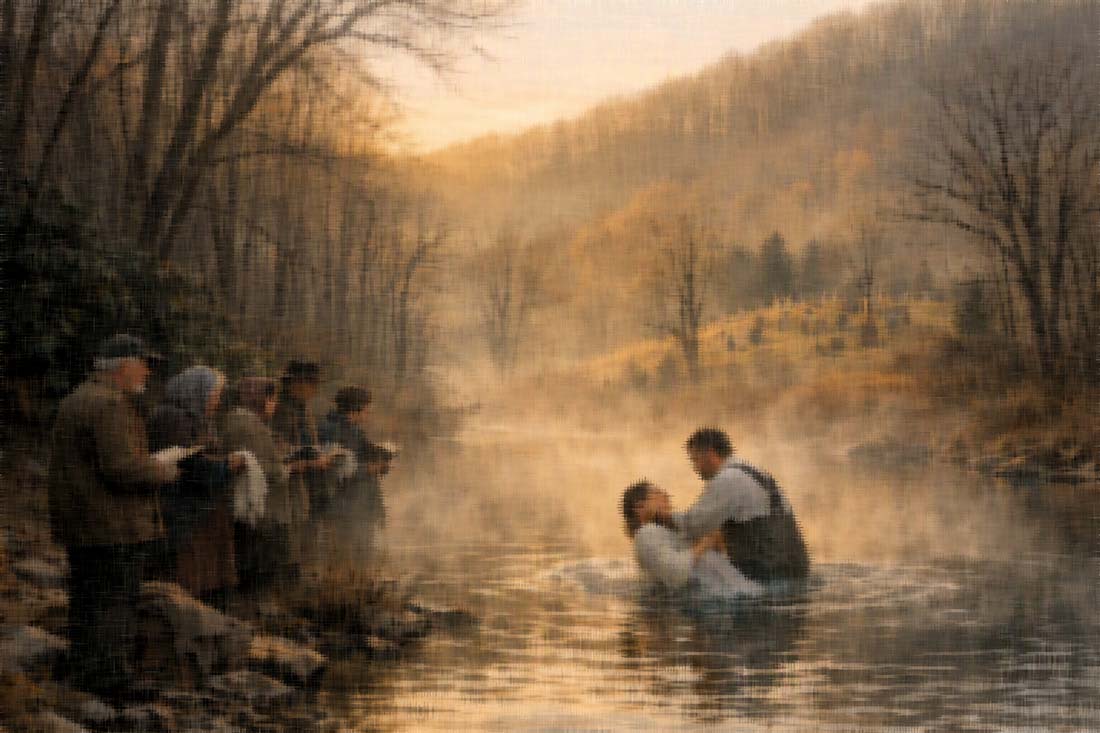
I remember going to creek baptisms with my Pap, standing on the bank with my shoes in my hand and my toes in the mud while the congregation gathered along the water’s edge. We’d walk down to the creek with towels tucked under our arms and a book of hymnals, the path worn soft by generations of feet.
Someone always started singing “Shall We Gather at the River,” and the sound would move ahead of us through the trees, floating over the water before we ever reached it. The song felt older than the people singing it — like it belonged to the creek itself.
Men waded in first.
Then women.
Sometimes a child would step forward, eyes wide, hands clenched tight.
They were submerged fully, no matter the weather. No matter the season.
I watched them break ice in the dead of winter, the creek cracking open like glass, hands red with cold, breath rising in clouds. And when someone came up out of that water — sputtering, soaked, smiling — the people rejoiced like they’d witnessed a resurrection.
They called it being washed clean.
Washed new.
Washed whole.
As if the river itself had spoken forgiveness.
There was joy in it that had little to do with theology and everything to do with witness — with the body bearing something visible, with change you could see and touch.
Even as sermons grew sharper and warnings louder, the water remained what it had always been — a place where faith became visible.
And then there were the foot-washing Sundays.
Long wooden pews.
Metal pans of water passed hand to hand.
Neighbors kneeling in front of neighbors.
The choir would sing:
“Are you washed, in the blood? In the soul-cleansing blood of the Lamb...”
Hands cupped heels and poured water slowly over tired feet. It was humble and a little uncomfortable in the way holy things often are. You couldn’t stay distant in a room where someone was washing your feet.
You had to be seen.
And people wept — not from fear, but from tenderness.
Because for a moment, the church remembered something it was already in danger of forgetting:
that holiness looks like service.
that cleansing looks like care.
that love kneels low.
Those were sacraments, whether anyone named them that way or not.
Body.
Water.
Witness.
Touch.
Song.
Not doctrine first.
Not belief first.
But presence.
And even now, when I think of baptism, I don’t picture fonts or altars or white robes.
I think of cold creek water.
I think of broken ice.
I think of hymns rising into trees.
I think of hands steadying bodies in moving current.
I think of a faith that lived in flesh and water and song long before it lived in walls — and lingered there even as fear tried to fence it in.
Because in these hills, water didn’t just symbolize cleansing.
It practiced it.
And some of us learned holiness not from pulpits —
but from rivers that held us,
and people willing to get wet for one another.
Even those who later left the church often remember the water with tenderness.
Not the sermons.
Not the rules.
But the feel of the creek pulling at their legs and the sound of hymns drifting through the trees.
Memory has a way of revealing what mattered most.
For many, it wasn’t doctrine they carried forward.
It was the water.
The feeling of being held by something larger than themselves.
The sense that renewal was possible.
That they could begin again.
And maybe that’s why so many people still find themselves drawn back to water when life breaks them open.
To sit beside it.
To listen.
To let it carry what feels too heavy to hold alone.
In Appalachia, water has always been a threshold — between seasons, between grief and endurance, between life and whatever comes next.
It baptizes more than belief.
It baptizes memory.
Because if water cleanses, it also remembers.
It flows past graveyards.
It carries names spoken aloud and names long forgotten.
It moves through places where the dead are not gone so much as nearby.
In the hills, baptism and burial were never far apart. Creeks ran close to family plots. Springs rose near old bones.
Water touched both the living and the dead, binding them together within the same landscape. The same creek that baptized a child might one day flow past the cemetery where their grandparents rested.
The same spring that sustained a family through drought might continue running long after every name connected to it had faded from memory.
Water outlasts us.
It becomes a keeper of stories.
A witness to generations.
And if you listen long enough, you begin to understand that renewal and remembrance are not opposites.
They are companions.
Perhaps that’s why so many Appalachian people speak of the dead as though they remain close.
Never miss a thing with our FREE weekly newsletter.
Not gone.
Not absent.
Simply part of the landscape now.
Part of the hills.
Part of the stories.
Part of us.
Which is why so many of our stories don’t stop at the water’s edge. Because in these mountains, the sacred doesn’t stop with the living.
Next, we step out of the water and into the ground that holds those who came before — into graveyards, ghost stories, and the ancestors who never quite learned how to leave.
