

The older I get, the less interested I become in neat categories.
Growing up, people seemed to want everything sorted into tidy boxes. Sacred or sinful. Christian or pagan. Godly or worldly. Right or wrong.
But the mountains have never worked that way.
The mountains blur edges.
Maybe that’s why Appalachian spirituality has always been difficult to explain to outsiders. The faith I inherited was rarely one thing by itself. It was layered. Woven together over generations until the threads became difficult to separate.
It looked like Bible verses tucked into kitchen drawers beside handwritten remedies.
It looked like prayers whispered over gardens planted according to moon signs.
It looked like a cross hanging over the front door and a granny who could predict bad weather better than the evening news.
It looked, in many ways, like Jesus with a drawl.
In the last article, we explored how Christianity arrived in Appalachia and took root in communities that already carried their own traditions, wisdom, and ways of understanding the world. What happened next wasn’t replacement.
It was blending.
Historians call it syncretism — the merging of different religious traditions into something new. But most mountain people would never have used a word like that.
They simply carried forward what worked, what comforted, and what helped families survive.
A woman could quote the Gospel of Matthew by heart and still pay attention to signs in her dreams. A farmer might bow his head in church every Sunday and still refuse to plant certain crops during the wrong phase of the moon. A mother could pray over a sick child while also reaching for remedies taught to her by her mother and grandmother before her.
No one sat down and consciously designed a blended faith.
It happened naturally.
Like two creeks meeting in a hollow.
Eventually, the waters become impossible to separate.
I think about my Great Gran often when I consider this part of Appalachian history.
She was a woman of deep Christian faith.
Her Bible sat within arm’s reach of her favorite chair, its pages softened from years of use. She listened to gospel music while she cooked. She prayed over family members by name.
But she also trusted things that had never come from a sermon.
She trusted her instincts, the land, and what she sensed in people. She believed certain dreams carried meaning and that the natural world was speaking if you paid attention.
“That old cookbook tells the story of a woman—and a culture—that never felt the need to separate God from everyday life.”
Misty Gay
Not once did I hear her frame those things as competing beliefs.
To her, God was present in all of it.
Looking back now, I realize she embodied something deeply Appalachian.
She lived in the overlap.
In fact, I own one of the most tangible examples of that overlap.
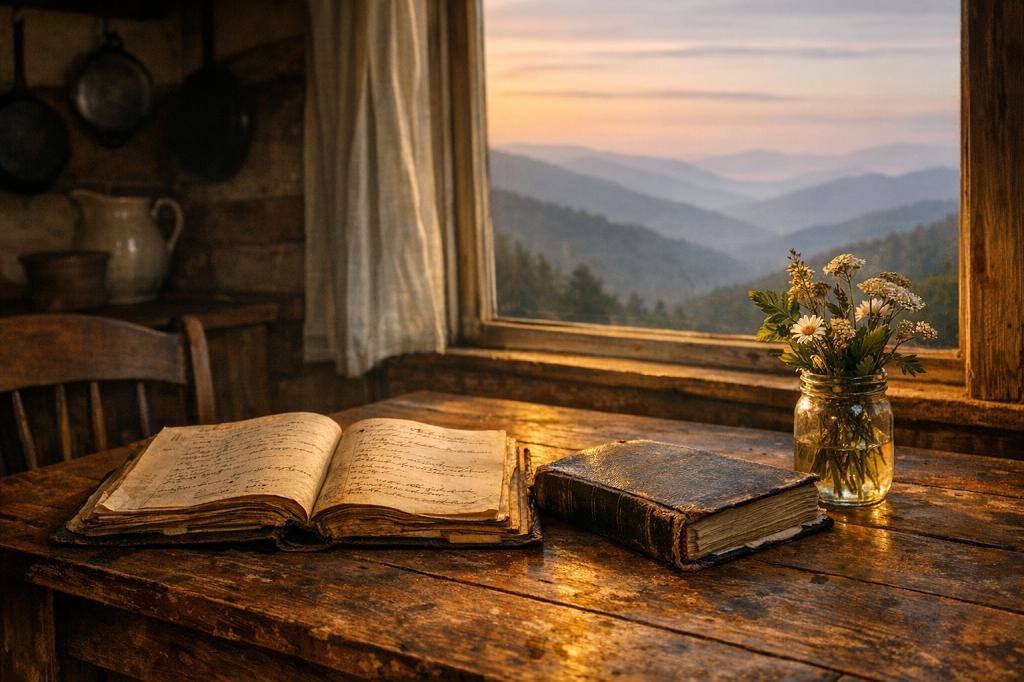
Among the family keepsakes I treasure most is a Depression-era cookbook that belonged to my Great Gran.
The printed pages are filled with recipes born from hard times — vinegar pie, tuna patties, and other meals created by women who knew how to stretch what little they had. But what fascinates me most isn’t what was printed there. It’s what my Great Gran added herself.
Scattered throughout the margins, in her beautiful penmanship, are Bible verses written beside recipes. Tucked between instructions for cakes and casseroles are remedies for salves, poultices, and tinctures. In other places, she recorded family births and deaths, preserving moments of joy and grief alongside instructions for supper.
When I flip through those pages, I see more than a cookbook.
I see an Appalachian worldview.
Bible verses sit beside herbal remedies. Family births and deaths share space with recipes meant to stretch a meal through hard times. That old cookbook tells the story of a woman — and a culture — that never felt the need to separate God from everyday life.
For generations, mountain families created spiritual lives that were both Christian and distinctly shaped by the culture surrounding them.
Scripture was spoken over gardens.
Psalms were recited during illness.
Prayer happened on front porches as often as it happened in sanctuaries.
Crosses stood beside root cellars.
Faith was woven into everyday life rather than confined to Sunday morning.
Some of these practices originated from older European folk traditions carried across the ocean by settlers. Others grew from Indigenous influence, African traditions, local customs, and generations of observation passed down through Appalachian families.
Most people practicing them never thought of themselves as preserving ancient traditions. They were simply carrying forward the customs and wisdom they had inherited.
A prayer spoken over a garden might contain scripture, folk wisdom, agricultural knowledge, and ancestral memory all at once.
Where does one end and the other begin?
I’m not sure it always can.
As an adult, I’ve found myself standing in that same overlap.
I was raised around Christianity.
The stories of Jesus are familiar to me. The language of scripture still lives somewhere deep in my bones. There are hymns that can bring tears to my eyes before I even understand why.
But there is another part of me that feels closest to the Devine beside a creek, on a mountain trail, or in the quiet turning of the seasons — a part that believes creation itself carries wisdom if we’re willing to pay attention.
For a long time, I thought I had to choose between those parts of myself.
Many people do.
We’re often told faith requires certainty. That it must fit inside clearly defined boundaries.
But the older I get, the more I suspect the people who came before me would find that argument strange.
The women of Appalachia rarely had the luxury of living in absolutes.
They lived in complexity.
They prayed and planted. They quoted scripture and trusted intuition. They sang hymns and watched the weather. Their faith was broad enough to hold all of it.
Perhaps that is why so many Appalachian people today find themselves returning to ancestral traditions — not as a rejection of Christianity, but as a search for forgotten pieces of themselves.
Not everyone makes that journey.
Not everyone wants to.
But for those of us who do, it often feels less like discovering something new and more like remembering something old.
Something that was quietly waiting beneath the surface all along.
Because the story of Appalachian spirituality was never simply about Christianity replacing older beliefs.
It was about what happened when those beliefs met.
What emerged was a distinctly mountain faith — rooted in scripture, shaped by the land, and carried by generations of ordinary people who found God in church pews, on front porches, in garden rows, beside creek banks, and under star-filled skies.
For generations, that blending allowed Appalachian people to hold seemingly different truths together.
Never miss a thing with our FREE weekly newsletter.
Yet traditions rarely remain untouched by time.
As churches became more established and religious authority grew stronger, some of the older practices that had once lived comfortably beside Christianity began to face greater scrutiny. Certain beliefs became suspect. Certain forms of knowing became harder to speak about openly.
The mountains still remembered.
But the conversation was beginning to change.
And with that change came something many Appalachian families would come to know all too well: the growing influence of fear.
