
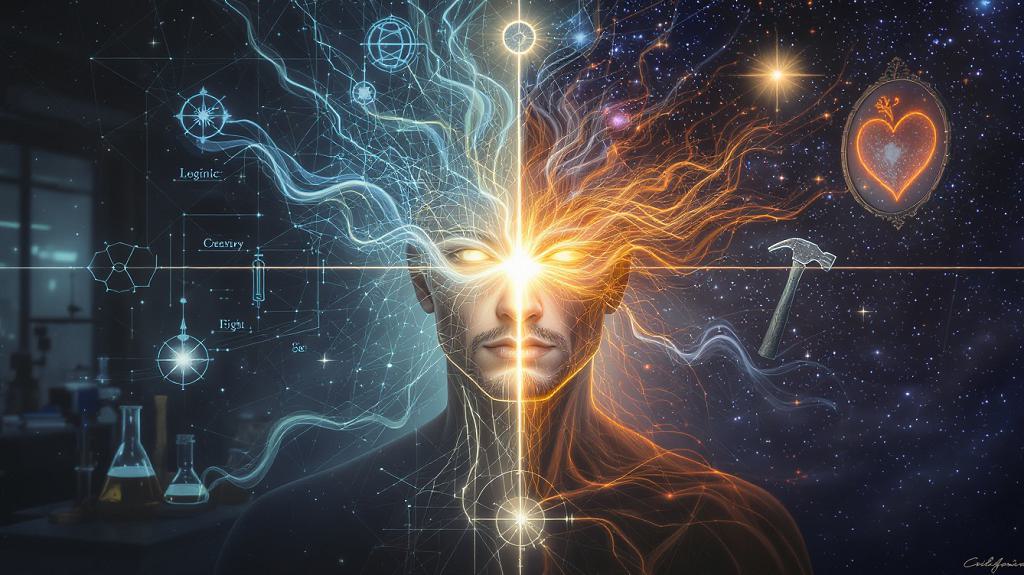

In healthcare, we don’t declare someone dead until they are “brain dead”. Until there is consistent evidence that a person no longer has brain function (and pretty specific brain function at that), they aren’t generally considered dead.
If you have ever had a friend or loved one in a coma or under sedation, you know they breathe, their hearts beat, their bowels go on digesting food. But during their time in that altered state, they can’t interact with you in any human way. It is almost like they aren’t there.
When someone suffers a brain injury, they often pass away. If they do recover, their personality may change drastically, even to the point of seeming like a totally different person. The very essence of “who they are” may alter in profound ways.
But injury to other parts of the body doesn’t have this impact on who we are. People live out their complex, beautiful, chaotic lives even when they have suffered extreme alterations to their bodies. Think of those you know who have suffered heart attacks, fractured limbs, kidney disease, or amputations. They remain “themselves” in spite of major changes to their physical selves. But injuries to the brain often have drastically different outcomes.
So, is the thing that we tie our notion of who a person is to simply the cells living inside their skull?
For much of human history, various peoples around the globe developed unique (and yet strikingly similar) concepts of what most Americans would call the soul. The essential self. Who we are as a person. Though those notions have some differences, they all share a basic concept, that who a person is (what they think, what they believe, their essence) can be identified and labeled.
They also share the idea that when that essential part of a person is no longer present, the soul has left the body and the person has died.
In our modern world, we understand that the things we associate with the soul (self, “other,” identity) are complex interactions between cells in our brains. Neurons throughout parts of our brains communicate with each other (and with distant parts of the body), and that communication leads to what we envision when we hear the word “soul.”
For some, the notion that who and what we are can be reduced to chemical interactions is upsetting. People may think that this means there is no purpose in the universe. Others might see this as a profoundly wrong, even sacrilegious idea.
Maybe they are correct. Maybe there is no way to reconcile scientific understanding and matters of faith and religion. Maybe understanding how the body works (or the universe, for that matter) disrupts us in a way that makes belief impossible.
I am not so sure.
We are all scientists
Does the understanding that our sun shines because hydrogen atoms fuse into helium, releasing heat and light, make it any less rejuvenating to bask in the sun’s warm embrace?
Does knowing that a rainbow results from the bending of light so that its individual wavelengths become visible to our eyes make it any less magical to spot one after a summer rain?
Does learning the complex biology of fertilization, gestation, and labor make it any less transcendent to hold your child for the first time?
Why should grasping a tiny fraction of understanding regarding the physics of how the soul works diminish its miraculousness?
The fact that nothing more than chemical interactions between some of the tiny components of us leads to Mozart, Angelou, Paul the Apostle, Shelley, Plato, and Salk seems to me to be far more miraculous than what most people associate with that word. Humans are incredible beings. While at our most basic cellular level we are animals, we are also poets, architects, sculptures, and dreamers.
Never miss a thing with our FREE weekly newsletter.
And we are scientists.
Science is something sacred to me. I believe that science and all of its complexities exist because we have a drive to understand the world around us and our place in it. We have a hardwired-into-our-brains-which-are-also-our-souls NEED to know.
A need to know HOW? WHERE? WHY?
Isn’t it logical to believe that this drive, so unique to us, so essential to our separation from other living things, is divine? And if it is divine, why should uncovering glimpses of how miracles work make their existence any less miraculous?
Why should the fact that we now understand some portion of where (and when and how) in the body the soul resides make its existence any less amazing?