
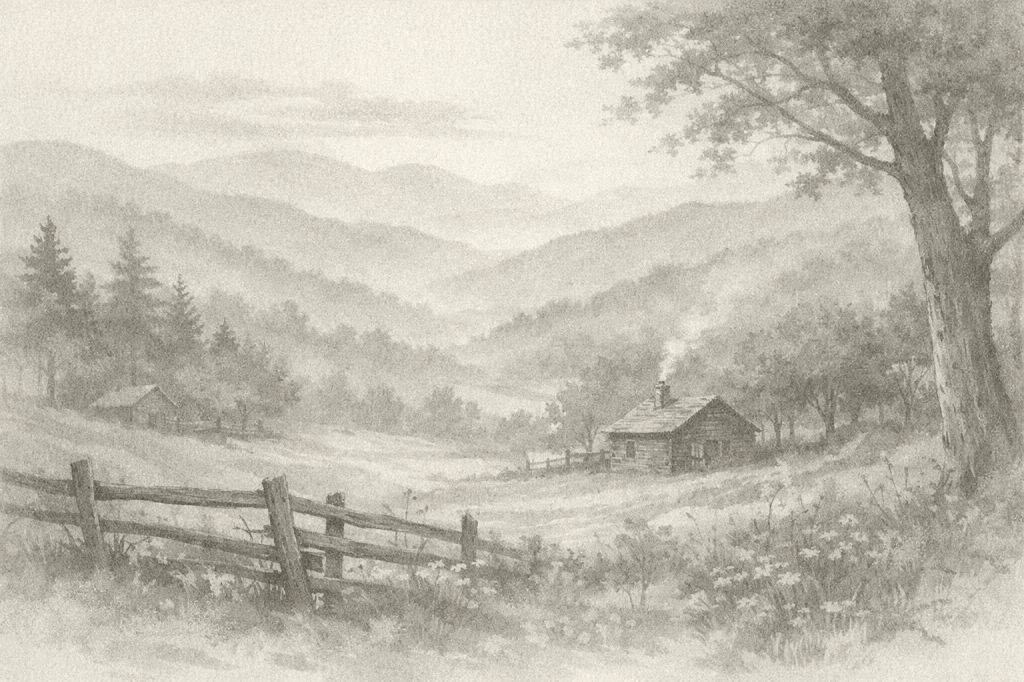
Before there were steeples piercing the ridgelines, the hills themselves were holy.
Long before most Appalachian families had a church they attended regularly, they had land that taught them how to live. The seasons preached their own sermons. The weather set the liturgy. Birth, death, hunger, healing, and survival shaped a faith that didn’t need a name to be real.
In Appalachia, faith did not begin in a building — it began in relationship. With the mountains. With the sky. With the fragile understanding that survival required listening closely to forces larger than oneself.
The elders I grew up around rarely talked about theology, but they lived a spirituality as steady as the mountains. They believed God could be found in hard work, in knowing when to plant and when to wait, in reading the signs of the sky, and in paying attention to the land beneath their feet. Their faith wasn’t loud. It wasn’t polished. It was practiced.
The earliest spiritual life here wasn’t about belief as much as belonging.
People learned to read the world around them — when frost would come early, when storms were gathering, when the woods went quiet in a way that meant trouble. They understood that life moved in cycles: that death fed life, that loss made room for growth, that nothing truly ended without becoming something else.
That way of knowing was sacred, even if no one called it that.
Appalachian spirituality has always been layered. It was shaped first by Indigenous reverence for the land, then braided with the folk traditions carried across the ocean by Scotch-Irish, English, and German settlers. These beliefs traveled in memory more than manuscripts. Blessings were spoken over babies and fields. Remedies were gathered from the woods. Signs were watched. Stories were told to teach what could not be written down.
Faith was practical. It had to be.
You prayed for rain because your family needed food. You trusted intuition because doctors were days away, if they came at all. You honored the dead because you knew they were not gone so much as changed. The sacred was woven into daily survival, not separated from it.
When Christianity arrived in Appalachia, it did not land on empty ground.
It met a people who already believed the world was alive with meaning. Scripture didn’t erase the old ways — it settled into them. Bible verses were spoken alongside old sayings. Porch prayers lived alongside herbal remedies. Jesus became part of a spiritual landscape that already understood suffering, endurance, and resurrection in its own way.
What emerged wasn’t contradiction. It was continuity.
The hills didn’t stop being holy just because a church was built nearby.
I grew up hearing people say things like, “The land will tell you,” or “Watch the signs.” No one called this theology. It was just how things were done. Faith lived in attention, in care, in knowing when to speak and when to stay quiet.
The woman who shaped my earliest understanding of God never stood behind a pulpit.
My Great Gran never preached a sermon, but she taught me what holiness looked like in a body. She found it in her hands — in the way she worked, tended, cooked, and cared. Her Bible was worn soft from use, its pages curled like leaves, but her faith lived far beyond the book. It lived in the way she paid attention. In the way she loved without needing to be seen.
Her kitchen, her porch, the yard beneath the old walnut tree — those were sanctuaries long before I knew the word. People came carrying grief, worry, hunger, and hope. And somehow, they left lighter.
She taught me — without ever saying the words — that a person’s life is their truest theology.
Over time, as church culture grew louder and more rigid, many of the older practices were pushed aside or labeled “wrong.” Folk belief became something to be corrected. Intuition became something to fear. The sacredness of land was replaced with sanctuaries built to contain God instead of to encounter Him.
Something essential was lost in that narrowing.
Because when faith is separated from the body, from the earth, from the daily work of loving and surviving, it becomes easier to control — and harder to live.
And yet, the old ways never fully disappeared.
They lingered in sayings and signs, in the way births were welcomed and deaths were mourned, in the way grief was held and healing was sought. They lived on in the quiet faith of people who didn’t need permission to believe.
This series is not about rejecting Christianity. It is about telling the fuller story of Appalachian faith — one that honors what came before, what blended, and what endured. It is about recognizing that spirituality here was never confined to a building, a doctrine, or a single tradition.
It was lived.
Never miss a thing with our FREE weekly newsletter.
In the weeks ahead, we’ll explore the folklore, practices, and beliefs that shaped Appalachian spirituality: the signs and omens, the healing hands, the porch prayers, the women who kept faith alive without calling it that. We’ll look at how Christianity changed the landscape — and how the landscape changed Christianity right back.
This is not a history lesson meant to judge the past.
It is a remembering.
Because sometimes healing begins when we tell the truth about where we came from. And sometimes faith grows stronger when we stop pretending it was ever as simple — or as narrow — as we were taught.
Before the church, there were the hills.
And for many of us, they are still preaching—
if we listen.
