
Grace’s voice was gone, and I continued: a ghost in the room with her story of Max.
This was Max’s twenty-third day. The suits would come from the insurance company. They would call the Veihls in for a meeting. Apologies would be proffered. Decisions would be made. Machines would cease beeping in the evening while she was getting ready for work, and Max would be gone when she returned to the room tomorrow. Godiya needed to look through the glass one more time because what Max had built in that space was something so beautiful and terrifying that someone should remember it for him.
Godiya pulled the edge of the curtain back, walked back to the bed, and brushed the hair back from Max’s forehead. It was now twenty minutes after eight. She checked her watch, then the window, waiting a few minutes until the “light was about right.” When the beam crested the brown Formica of the adjustable table, she slid the corner of the dark platform into the encroaching illumination, moved to the opposite side of the table, leaned down, and brought the glass to her eye.
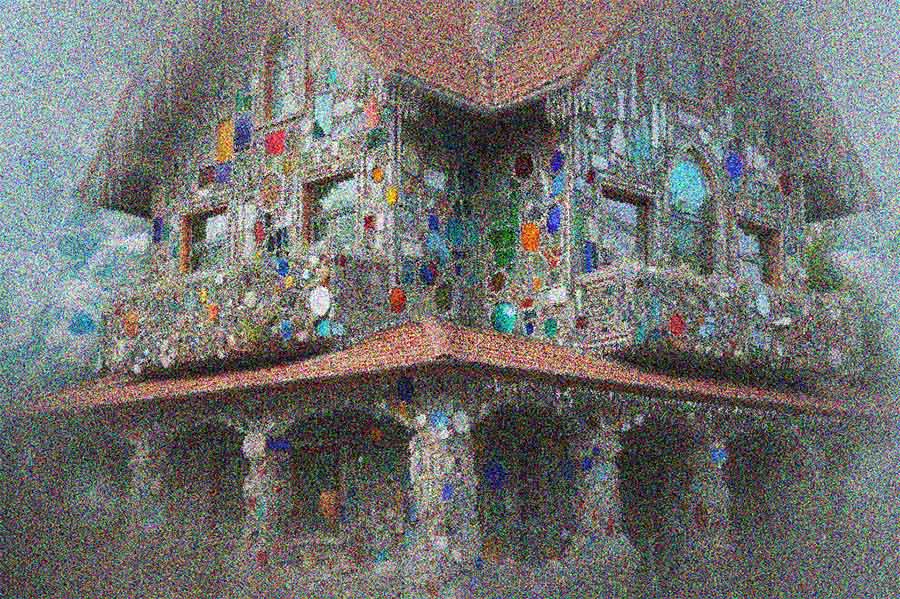
What Max had constructed on the pine platform, whose dark stain mirrored the semi-random pattern of the cross-cut grain beneath, was a two-story, three-and-a-half-bedroom house made entirely of broken glass. The glass varied in thickness, type, and clarity, some bits even bearing the brands of the products from which they were smashed. Though the levels of clarity varied, all included some feature of obscuration precluding any visibility to the structure’s interior. Some of the pieces had inclusions of various semi-transparent colors. Others had bubbles, or thicknesses warped by the application of heat. Small sections were built of shattered automobile glass with dense fractures of tiny shards. The observer could see that the house included interior elements, but those elements had no distinguishing features. Godiya felt Max had tried to capture the concept of full transparency and total obscuration at once and had mostly succeeded to a somewhat mystifying effect. She was compelled to keep exploring the structure with her eyes while consistently confused by the varying shapes of nothing she could define inside. The sculpture as a whole was enchanting in a haunting way, and Godiya would examine its facets at length every time she came to care for Max. It had a strange attracting quality. Once you saw it, you couldn’t ever quite let the glass house escape your attention. It begged for your investigation when you were in its presence. But the real magic of Max’s construction could only be seen in the daylight — and only if you were invited.
“This is the key in,” Mrs. Veihl had told Godiya when she handed her the magnifying glass those five days ago.
So now, on Max’s last day, Godiya brought the magnifying glass to her eye and leaned over for one last look into Max’s secret world, so she could remember it in the world that would forget him.
In the far right corner of the second floor of the glass house was a small distorted chunk broken from a blue hurricane lamp. There was a small droplet-shaped dot of midnight where the dye blended unevenly in the glass. Below the mark was a single, perfectly clear air bubble. This is the keyhole, Godiya remembered. She shifted her position and focused through the lens, revealing the interior of Max’s house.
The tiny aperture provided by the bubble gave Godiya a minuscule range of motion whereby subtle adjustments of the lens let her explore the interior floorplan. There was the mystery. There were no objects inside to explain the shapes shadowed on the exterior of the glass. She couldn’t see it, but Godiya was sure Max must have arranged a tiny mirror diagonally in the corner of the ceiling of the area that would have been the dining room adjacent to the kitchen. When the sun shone on the grain of the dark wood, the mirror would reflect those shapes and project them like translucent pastel specters across the many cracked facets of the house’s exterior glass panels, which would then reflect them back into the interior of the rooms.
The interior sides of the house’s walls were smooth and clear. She could see no indication of the shattering visible from the outside. There was no hazing around any of the joints connecting the shards making up the house’s surfaces. Godiya wondered how the boy got the thing to stick together. The light inside the house played shadows fractured into smaller shadows swirling around a central figure, the only thing actually “in” the house. She guessed a tiny mirror mounted in the opposite corner caught light from the first mirror to create the spotlight that cut through the shadows in a path to the figure of a man sitting at a desk reading a book. The figure was cut from some sort of lavender glass with remarkable detail. Godiya could make out lines of wear on the tiny man’s face. His shoulders were slumped as if the book were very heavy, and he had been holding it for a long time. There were rumples in the fabric of the man’s pants where they extended under the tabletop. He had long hair and glasses, and the look on his face was one of deep concentration and weary sadness. Godiya had never seen a figurine like this, not in a curio shop, not in a pawn shop, not even in her grandma’s vast array of carnival glass home shopping catalogs. She wondered where Max could have found such a thing.
Though the swirling ghosts inside the otherwise empty house were mesmerizing, it was the old man at the desk that captured most of her attention. He looked so sad to her, so lost and overwhelmed by what was in front of him, and it was likely that final, tiniest detail of the figurine that weighed so heavily across his face and shoulders.
In clear glass relief through the lavender of the miniature glass book was the single word: “Truth.”
Satisfied with her examination, Godiya stretched to set the magnifying glass back up on the top shelf just so, then lugged the heavy glass sculpture to its shelf, shifting the base to match its diagonal footprint so Mrs. Veihl wouldn’t notice it had been moved. She picked the cloth out of its basin and wiped it over Max’s forehead once more, brushed his hair from his face, and leaned her lips close to his ear.
Never miss a thing with our FREE weekly newsletter.
“I know you’ll never get to hear anyone say this Max, but because this is our last day together, I wanted to make sure you did.
“It’s a masterpiece, Max. I could stare into it forever. It practically compels me to do so. It is sweet, and sad, and enigmatic, and beautiful, and I find myself ever wondering what is so troubling the old man. What truth is it that hangs so heavily on him? I think many, many people would have had the same reaction to your work, Max. I think you would have been a famous artist, a town hero. Everyone would have been so proud of you, which makes me even sadder. I am so very sorry for what happened to you, Max.
“I know you’re still in there, Max, and I wish I could get you out because after looking into your glass house I knew that in a few years, I might have loved you. Everyone has ghosts, Max. I love that you put yours on display. What a very brave thing to do.
“I’ve become much too good at goodbye, Max”, said Godiya, and realizing this made her feel much older and more heartbroken than she was ready to be.
