
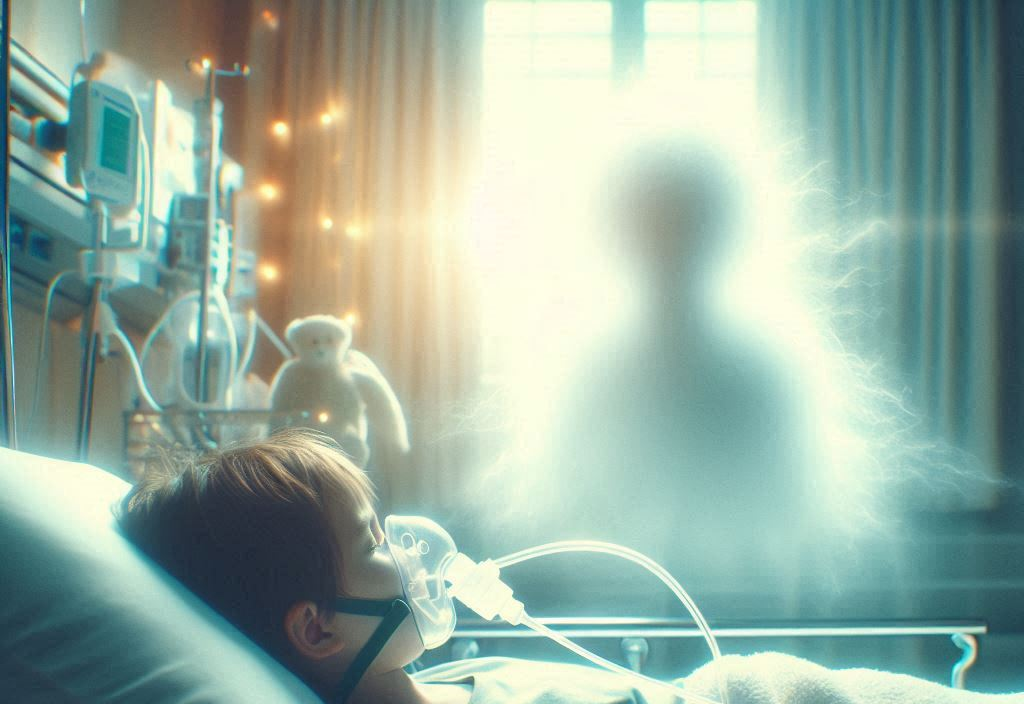
The waiting room outside the children’s LTW was shrunken in direct proportion to the hope that dissipated the further you got from the intake ICU. The long couches, recliners, magazines, and coffee tables common to the primary wing of the hospital were nowhere to be seen in the shadowy mint hallways of the LTW. The bright colors of hillsides, unicorns, and superheroes painted on the walls in the children’s facility had been replaced by the institutional colors of calm for families facing “decisions.” Two chairs crammed into a tiny alcove outside the financial offices discouraged despondent parents from “waiting” too long while making their “decisions.”
Helen Veihl was a tiny woman who sat crumpled in one of the “waiting” chairs wearing an oversized and somewhat threadbare version of what was once an expensive, mid-length, brown calf-skin winter coat. There was never much traffic in this part of the hospital, and the morning of November 22nd found the wing emptier than usual. The upcoming holiday weekend had kept most of the usual visitors at home with their more ambulatory relatives.
Godiya was at once pleased and dismayed to see that this morning, Joseph Veihl had returned to the seat next to his wife in the waiting alcove. She was pleased to see Mrs. Veihl have some support from Max’s father, but she was dismayed because his presence was a clear indicator that “decisions” were going to be made today. A part of her had hoped the administrators would wait until after the holiday. But “time is money,” they said, and around here, “time waits for no one.” She was surprised to notice how much Mrs. Veihl reminded her of the old man in the house today, like something heavy was dragging all of her features toward the floor.
“Max is doing just fine, Mrs. Veihl,” Godiya comforted as she approached the couple.
“He’s had his bath. The telemetry shows that all the machines are working correctly. We talked about his pictures, his art, and his house. He rolled over easily today. I swear it was almost like he was helping me. His eyes are fine and moist. They show no signs of scratches or discomfort. I trimmed his nails. His teeth are brushed. He’s still sitting up from our talk, if you want to visit Mr. Veihl. I’m sure Max will be happy to hear your voice.”
“Did the insurance company tell you that you needed to come in today?” Godiya asked the question, fishing for a “no.”
“The old one did, but I started calling some others last week,” Helen responded.
“There’s a new one coming in today. Garrison… something, I think. He wants to go through our paperwork again. Max’s history,” she said, patting the black briefcase at her feet. Joe Veihl was looking at the floor, but Godiya could see his face beginning to flush.
“You’ve got to stop hurting yourself with this, Helen,” he muttered, turning his face toward her over slumped shoulders.
“You need to start praying for his soul, Helen, and for your own healing, honey. How many doctors have to tell you this before I’m no longer the bad guy for telling you that you have to let him go? How long…”
“He’s still in there, Joe!” Helen cut him off with a hissed whisper.
“He’s your son, and he’s still in there, and if you’re so worried about his SOUL, shouldn’t you be praying that he will get up out of that bed so he can redeem himself IN HIS FATHER’S EYES?!!!” The whispers became breathy shouts before Mrs. Veihl could finish.
“He told us, Joe. He warned us. Not just of what was happening to him, not just of what he was going to do, but what the result of those actions would be. That’s the part you really should have noticed, Joe, what with your love of prophets and their meanderings. He told us in his stories. He told us in his poetry. He told us in his photos, and his drawings. But you were too busy to be bothered. He didn’t do right by you. Wasn’t like you were growing up. Wasn’t like the other kids. You couldn’t find a way to be proud of who he was. So then he told us exactly what was going to happen, and since we never listened, he showed us instead. He built that glass house, and he left it on the kitchen table with the magnifying glass and a note that said, ‘Look’ and ‘Please.’ He said, ‘Please look,’ Joe. Very polite, like you always asked of him. But you didn’t look, did you? And by the time you called the police the next day, it was too late, wasn’t it, Joe?”
Mrs. Veihl’s lecture of guilt for her husband dissolved into sobs.
“So don’t you tell ME what to pray for, Joe. My phone, and my briefcase, and me are praying we can find someone in a suit who will understand that our son is a real boy, not a soulless chunk of meat that can be thrown away to protect the bank accounts of other fathers who don’t pay attention to their boys because they aren’t made of dollar bills, sports scores, or Biblical quotes.
He told us what would happen, and then he trapped himself inside that glass house with nothing but ghosts, so you would finally have to look for him hard enough to notice your son. When I’m finished praying for our son, Joe, I’m going to start praying for you. For your vision, in fact. That you might have eyes that can see.”
Joe Veihl’s gaze returned to his shiny black office shoes, and he turned from Helen wordlessly, flushed with both red and pale shame.
“Hi, uhhmm, Nurse, uhmm…”
Godiya spun to face a tall man with dark hair and hazel blue eyes standing uncomfortably behind her.
“Lambro,” she responded.
“I’m Nurse Godiya Lambro, children’s ICU.” She extended her hand to the man in the crisp black suit.
“Hi, sorry. I’m Tony Garrison from TelpEm Insurance. Nice to meet you, Ms. Lambro.” Tony shuffled his feet.
“You must be here to talk to the Veihls.” Godiya gestured to the attendant parents.
“I’ll show you to the office as soon as they’re ready.”
Helen Veihl sucked in her breath, stood up from the stiff hospital chair, and collected her briefcase in her arms. She elbowed her husband’s fingers away when he tried to take her arm and turned from the group, pointing herself in the direction they would be walking.
Godiya motioned for Tony to follow. The noise of the group’s footsteps echoed as she led them down the hall and around the corner to the financial offices. It seemed unavoidably disrespectful to the vigil she held over her silent clients, yet another reminder of all the twenty-third days since she started at the hospital.
“Yes,” she thought again, “I have become much too good at goodbye.” She grasped the door handle and ushered the couple and the insurance agent inside the cramped office.
“Mr. and Mrs. Veihl, TelpEm flew me all the way up here from Nevada because we think we may be able to offer you some hope. Max’s case is unique, and this won’t be easy or quick, but if you can agree to work with us…” The words cut off as the door swung shut, and Godiya made her way off the LTW and back into the land of the living and the hopeful.
Max’s room was silent but for the hissing and clacking of the respirators and the beeping of the telemetry monitors. It was an oddly noisy kind of silence but rhythmic and calming, like a metronome of footsteps and horns in their staccato march to the great beyond. Wheels squeaked, and heels clacked in the hallway outside the room, the scuffle of life cacophonic around the LTW’s mausoleum of departing guests. Max didn’t notice any of this. These were things he had hardly noticed when he was conventionally aware. Max also didn’t notice the unaccompanied shadow that flicked across his room to congeal as a perfectly still spot of greyness in front of his dresser. The shadow hovered there for a moment, shifting in shapes from a spiky ball to an angular polygon to a vaguely humanoid but primarily amorphous blob. The shape zipped to the visitor’s chair in the room’s opposite corner and occupied it for a moment. Back in motion, the shadow flickered like static as it moved from point to point throughout the room. When it finally approached Max’s bed, the shapeshifting fuzziness subsided, and the figure began to take a more recognizable form.
She was a translucent whisper of nothingness, a two-dimensional silhouette of a diminutive girl. Slightly under five feet in height, the arches of what must have been wings poised a few inches above the shadow of what could only be a ponytail. She was just tall enough to reach Max’s ear where he lay prone in the hospital bed.
“Hello, Max. My name is Mercy.” Her voice was a low feminine vibration, ancient and youthful at the same time.
“We are almost ready, Max. It will happen tonight.
“It will be a long time before we get to talk again, Max. You have a very difficult journey ahead. It will be worse than you can ever imagine. You will wish your mother had failed. You will be unable to see the light until you understand the darkness, and it will get very dark, indeed.
“But through all of what comes next, these things shall remain.
“I love you, and I am always watching.
“Most importantly, Max, until we find each other again, remember these questions. They are my spirit, my comfort, and my guidance. Remember it was I who asked you so that you will remember my name, for these are the words of Mercy, Max, and that is my true name.”
With that, the apparition began to hum a low sound, and in a voice as quiet as a new mother to an infant, she recited the following.
“What if you believed you could change the world?
“What if you believed you would succeed?
“What if you believed you were important enough to be heard?
“What if you loved yourself enough to know that you were worthy of that love?
“What if the world inside of you was as important as the world outside of you?
“What if you believed every wonderful, beautiful, unique aspect of yourself that you knew to be true so much you could ignore every hateful, hurtful, negative thing you were told about yourself?
“What if you so clearly believed in your own vision of beauty you knew you could make real?
“What if you believed you could be a hero just by being yourself?
“What if you believed that being yourself made you stronger rather than weaker?
“What if you believed you were enough?
“Now, Max, after you have answered all of those questions, the most important one is this last…
“What if you believed your own story?”
When the beeping of the monitors resumed three seconds later, the shadow was gone.
Godiya was very surprised to see Max when she started her rounds on Thanksgiving morning.
My eyes opened lazily to find Grace’s gaze patiently awaiting mine.
Never miss a thing with our FREE weekly newsletter.
“I remember the name Mercy.” My voice is the low grumble of a Harley from a block away, but it feels awkward—too big for me—like I’m wearing my father’s dinner jacket.
“Mercedes is a co-worker of yours, Jack. Though, that night you would have seen her as a projection of Ashli. Ashli was running several projects for I.C.K.O. at the time. Mercedes was on loan from us for that transmission. What you witnessed is a memory implant process. It will be a key element of Max’s extraction when that is accomplished. Do you remember anything about Max?”
Grace’s voice had returned to its deep resonance.
“He was a rescue, wasn’t he?” The question startled me even as I asked it. It was non-sequitur, apropos of nothing.
“He still is,” Grace returned.
