
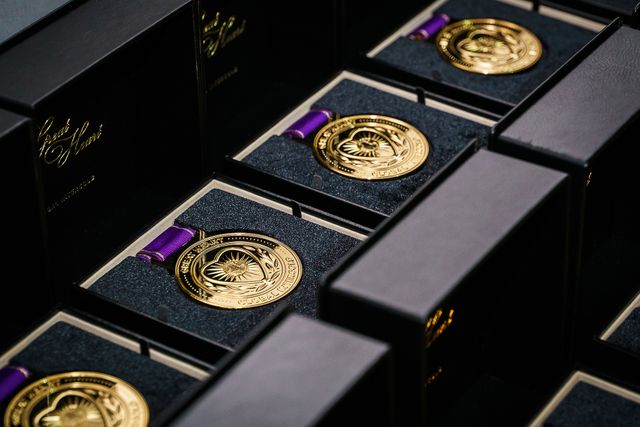
The soldier walked briskly into the major’s office, came to a halt in front of his desk and assumed a stance of attention.
“Corporal Harkness reporting as ordered, sir.”
“At ease, corporal, have a seat,” responded the major, admiring the stature and poise of the soldier before him.
A brief silence ensued between the two individuals before the major began, “Corporal, I imagine you understand how slowly things often move in the military. It seems they move even more slowly in the halls of Congress and in the government generally.
“The recommendation for a Medal of Honor takes even longer because of the very solemn nature of the honor. Some Medals of Honor have not been awarded for decades after the action for which they have been recommended.
“However, I wanted to be among the first to congratulate you on being approved for this honor and to assure you that an additional honor is mine for having you in my outfit. Harry Truman is reputed to have said that he would rather have this honor than be President. Since he served in World War I, I expect he was stating the truth.”
The attitude and poise of the soldier seated before the major did not noticeably change, even after the confirmation of the award and the compliment of the officer.
The major continued, “The President will present the medal and there will be a White House ceremony involved. Your family will obviously be invited to attend. I assume your mother and father are still living and would be available to attend. All their expenses would be covered for the trip.”
“Yes sir,” replied Corporal Harkness. “Both parents still living. I also have a brother and two sisters, all married.”
“I’ve no doubt they would be invited as well,” the major continued, “A time and date have not been set yet. Whenever it is scheduled, there won’t be any problem with getting you the necessary leave.”
Harkness, still sitting almost at attention in the chair, began, “Sir, I am deeply honored to have been recommended for this award. I am even more honored to think that the actions that precipitated the recommendation were deemed sufficient, but I must respectfully decline.”
The major looked up from the papers in front of him, startled, momentarily unable to respond. Gaining a bit of composure, he said, “I’m not sure I understand, corporal. This is the highest honor that can be afforded to a soldier, one that you certainly earned, and you don’t want it?”
“Sir, permission to speak freely?”
“By all means, corporal. I definitely want to hear this.”
Corporal Harkness continued, “Sir, as I said, I am deeply honored to have been recommended for this award and for it to have been granted. The fact that nine fellow soldiers are perhaps alive today because of some action that I took at the time matters more to me than the awarding of the medal ever could. I also realize that the President is our commander-in-chief and I am bound by the oath I took when joining the service to obey all legitimate orders issued under his jurisdiction. I have always done so.
“But I am no admirer of a man who has referred to members of the military as jerks and losers, one who proclaimed that John McCain, who suffered as a prisoner of war for five years and was severely handicapped by torture, was not a hero. A President who avoided the draft and service in Vietnam five times over ‘bone spurs’ which never kept him from playing a round of golf. I cannot admire a person who throws a salute to service personnel every time he leaves the Marine chopper but considers himself too good to render a salute while wearing the uniform. I believe he does not value the military but only uses it to his advantage and to make himself feel important, while he threatens to use it against the states in violation of the rule of law.
“I believe, sir, that the President will only use the placement of the Medal of Honor around my neck for his own personal aggrandizement, and, with all due respect sir, I don’t wish to be a party to that.”
The major paused for what seemed an interminable moment before commenting. “Well, corporal, you’ve certainly made your position very clear. I suppose that you have every right to decline the award. You may also have the right to decline to allow the president to present it. But I’m not so sure that you have a right, as a member of the military, to refuse an order from the President should he wish to issue that order for you to appear and accept it.”
“Sir, begging your pardon, if that order were to be issued, I would refuse to obey it.”
“Then you might very well subject yourself to court martial were you to do so. Do you understand that?”
“I do, sir. If I may continue to speak freely?”
“By all means, corporal.”
“Sir, I think it would reflect very badly on both the President and the Army should the media ever become aware that the MOH had been refused because the recipient did not respect the President.”
“Are you making a threat, corporal?”
“Absolutely not, sir,” responded Harkness, shocked that the major could even consider it such. “But the military is a large club, sir. And the number of people surrounding the President must number in the hundreds, a group that seems totally unable to keep anything under wraps.”
“You’re probably right about that, Harkness.
“Since you seem determined on this route, I’ll see what I can do to make this go away. I’m truly sorry because you definitely earned the award and should have it. Maybe I can convince the higher-ups that you are on a special assignment from which you cannot be removed for the time being. And maybe the award can be postponed until such a time as someone in the office is more acceptable to you.”
The major exposed a slight grin, obviously considering that a lowly corporal was taking a stand against the most powerful man in the country.
Never miss a thing with our FREE weekly newsletter.
“Well, I guess there’s nothing else to discuss, corporal. If you have nothing further, you can return to your duties.”
“Yes. sir. Thank you, sir.”
Corporal Harkness stood, did a brisk about face and headed for the office door.
“Oh, corporal,” said the major, causing Harkness to pause and turn. “I guess you know, you’d be only the second female to be awarded the Medal of Honor, the first one being in the Civil War?”
“I do, sir,” she responded, with a slight note of sorrow in the reply.

