
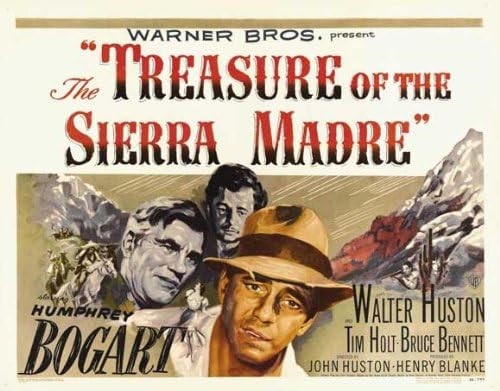
Today’s Reel Classic is set in the year 1925 in the Mexican town of Tampico. We meet two down-and-out drifters named Fred C. Dobbs (Humphrey Bogart) and Bob Curtin (Tim Holt). Their fortune takes a turn for the positive when they are offered jobs by contractor Pat McCormick (Barton MacLane) to help build an oil derrick. After completing the job they go back to Tampico to meet with McCormick to collect their pay. Their fortune takes a turn for the negative when they learn he has left without paying them.
They meet an old prospector named Howard (Walter Houston) in a flophouse who tells them stories of prospecting for gold and the possibilities of striking it rich. This encounter begins to stoke their dreams of one day being rich. Later Dobbs and Curtin run into McCormick at a local Cantina where after a bar fight McCormick settles up with the two. Dobbs takes part of his earnings and buys a lottery ticket and surprisingly wins a small jackpot. With money in their pockets Dobbs, Curtin, and the old man Howard begin to talk and plan to take the money they have to buy supplies and head into the Sierra Madre mountains to find gold and realize their dreams. What they will also discover is that three things will be the biggest challenges to their success: the harsh environment, bandits, and the most difficult, greed.
The environmental conditions are difficult but the three pursue the hunt for gold. Prospecting is not new for Howard, and he discovers the gold. They work hard and long to collect the gold dust and they amass their treasure in the hills of the Sierra Madre. But as the fortune grows the third challenge begins to emerge—greed. And with the feelings of greed comes distrust. Dobbs becomes more and more distrustful of his partners, and we see this partnership begin to devolve. It reaches a point where the three agree to divide the gold and hide their shares from each other. What we witness is the beginning of the emotional and mental decline of Dobbs.
As the story progresses our prospectors are visited by another American wanderer named Cody (Bruce Bennett) who wants in on the prospecting deal. His request is not at all well received but before the partners can respond they receive a visit from a local gang of bandits led by Gold Hat (Alfonsa Bedoya). Gold Hat has some of the most memorable lines in the film. When the bandits ride up on the prospectors Gold Hat tells them that his group is the police.
Gold Hat: “We are Federales . . . you know, the mounted police.”
Dobbs: “If you’re the police, where are your badges?”
Gold Hat: “Badges? We ain’t got no badges. We don’t need no badges! I don’t have to show you any stinkin’ badges!”
This line has become very famous and is usually misquoted as “We don’t need no stinkin’ badges!”

As the story progresses, we continue to witness the steady emotional decline of Dobbs, and the demonstration of care and compassion of Curtin and Howard. As usual, I don’t want to provide any spoilers. We watch the impact of greed on Dobbs—at first unpleasant, then bitter and angry, and then finally paranoid and dangerous. To quote a line from the Turner Classic Movie review, “His character undergoes a moral metamorphosis from a congenial, average guy to a murderous monster gripped by paranoia. Not the sleek, smooth-talking Bogart we find in The Maltese Falcon or The Big Sleep.
Reportedly Humphrey Bogart was wanting something different than the sleek, smooth talking private eye. In this film he would not be the hero. In fact, he plays a character that is very difficult to like at all. Many of his fans were disappointed in this role, but many critics identify this effort as one of Bogart’s best.
The director of The Treasure of the Sierra Madre was John Huston. He and Humphrey Bogart worked together on multiple films including The Maltese Falcon, Key Largo and The African Queen. The film was adapted from a novel of the same name written by B. Traven. Houston had read the novel in 1936 and decided at that time that he wanted to bring the story to the screen. The success of The Maltese Falcon in 1941 gave him the success he needed to convince the studio, Warner Bros., to allow him to write and direct the film. He had previously secured the rights to the novel.
John Huston’s father, Walter Huston, was cast as the older prospector Howard. Walter Huston worked very hard on his character portrayal. There are scenes in the film where he speaks Spanish. Huston did not know Spanish, so a person was hired to speak the lines in Spanish. Huston memorized the lines and did so well that others on the set thought he knew Spanish. An interesting note here: Reportedly Humphrey Bogart knew only two words in Spanish—Dos Equis (a Mexican beer, for those of you who may not know).
Another fact regarding Walter Huston’s portrayal of Howard. There is a scene where Howard gets excited and does a jig. This scene was unscripted, and Huston came up with the idea. It was a jig he had learned when performing in Eugene O’Neill’s play Desire Under the Elms in 1925.

Many may remember Tim Holt, who played Curtin from the many B movie westerns that he played in during the 1940s and 1950s. He also had a role in one of the more famous westerns — John Ford’s Stagecoach in 1939. A couple of other familiar faces appear in the film. Robert Blake is the young Mexican boy who sells the winning lottery ticket to Dobbs. You may remember him from the “Our Gang” series (also known as the “Little Rascals”) and later in life from the TV show Baretta. Jay Silverheels, also known as Tonto on The Lone Ranger, appears in the uncredited role as the Indian guide.
The Treasure of the Sierra Madre received much in the way of critical acclaim at the time but did not fare well at the box-office. Many attributed the poor showing to the disappointment of Bogart’s fans with his character. However, the critics praised the film. The reviewer in Variety wrote “If the box office is currently ailing from an over-diet of films that look too much alike, then this production is what the doctor ordered. The Treasure of the Sierra Madre is not only radically different, but it’s a distinguished work that will take its place in the repertory of Hollywood’s great and enduring achievements.”
It has been deemed by some critics as director John Huston’s finest work.
The film was also acknowledged with four Oscar nominations and three wins. Nominations included Best Picture (the award went to Hamlet), and Oscars were awarded for Best Director (John Huston), Best Supporting Actor (Walter Huston) and Best Screenplay (John Huston). In his Oscar acceptance speech Walter Huston said “Many, many years ago, I brought up a boy and I said to him, ‘Son, if you ever become a writer, try to write a good part for your old man sometime.’ Well, by cracky, that’s what he did!”
John Huston stated that working with his dad and his dad’s winning the Oscar were among the favorite moments of his life. Walter Huston was also quoted as telling his son “From now on I’d like to make one picture a year—with you.” Unfortunately, Walter Huston died the next year and they never got to work together again. The Academy did not nominate Bogart for Best Actor and was criticized by many for the oversight.

Lux Radio Theater broadcast a radio adaptation in April 1949 with Humphrey Bogart and Walter Huston reprising their roles.
Never miss a thing with our FREE weekly newsletter.
In 1990 The Treasure of the Sierra Madre was selected into the National Film Registry for being “culturally, historically, or aesthetically significant.” In 1998 the American Film Institute included it in its list of Top 100 Greatest American Movies. Film critic Leonard Maltin has listed this film in his 100 Must-See Films of The 20th Century and Roger Ebert has included it in his “Great Movies” list.
The Internet Movie Database rates the film at 8.2 of 10. Remarkably, Rotten Tomatoes has given it a critics score of 100% — very rare indeed for that site. They also have an audience score of 93%. Of all the movies I have written about, these scores are the highest I have seen to date.
I searched with my Roku device and only found one site where The Treasure of The Sierra Madre was streaming for free: WatchTCM. But I did find that the Clark County Public Library has a copy on the shelf in a collection entitled “Humphrey Bogart: The Essential Collection.”
Information for this Reel Classic review was gathered from Internet Movie Data Base (IMDb), Rotten Tomatoes, Turner Classic Movies (TCM) and Wikipedia.
I’ll be back soon with the next Reel Classic, but before I leave you with the trailer below let me remind you that if you enjoy these classic movies, please join me on the second Tuesday of each month at 6 PM at the Clark County Public Library for “Ron Kibbey’s Comedy Classics.” I present a classic comedy film usually accompanied by a vintage cartoon. Popcorn and drinks are provided. More information about the next film is available on the library’s website and Facebook page, as well as WinCity Voices Facebook page.
