
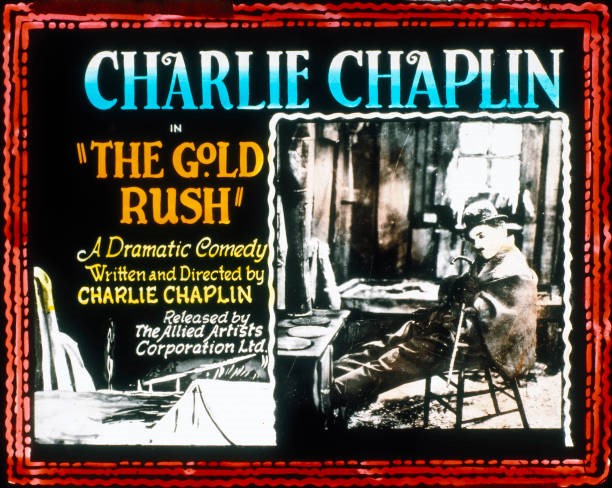
Today’s Reel Classic is truly a classic of the silent film era—Charlie Chaplin’s The Gold Rush, released in 1925. Before I get into details about the film, let me provide you with a quote from Chaplin’s biographer, Jeffrey Vance: “The Gold Rush is arguably his greatest and most ambitious silent film; it was the longest and most expensive comedy produced up to that time. The film contains many of Chaplin’s most celebrated comedy sequences, including the boiling and eating of his shoe, the dance of the rolls, and the teetering cabin. However, the greatness of The Gold Rush does not rest solely on its comedy sequences but on the fact that they are integrated so fully into a character-driven narrative. Chaplin had no reservations about the finished product. Indeed, in the contemporary publicity for the film, he is quoted, ‘This is the picture that I want to be remembered by.’ ”
Charlie Chaplin, in his “Little Tramp” persona, is “The Lone Prospector” who has headed for the wilds of Alaska to take part in the Klondike Gold Rush. As everyone who did so, he has dreams of striking it rich and living his life in comfort. Another prospector, Big Jim McKay (Mack Swain), has found gold when a blizzard suddenly hits. Meanwhile, the Lone Prospector is also caught in the blizzard and comes across a cabin where he seeks shelter. The cabin happens to belong to Black Larsen (Tom Murray), a wanted criminal. Black Larsen is trying to throw out the Lone Prospector when Big Jim appears—also seeking shelter from the storm. The three agree to a truce.
The blizzard continues to rage and the food begins to run out. They draw lots to see who has to go out into the raging storm to seek more food and Black Larsen loses. While out seeking food Black Larsen comes across Big Jim’s gold and plans to ambush him upon his return and steal the gold.
Meanwhile, back at the cabin, Big Jim and the Lone Prospector are starving and decide to cook and eat one of the Lone Prospector’s shoes. Eventually the storm subsides and the two go their separate ways. The Lone Prospector heads for the nearest town while Big Jim goes back to his claim. There he is hit by Black Larsen with a shovel, and after awakening has lost his memory. Meanwhile, Black Larsen has taken the gold and escaped.
The Lone Prospector has arrived in town and in a local dance hall meets a dancer, Georgia. He is immediately smitten and falls in love with her. She and some of her dancer friends visit him and she teases him, promising to return on New Year’s Eve for dinner. In the meantime, Big Jim has arrived in the town and his memory begins to return. He remembers that he had found gold, and that it was near a cabin he shared with the Lone Prospector.
When Georgia does not show up for the dinner he has prepared for her he is saddened and goes to look for her. While doing so he and Big Jim meet and Big Jim insists he help him find the cabin and the gold. The Lone Prospector lets Georgia know that he loves her and will return a rich man.

As usual, no spoilers.
Charlie Chaplin reportedly was inspired by photographs of the Klondike Gold Rush shown to him at the home of his friends Mary Pickford and Douglas Fairbanks as well as the story of the Donner Party who was stranded in the Sierra Nevada during a snow storm—resulting in cannibalism and eating shoe leather. He believed that tragedies and comedies were not that far removed from each other. In the movie poster above it is subtitled “A Dramatic Comedy.” Chaplin was quoted in an interview with the New York Times in 1925 saying “What I have done in The Gold Rush...is exactly what I wanted to do....Back of it all—back of the funny clothes, the mustache and the big feet—I wanted to produce something that would stir people. I was after after the feeling of Alaska, with a sweet, poetic, yet comic, love story....I wanted audiences to cry and laugh.”
The opening scenes were the only scenes filmed outside the studio. We see hundreds of men scaling a snow-covered Chilkoot Pass in Alaska. That scene was actually filmed in Truckee, California. The men seen in the film were vagrants from Sacramento, California (600 hundred of them) who were transported to the site by train and hired for one day. There are several scenes within the film that have become classic Chaplin film scenes. One of those scenes is where the Lone Prospector cooks his shoe as he and Big Jim are out of food. That scene took three days and 63 takes to satisfy Chaplin (who was also writer and director). The boot was made of licorice and Chaplin was taken to the hospital after suffering insulin shock.
Another infamous scene is where the Lone Prospector puts forks in the bread rolls and has them dance to entertain Georgia and her friends. Reportedly the dancing rolls were so popular that in some cases the projectionists stopped the film and replayed the scene for the viewers. Other memorable scenes include the cabin tilting in the storm and Big Jim hallucinating from being hungry and seeing the Lone Prospector as a giant chicken. These scenes described are part of what makes this film so memorable nearly a hundred years later.

Lita Grey, who had appeared in Chaplin’s earlier film The Kid (1921), was initially signed to portray the leading lady. However, she and Chaplin began an affair which resulted in her getting pregnant six months into the shooting of the film. They married and he sought another leading lady. Reportedly Carole Lombard was considered but the role went to Georgia Hale.
The Gold Rush was a huge success at the box office worldwide and is the fifth highest-grossing silent film in history. Critics praised it as well. The reviewer for The New York Times wrote: “Here is a comedy with streaks of poetry, pathos, tenderness, linked with brusqueness and boisterousness. It is the outstanding gem of all Chaplin’s pictures, as it has more thought and originality than even such masterpieces of mirth as The Kid and Shoulder Arms.”
Variety described it as “the greatest and most elaborate comedy ever filmed, and it will stand for years as the biggest hit in its field....” The New Yorker was not quite as complimentary as the critic did not appreciate the drama included in the comedy: “One might be given to expect wonders of Gold Rush burlesque with the old Chaplin at the receiving end of the Klondike equivalent of custard. But one is doomed to disappoint, for Chaplin has seen fit to turn on his onion juices in a Pierrot’s endeavor to draw your tears....” However, The New Yorker did include The Gold Rush in its list of the ten best films of 1925.
In 1942 Charlie Chaplin re-released a version of The Gold Rush that included a newly written film score composed by Chaplin as well as sound effects and some narration. The 1942 version received two Oscar nominations for Best Music Score and Best Sound Recording.
Modern day reviews of The Gold Rush are very positive. The American Film Institute lists it at #25 in the 2000 list of the Top 100 Funniest American Movies. The American Film Institute also lists it at #58 in their 2007 list of Top 100 Greatest American Movies. In 1992 the Library of Congress selected it for preservation in the National Film Registry.

The Critic’s Consensus for Rotten Tomatoes states that The Gold Rush is “a delightful blend of slapstick humor, poignant emotion, and social commentary. The Gold Rush encapsulates Chaplin’s strengths as a writer, director, and star.” The critic for Turner Classic Movies (TCM) wrote: “Charles Chaplin was and remains...an icon of history and a brand name recognized in every corner of the globe. Chaplin developed a personal cinematic technique to display his comedic and dramatic talents and to showcase his star personality....No ballet dancer was as graceful, no clown as funny, no tragedian as heartbreaking.”
Never miss a thing with our FREE weekly newsletter.
The Internet Movie Database (IMDb) rates The Gold Rush at 8.1 of 10. Rotten Tomatoes gives it a Critics Score of 100% and an Audience Score of 93%.
In searching my Roku device I found the film available on multiple streaming sites: Hoopla, Tubi, Cinema Box, Fawesome, Classic Movies, Comedy Classics, Hollywood Classics, Freevee, Plex and Classic Clowns. Several of these sites feature a version that was restored in 2007 and is an excellent view.
I also found a copy of the DVD on the shelf at the Clark County Public Library.
Information for this Reel Classic review was gathered from Internet Movie Data Base (IMDb), Rotten Tomatoes, Turner Classic Movies (TCM) and Wikipedia.
I’ll be back soon with the next Reel Classic, but before I leave you with the trailer below let me remind you that if you enjoy these classic movies please join me on the second Tuesday of each month at 6:00 PM at the Clark County Public Library for “Ron Kibbey’s Comedy Classics.” I present a classic comedy film usually accompanied by a vintage cartoon. Popcorn and drinks are provided. More information about the next film is available on the library’s website and Facebook page, as well as WinCity Voices Facebook page.
