
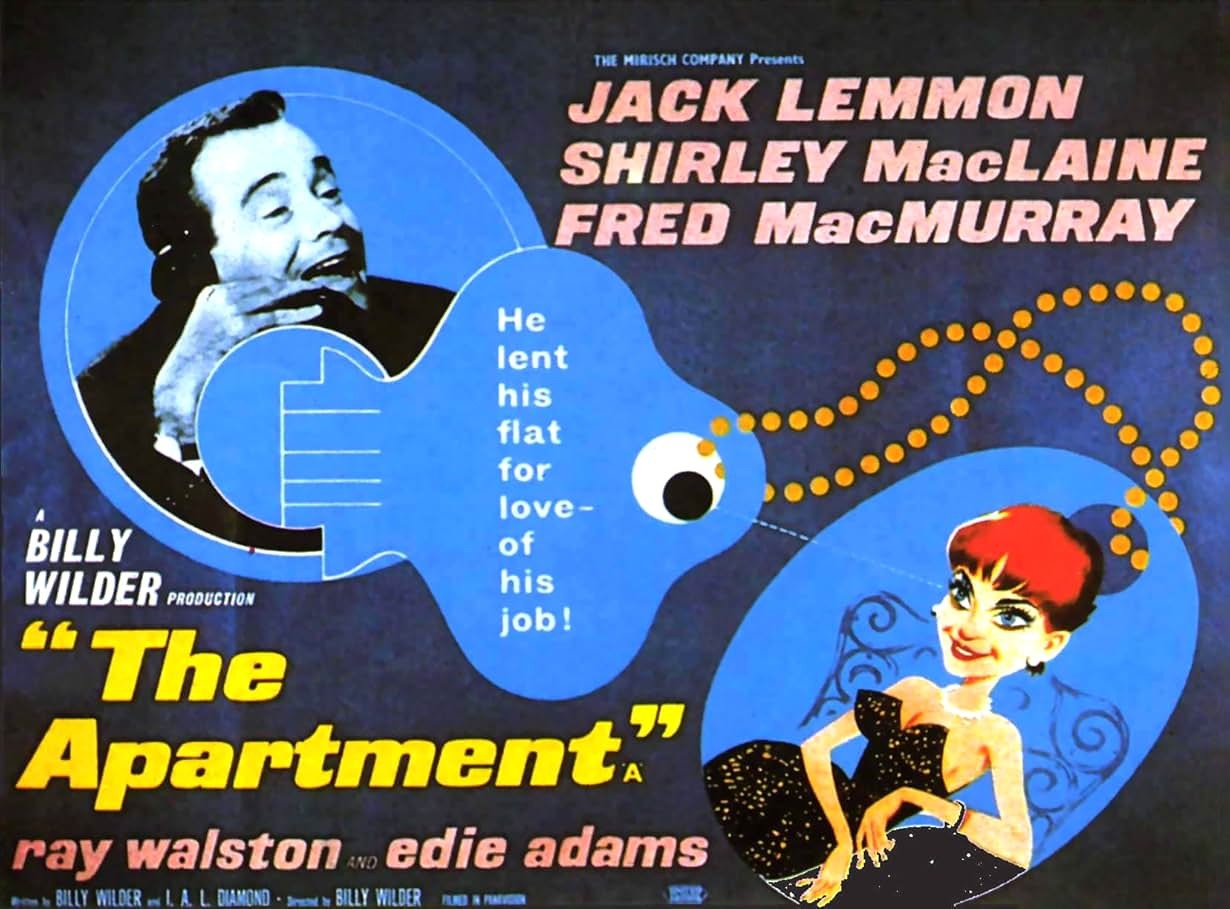
Billy Wilder was a very successful screenwriter and director in Hollywood. His films include many classics—Double Indemnity (1944), Sunset Boulevard (1950), Witness For The Prosecution (1957) and Some Like It Hot (1959) to name a few. Today’s Reel Classic also appears in that list of Wilder’s successes.
The Apartment, released in 1960, starred Jack Lemmon, Shirley MacLaine and Fred MacMurray in a romantic comedy with a serious commentary. As stated in the review on the TCM (Turner Classic Movies) site: “Wilder walks the tightrope between humor and tragedy and creates sympathy for his morally ambiguous characters in a way very few filmmakers could pull off.”
So, who are these “morally ambiguous characters?” C.C. “Bud” Baxter (Jack Lemmon) is an office worker in a huge insurance company in New York City. His ambition is to climb the ladder in the company and secure a higher position. One way he has found to secure the support of his supervisors is to allow them the use of his apartment to carry on extramarital affairs. He is juggling the schedules of four of his managers. There is so much “coming and going” in his apartment that his neighbors, thinking it is Baxter entertaining all these women, believe him to be a playboy.
Hearing all the positive comments about Baxter from the managers, the personnel director, Jeff Sheldrake (Fred MacMurray), figures out what is going on and decides to take advantage as well. He promises Baxter a promotion if Sheldrake can utilize the apartment for his own extramarital affair. Baxter is agreeable and in return Sheldrake gives him two tickets to a Broadway show.
Baxter does have a crush on the building’s elevator operator Fran Kubelik (Shirley MacLaine), and asks her out to the show. She informs him that she has a date that evening but will meet him before the show. What Baxter doesn’t know is that the date Fran has is with Sheldrake. We learn that she had been seeing Sheldrake in the past but decided to stop. He has told her that he plans to divorce his wife to be with her and they head for Baxter’s apartment leaving Baxter waiting for her.
Fran eventually learns from an employee of the insurance company that Sheldrake has had multiple affairs and struggles with that knowledge. Baxter also learns that Sheldrake has been seeing Fran in his apartment. Both are tremendously impacted by their newfound knowledge. As the story plays out we see Baxter and Fran cope with their feelings and discover each other as part of the healing process. As usual, no spoilers.
Now, I can almost hear you saying “I thought this was a romantic comedy!” Well, it is, but remember the quote above from TCM about how Wilder walked the tightrope between comedy and tragedy. There are laughs and smiles throughout the film but it has its share of serious moments as well. This is not your 1930s screwball comedy.

The role of Fred Sheldrake was not the kind of role that most people think of when they think of actor Fred MacMurray. Most remember him as the father in the popular television series My Three Sons, or perhaps from his various Disney movies roles (The Absent Minded Professor, The Shaggy Dog and Son Of Flubber). He had worked with Billy Wilder previously in the film noir classic Double Indemnity along with Barbara Stanwyck and Edward G. Robinson.
He hesitated at first in taking this role, as it was different from those he had been playing at the time. However, his past work experience with Wilder led him to accept it. As it turned out, he paid a price for choosing to do so. Fan mail for MacMurray after the release of The Apartment was very critical of him. Fans did not like seeing the friendly, easy going actor they had grown accustomed to play such a “morally corrupt” character. MacMurray described an incident where he was berated by a woman on the street for making a “dirty, filthy movie” and she struck him with her purse. She told him she had brought her six year old son to see the movie, thinking it was another Disney film. He was so taken aback by the responses that he said he would never take on a similar role again.
Interestingly, Fred MacMurray was not the initial choice for the role of Sheldrake. Paul Douglas had been cast in the role. However, he died from a heart attack in New York prior to flying to Hollywood. Another interesting note regarding casting is that the studio wanted Groucho Marx to play the role of Baxter’s neighbor, Dr. Dreyfuss. Billy Wilder nixed that as he wanted an actor with a more dramatic flair. Jack Kruschen was chosen and received an Oscar nomination for his efforts.
Other familiar faces in the cast include Ray Walston and Hal Smith. You may not know him by his name, but you would likely recognize the face of Hal Smith. In The Apartment, Smith is seen as the drunken Santa Claus in a bar scene. You will know him as the drunken Otis Campbell from The Andy Griffith Show.
The film received ten Oscar nominations and won five, including Best Picture, Best Director, and Best Screenplay. Billy Wilder became the first person ever to win an Oscar for all three categories. Jack Lemmon and Shirley MacLaine also received nominations for their roles.

The subject matter of the film created some disagreement when it came to the critics’ reviews. Time and Newsweek both praised the film as did the critic for The New York Times who described it as “gleeful, tender, and even sentimental” while praising Wilder’s direction as “ingenious.” However, the critic for Esquire described it as “a paradigm of corny avantgardism” and the Saturday Review described it as “a dirty fairy tale.”
Jack Lemmon addressed the subject matter of the film and Wilder’s efforts. He stated “ I always felt that Billy Wilder grew a rose in a garbage pail with this one. He was throwing cold water right in our faces about the terrible false premises with which most of our society lives. He challenged our priorities and the way we rationalize our behavior on the grounds of getting ahead in America—at a time when it wasn’t fashionable to challenge these things.”
Lemmon also said of his character: “As I saw it [Baxter] was ambitious; a nice guy but gullible, easily intimidated, and fast to excuse his behavior. In the end, he changes because he faces up to having rationalized his morals. He realizes he’s been a dumb kid, he’s been had.”
In 2001 Roger Ebert gave the film four of four stars and added it to his list of “Great Movies.” Rotten Tomatoes Critics Consensus states “Director Billy Wilder’s customary cynicism is leavened here by tender humor, romance, and genuine pathos.” The American Film Institute has also included The Apartment on it’s list of “Greatest American Movies of All Time,” “Top 100 Funniest American Movies,” and “America’s Greatest Love Stories.”
In 1968 Neil Simon adapted the screenplay for Broadway as a musical titled “Promises, Promises.” It ran for 1,281 performances and included the Burt Bacharach and Hal David song “I’ll Never Fall In Love Again,” made popular by Dionne Warwick.
Never miss a thing with our FREE weekly newsletter.
The Internet Movie Database gives The Apartment a score of 8.3 of 10. Rotten Tomatoes Critics Score is 93% and the Audience Score is 94%.

In searching my Roku device I found the film available for free on several sites including Tubi, Kanopy, Hoopla and PlutoTV. (Kanopy and Hoopla are available with your library card). There is also a copy of the film on DVD on the shelf at the Clark County Public Library.
I will leave you with the valuable advice offered to Baxter by his concerned neighbor Dr. Dreyfuss: “Be a mensch!” (a Jewish term meaning a person of integrity and honor). Good advice for us all.
Information for this Reel Classic review was gathered from Internet Movie Data Base (IMDb), Rotten Tomatoes, Turner Classic Movies (TCM) and Wikipedia.
I’ll be back soon with the next Reel Classic, but before I leave you with the trailer below let me remind you that if you enjoy these classic movies please join me on the second Tuesday of each month at 6 PM at the Clark County Public Library for “Ron Kibbey’s Comedy Classics.” I present a classic comedy film usually accompanied by a vintage cartoon. Popcorn and drinks are provided. More information about the next film is available on the library’s website and Facebook page, as well as WinCity Voices Facebook page.
