
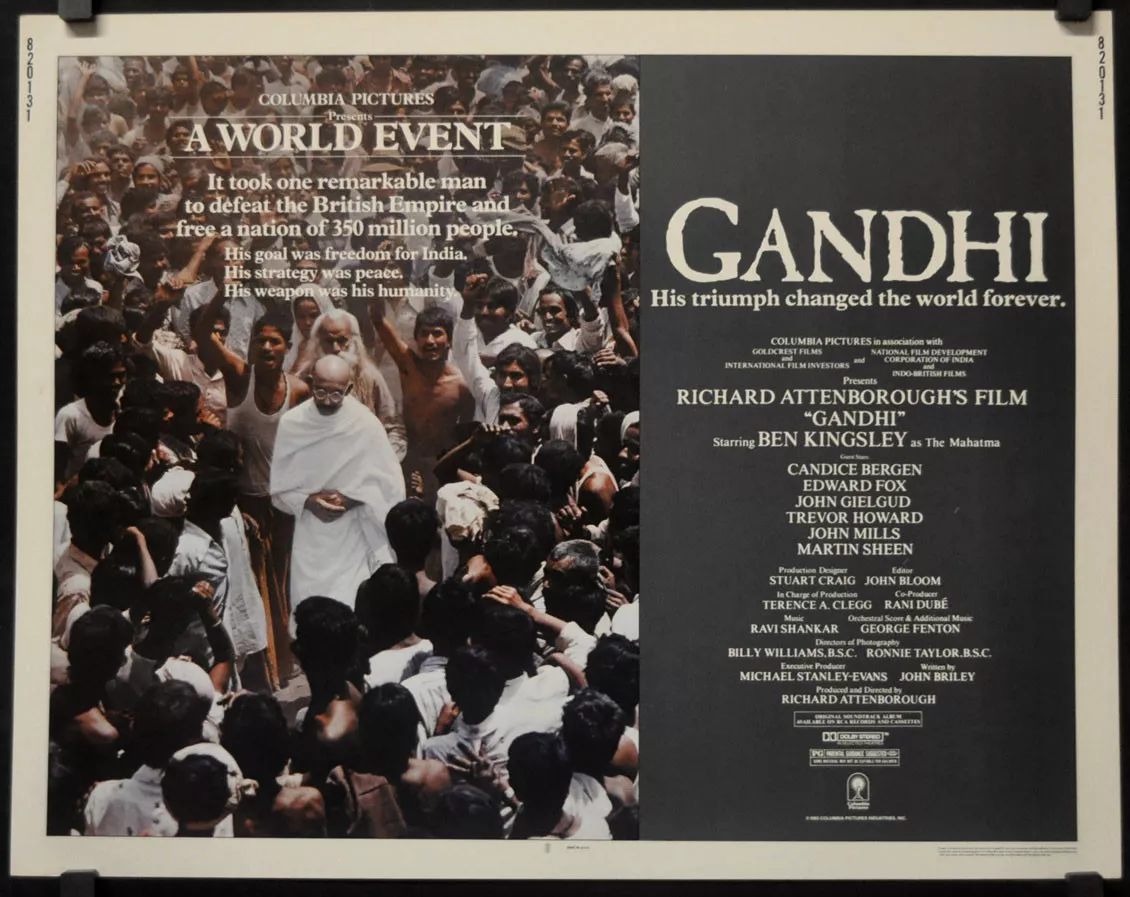
Today’s Reel Classic looks at a film released in 1982 highlighting the life (and death) of an iconic figure and social activist, Mohandas Karamchand Gandhi (aka Mahatma Gandhi). It follows his story from 1893 as an attorney in South Africa through his efforts to work for the independence of India from the rule of the British Empire and his assassination in 1948. It outlines his efforts to free India utilizing non-violence as his means of creating change. His strategies were utilized by another great change agent in our country during the struggle for civil rights — Martin Luther King.
Gandhi and King are my two most respected heroes; both demonstrated the power of non-violence as a tool for positive change.
Richard Attenborough was the director of the film and was first approached with the concept of making a film about Gandhi in 1962. Reportedly he was approached by an Indian civil servant working in London who was a devoted follower of Gandhi. After speaking with the individual, he read the biography of Gandhi by Louis Fischer and agreed that Gandhi’s efforts would make a fine film. However, it would take another twenty years to see the concept come to fruition.
We meet the young Gandhi as an attorney in South Africa who finds himself thrown off a train because he is riding in first class. Neither Indians nor Africans are permitted in the whites-only cars. The incident leads Gandhi to initiate a non-violent protest advocating for the rights of Indians in South Africa. Eventually the efforts lead to the government recognizing rights for Indians (but not for native Africans).
Gandhi returns to India and is acclaimed for his efforts in South Africa. He is urged by many in India to take up the cause of independence from British rule, and he agrees to lead the effort. He mounts a non-violent protest that brought millions of Indians into the movement. The efforts saw violence against the protesters where many non-violent participants were gunned down by British military. We also see the imprisonment of Gandhi for his efforts in leading this cause.
However, Gandhi persists in advocating non-violence as the means for change. A quote from Gandhi regarding the strategy: “The function of a civil resistance is to provoke response and we will continue to provoke until they respond or change the law. They are not in control, we are.” Another quote: “An eye for an eye ends up making the whole world blind.”

Through terms in prison and hunger strikes, Gandhi persisted in his efforts to free India and to pursue the non-violent path in doing so. He brought world-wide attention to his cause and to his beliefs. In 1947 Great Britain relented and granted independence to India. There were tremendous celebrations throughout the country, but their troubles were far from over. There were major tensions between Hindus and Muslims, leading to violence. Gandhi continued to advocate for non-violence and acceptance of others. He worked to diminish the divisive impact of religious differences. Another quote from Gandhi: “I am a Muslim and a Hindu and a Christian and a Jew and so are all of you.”
Unfortunately, the country was split and the northwest part of India which was primarily Muslim became a new country, Pakistan. Gandhi was opposed to the splitting of the country and in turn angered both Muslims and Hindus. His life of seeking peace and unity by means of non-violent protests came to an end in 1948 when he was assassinated by an angry Hindu protester.
For the role of Gandhi, several well-known actors were considered including Alec Guinness, Albert Finney, Dirk Bogard, and Anthony Hopkins. Reportedly Dustin Hoffman was interested in the role but took the lead role in Tootsie. The role was eventually given to Ben Kingsley, whose father was of Indian descent. Kingsley’s birth name was Krishna Bhanji, but he changed it after he began to appear on stage.
Kingsley prepared for the role by reading up on Gandhi and studying old newsreels. The choice of Kingsley for the role and his efforts at portraying Gandhi paid off for the studio and for Kingsley, as he won an Oscar for Best Actor at the Academy Awards. In fact, the film was nominated for eleven Oscars and won eight, including Best Picture, Best Director and Best Screenplay. The film was also nominated for an Oscar for Best Original Score (Ravi Shankar and George Fenton).
Reportedly, Ravi Shankar immediately agreed to be involved in the music. He and Indian musicians went to London to work on the soundtrack. For those who may not be familiar with him, Ravi Shankar is a master of the sitar and classical Indian music (and one of my favorite musicians).
Other well-known actors appearing in the film include Candice Bergen as Margaret Bourke-White, John Gielgud as Lord Irwin, Trevor Howard as Judge Broomfield, and Martin Sheen as Walker.

The scene depicting Gandhi’s funeral had 300,000 extras participating. Over 200,000 of those extras volunteered to participate in that scene. That made it into Guinness Book of World Records for the largest number of extras ever in one scene. It was shot on January 31,1981, the 33rd anniversary of Gandhi’s death, and utilized eleven film crews.
Edward R. Murrow, a well-known television reporter at the time, was quoted saying at the reporting of the funeral: “The object of this massive tribute died as he had always lived — a private man without wealth, without property, without official title or office. Mahatma Gandhi was not a commander of great armies nor ruler of vast lands. He could boast no scientific achievements or artistic gift. Yet men, governments and dignitaries from all over the world have joined hands today to pay homage to this little brown man in the loincloth who led his country to freedom.”
Reviews of the film were very positive. The reviewer in Newsweek stated, “There are very few movies that absolutely must be seen. Sir Richard Attenborough’s Gandhi is one of them . . . Ben Kingsley . . . gives what is possibly the most astonishing biographical performance in screen history.”
The reviewer for The New York Times wrote: “Gandhi, who was born a Hindu but who preached the brotherhood of men under one God, was assassinated in Delhi by a Hindu fanatic. His is one of the great stories of modern times. Of more importance is the possibility that the film will bring Gandhi to the attention of a lot of people around the world for the first time, not as a saint but as a self-searching, sometimes fallible human being with a sense of humor as well as of history.”
The reviewer in Variety wrote: The thin voice of the aging Gandhi, whose life was ended at age 78 by an assassin’s bullet in 1948, should ring out loud and clear from the screen to remind the world that for all our technological progress the mind and heart of mankind remains in the dark ages, surging with envy, greed and bigotry.”
This was written in 1982. We continue to see the envy, greed and bigotry today in 2024.
Roger Ebert wrote: “What is important about this film is not that it serves as a history lesson (although it does) but that . . . it reminds us that we are, after all, human, and thus capable of the most extraordinary and wonderful achievements, simply through the use of our imagination, our will, and our sense of right.”
In 1998 the American Film Institute nominated Gandhi for their list of Top 100 Greatest American Movies and in their 2005 list of movies nominated for 100 Years of Film Scores. Steven Schneider also includes Gandhi in his book 1001 Movies You Must See Before You Die.
Never miss a thing with our FREE weekly newsletter.
Gandhi’s accomplishments and his staunch belief in the power of non-violence to create change should be acknowledged, and this film does a grand job of that. He was a human being, and all human beings have their flaws and faults. But he was committed to what he saw as freedom and equality for others and dedicated his life to that end.

The Internet Movie Database (IMDb) gives Gandhi a score of 8.0 of 10. Rotten Tomatoes gives it a critics’ score of 89% and an audience score of 92%.
In searching my Roku devices, I found the film available for free streaming on byutv. There is also a copy of the film on DVD at the Clark County Public Library.
Information for this Reel Classic review was gathered from Internet Movie Data Base (IMDb), Rotten Tomatoes, Turner Classic Movies (TCM) and Wikipedia.
I’ll be back soon with the next Reel Classic, but before I leave you with the trailer below let me remind you that if you enjoy these classic movies, please join me on the second Tuesday of each month at 6 PM at the Clark County Public Library for “Ron Kibbey’s Comedy Classics.” I present a classic comedy film usually accompanied by a vintage cartoon. Popcorn and drinks are provided. More information about the next film is available on the library’s website and Facebook page, as well as WinCity Voices Facebook page.
