
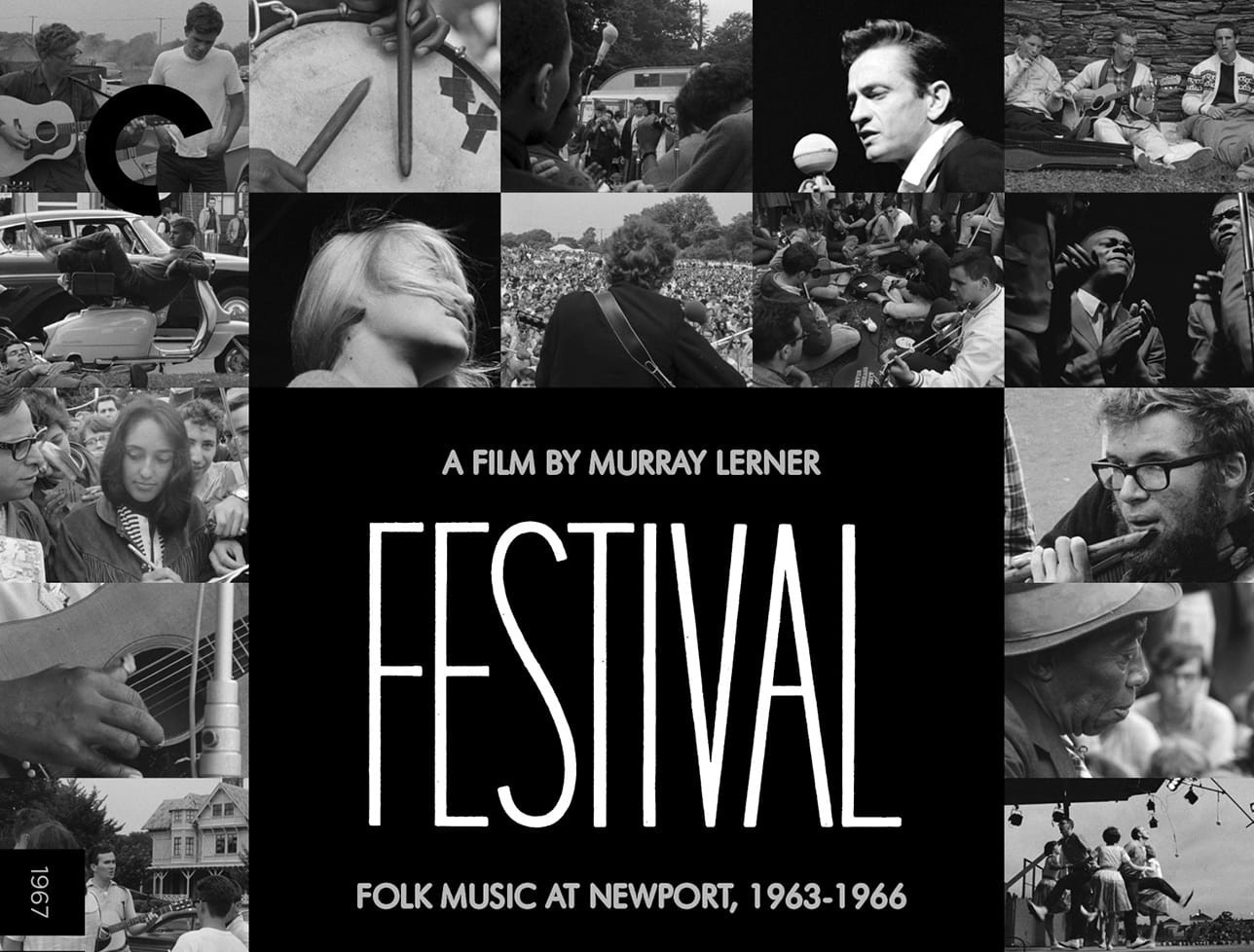
Today’s Reel Classic looks at a documentary film released in 1967 that focused on the Newport Folk Festival during the years 1963 through 1966. Murray Lerner was writer, director and producer of the film. Festival captures on film not only the musicians performing at these concerts, but also the essence of the growing counterculture movement within our society.
At that time, folk music was an essential voice for protest and speaking out against the perceived injustices within our society. Lerner filmed the festivals over the course of four years and provides us with a view of not only the music of the time, but of the changes that were occurring within our society.
The Newport Folk Festival included not just the popular folk musicians of the time, but also showcased blues, country, jug band, and Appalachian music on the stage. Musicians appearing in the film include Joan Baez, Bob Dylan, Pete Seeger, Jim Kweskin Jug Band, Howlin’ Wolf, Paul Butterfield Blues Band, Judy Collins, Johnny Cash, and Mississippi John Hurt. This is just some of the 30 various performers featured.
It is important to note though, that it is not a concert film. We don’t see long performances of musicians, but instead see clips of their performances. The focus is on the cultural impact of the performances and the gathering of those in attendance. The focus was to show how the music being performed was a reflection and expression of the changes going on at the time in our society.
The mid-sixties were a time of great change with regard to civil rights, the anti-war movement and the continued rise of feminism. Folk music was perceived as a voice for change. Nineteen sixty-three was a time of change that included Martin Luther King Jr. delivering his famous “I Have A Dream” speech, Betty Friedan publishing her book The Feminine Mystique, as well as the assassination of President John F. Kennedy. In January 1964, Sam Cooke recorded “A Change Is Gonna Come” just months after he was arrested in Louisiana for trying to check into a “whites only” Holiday Inn. President Johnson was to pledge continued support for the war in Vietnam.
The Newport Folk Festival began in 1959, managed by George Wein. He had previously set up and managed the Newport Jazz Festival starting in 1954. How folk music was perceived was as a reflection of the experiences of hardworking folks and as an expression of social conscience. Famous folk singer Woody Guthrie had been doing that for years. Murray Lerner first got involved with the Newport Folk Festival as a volunteer to film and help preserve the events at the festival. He decided to go beyond that and employed a crew to assist him in traveling throughout the concert site interviewing and recording both performers as well as those attending. Most of those attending were young folks who saw the need for change and felt comfort in both the music and the sharing of the experience with others. A quote early in the film from Peter Yarrow (Peter, Paul, and Mary) describes it well: “Folk music is really the personification of a human being extending his hand to another human being without losing any of his dignity. We feel this way about it; walk with us.”

There is almost as much attention paid to the folks in the crowd as there is to the musicians performing. Interviews are conducted with various attendees. Many came bringing their own guitars, banjos and harmonicas and the gatherings produced music from the folks grouped in circles. Pete Seeger talked about the value of the festival and why it was so important.
“Why have we done this? Because, we believe in the idea that the average man and woman can make his own music. In this machine age, it doesn’t all have to come out of a loud speaker. You can make it yourself, whether you want to shout or croon, sing sweet or rough. And it can be your own music. And when I say your own, music of your own kind, whether it’s your family or your town or your region, your race or your place, your religion or whatever it is,” he said.
In his review of the film, Roger Ebert gave it three and a half stars out of four. He praised Murray Lerner for making “full use of the strength of documentary film, the ability to catch unrehearsed moments that reveal personality.”
An example was when he described the interview with Mississippi John Hurt: “It would have been easy to get cheap laughs by cutting from the traditional performers to the college kids, but Lerner went for depth instead. You see Mississippi John Hurt singing, and then he talks about blues bands: ‘The way I see it, and I was talkin’ to the reverend (Reverend Wilkins) about it this morning, if it’s the blues, then they ain’t no jumping to it. If you’re jumping, you ain’t got the blues. The blues are kind of mournful and sad, like when you lock yourself in a room and don’t want to see nobody ...’ .”
In praising the editors of the film, Ebert said, “They make their points quietly, with humor and understatement. The result is marvelously entertaining.”
Festival won an award at the 1967 Venice Film Festival and was nominated for an Oscar for Best Documentary at the 1968 Academy Awards. Murray Lerner went on to direct and produce many documentaries focused on music. Some of the films he is noted for include From Mao to Mozart: Isaac Stern in China (1979 and an Oscar winner), Jimi Hendrix at the Isle of Wight (1991) and Miles Electric: A Different Kind of Blue (2004).

A more recent review from the magazine Slant in 2017 provides a more modern perspective on the film. “For a citizen of 2017, the most poignant recurring image in Murray Lerner’s Festival might be of the audience at the Newport Folk Festival, gathered around listening intently to the concert performances .... The film features a society that’s a ways away from cellphones and iPads. And the sight of people directly engaging with something in front of them, their attention largely undivided by ceaseless advertisements and vendors, suggests a lost communal oasis.”
Interestingly, it so happened that at one of these concerts (1965) Lerner captured on film when Bob Dylan chose to go electric on stage. His choice to do so upset many of the folk purists attending the show. Pete Seeger was especially upset. This performance has become one of the most note-worthy performances at the Newport Folk Festival. Dylan did not return to the stage of the Newport Folk Festival for 37 years. Though some were upset with his move, others praised his effort. In the year 2026 we all know he survived the radical change very well and has had a very successful and influential career.

After Festival we would see other documentaries focused on the music, the people and the times of the sixties. These included Monterey Pop (1968), Woodstock (1970) and Gimme Shelter (1970). It was not until 2021 that we saw the film that documented another amazing concert from that period in 1969—Summer of Soul (... Or, When The Revolution Could Not Be Televised).
The Internet Movie Database gives Festival a score of 7.5 of 10. Rotten Tomatoes gives it a Critics’ Score of 100% and an Audience Score of 73%. In searching my Roku device, I could find no free streaming sites and, unfortunately, the Clark County Public Library does not have a copy of the DVD on the shelf. I do believe that the staff there would obtain a copy if you ask. I do encourage you to watch it if you can as it is as much a lesson in our history as it is entertainment. And please check out the trailer below. It will give you an excellent insight into what the film presents.
Never miss a thing with our FREE weekly newsletter.
In closing, I would like to return to the review from the magazine Slant: “Festival brings to life a mythologized time, capturing the roots of its creation. The Newport Folk Festival offered a glimpse of the crystallization of the counterculture, in the wake of the racism and atomic fears of the 1950s and the already years-long war in Vietnam.”
I have long stated that, to me, music is a universal language. It can bring us together, and it can help us express our joys as well as our fears. But let us not forget that it can bring us together, and these days we need to be together. I will end with the lyrics from the song “Get Together” by The Youngbloods that came from this period of time but rings just as true today.
If you hear the song I sing
You will understand (listen!)
You hold the key to love and fear
All in your trembling hand
Just one key unlocks them both
It’s there at your command
Come on people now
Smile on your brother
Everybody get together
Try to love one another right now
Information for this Reel Classic review was gathered from sources including the Internet Movie Database (IMDb), Rotten Tomatoes, Turner Classic Movies (TCM), and Wikipedia.
Unfortunately, the video of this trailer cannot be embedded here, but you can view it on YouTube via this link: https://youtu.be/h2PPEyMLZAU
Ron Kibbey’s Comedy Classics
If you enjoy these classic movies, please join Ron on the second Tuesday of each month at 6 PM at the Clark County Public Library for “Ron Kibbey’s Comedy Classics.” The evening features a classic comedy film, usually accompanied by a vintage cartoon. Popcorn and drinks are provided. More information about the next film is available on the library’s website and Facebook page, as well as WinCity Voices Facebook page.
