
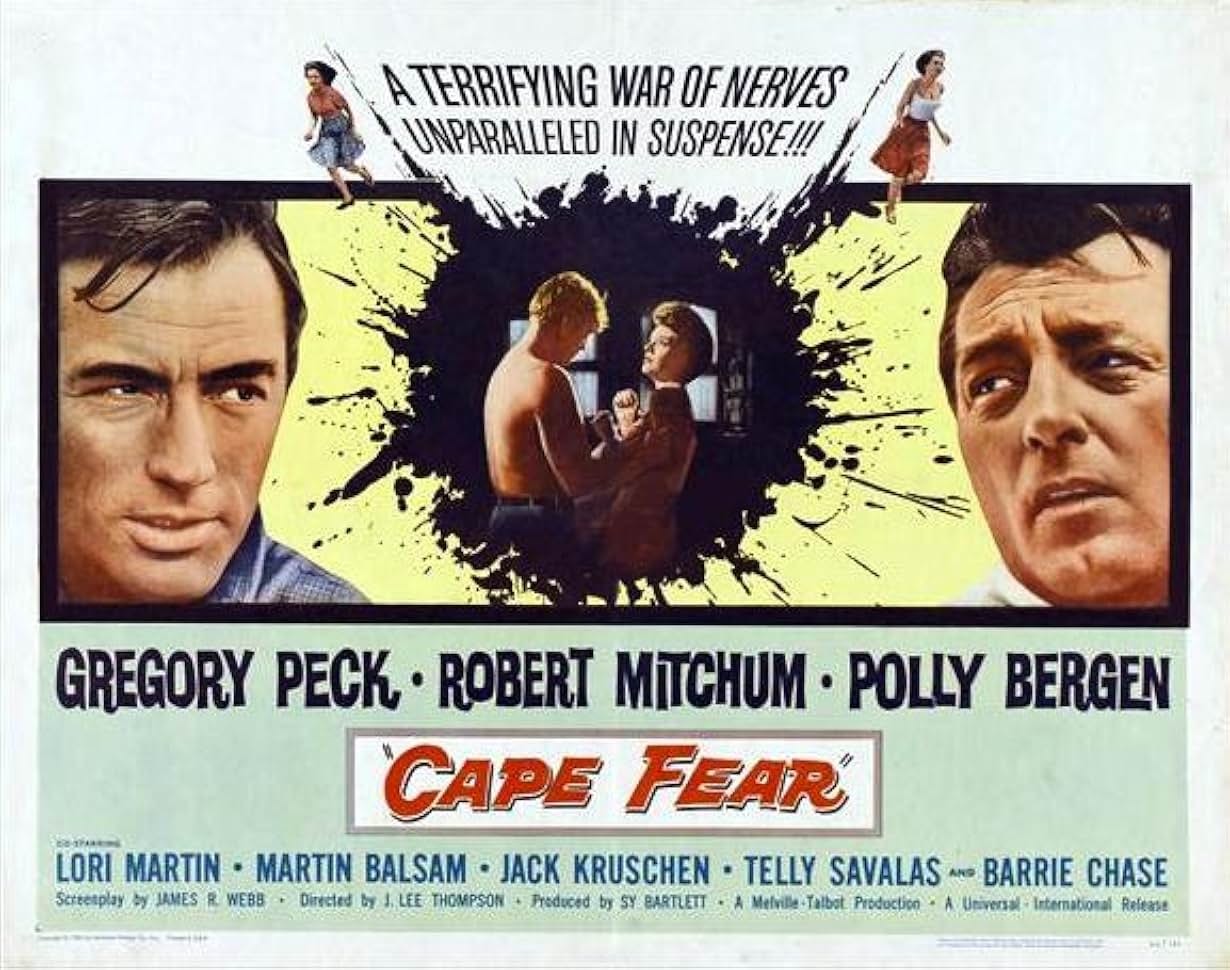
“In the annals of screen psychopaths, there are few who can top Robert Mitchum’s Max Cady in the 1962 version of Cape Fear. A convicted sex offender who is released from prison after serving a six year sentence, Cady is a walking time bomb, biding his time until he can take revenge …. Everything about him exudes menace, from his hooded eyes and insouciant sexual swagger to his smirking, undisguised contempt for everyone he meets. Mitchum was born to play this role and he applies the same relentless intensity to the part that he brought to his portrayal of Harry Powell, the homicidal preacher from The Night of the Hunter (1955).”
—TCM (Turner Classic Movies)
For those familiar with The Night of the Hunter (previously reviewed here) you will know that there was nothing likable about Harry Powell. You will not find anything warm or fuzzy about Max Cady either.
The story opens with Cady being released from prison and tracking down attorney Sam Bowden (Gregory Peck), who had been instrumental in his previous conviction. Cady begins a campaign to terrorize Bowden as well as his wife Peggy (Polly Bergen) and their 14-year-old daughter Nancy (Lori Martin). He stalks and glaringly leers at Peggy and Nancy, and quickly instills fear in them. While doing so, he is quite careful not to cross any line, ensuring no interference from the police. Cady continues his efforts at instilling fear by killing the family dog, but Police Chief Mark Dutton (Martin Balsam), Bowden’s friend, can find no evidence against Cady. His concern for the safety of his family rising, Bowden hires a private detective, Charlie Sievers (Telly Savalas), to assist him.
In the meantime, Cady picks up a young woman named Diane Taylor (Barrie Chase) and takes her home with him. Cady brutally assaults her, but she refuses to press any charges out of her fear of Cady. Bowden and the detective try to convince her to go to the police, but to no avail.
Eventually, Bowden decides to try to hide his wife and daughter from Cady and takes them to a houseboat near Cape Fear in North Carolina. He plans to set a trap for Cady, but events take a sinister turn. Cady does locate them and sets about with his plan for revenge. Needless to say, tension builds as does the terror within the Bowden family. As mentioned above, Max Cady “exudes menace” throughout this film. No spoilers here.

Gregory Peck acquired the rights to John D. MacDonald’s novel The Executioners while working on the film The Guns of Navarone. He had recently established an independent production company and was interested in adapting the novel’s concept for the screen. He asked J. Lee Thompson, the director of The Guns of Navarone, to assist him with the project. Changes had to be made to the storyline. In the book, Max Cady was a soldier who was court-martialed for the rape of a 14 year-old girl. Sam Bowden was a Lieutenant who testified against Cady. Censors did not allow the use of the word rape and also would not allow Cady to be depicted as a soldier as they claimed doing so reflected poorly on the U.S. military.
Thompson’s efforts with the use of black and white filming, camera angles, and the intriguing musical score smacks of Alfred Hitchcock. Reportedly, Thompson was a fan of Hitchcock and utilized close-ups and subtle hints as opposed to graphic depictions of the “evil” that lurked within Cady’s mind. Also, the musical score was composed by Academy Award-winning Bernard Herrmann, who had also been involved in the music for Hitchcock’s Psycho, Vertigo, and North by Northwest. Other films he was involved with include Citizen Kane and Taxi Driver. One other note about the Hitchcock connection—the hotel where Max Cady takes Diane Taylor and assaults her is the same “house” that was in Psycho.
Cape Fear was filmed in Savanna, Georgia; Stockton, California; and in the studios. Many of Mitchum’s scenes were not filmed in Savannah, as he had negative memories of the area from his teenage years. As a teen, he was arrested on charges of vagrancy and was placed on a chain gang. Reportedly, he later escaped and fled the area.
Telly Savalas screen tested for the role of Max Cady but was cast as the private detective Charlie Sievers. Many will remember him from the popular TV show Kojak. Also considered for the role of Cady was Ernest Borgnine. Initially, Robert Mitchum was not interested in the role. However, Gregory Peck and J. Lee Thompson were adamant that they wanted him for the role. They brought him a case of bourbon in an attempt to sway him. His response was, “Okay, I’ve drunk your bourbon. I’m drunk. I’ll do it.”
Besides Peck, several actors were considered for the role of Sam Bowden. These included Charlton Heston, Jack Palance, Charles Bronson, James Coburn, and John Wayne.

Released in 1962, the film received positive reviews, but concerns were expressed about its content. The underlying sexual content and the sadistic nature of Max Cady gave pause to some critics and censors. These concerns were no longer present in the 1991 remake, directed by Martin Scorsese and starring Robert De Niro, Nick Nolte, and Jessica Lange. Scorsese’s film was much more graphic in nature compared to the subtle and implied behaviors in the 1962 version. However, 1962 and 1991 were very different times.
Bosley Crowther, film critic for The New York Times, described Cape Fear (1962) as having a “tough, tight script” and a “steady and starkly sinister style...this is really one of those shockers that provokes disgust and regret.” He went on to say, “Menace quivers in the picture like a sneaky electrical charge. Mr. Mitchum plays the villain with the cheekiest, wickedest arrogance and the most relentless aura of sadism that he has ever managed to generate.”
Never miss a thing with our FREE weekly newsletter.
Variety’s critic described the film as “competent and visually polished” and described Robert Mitchum’s performance as a “menacing omnipresence.” The critics’ consensus from Rotten Tomatoes describes the film as “An exemplary thriller powered by Robert Mitchum’s chilling performance and Bernard Herrmann’s sinister score, Cape Fear seethes with perfectly modulated tension.” And, again from TCM: “Mitchum’s performance is still hard to top in terms of his imposing physicality and reptilian-like menace.”

In 2001 Cape Fear was included in the American Film Institute’s list of 100 Most Heart-Pounding American Movies. In 2007 Newsweek magazine identified Max Cady as on of the 10 best villains in cinema history.
The Internet Movie Database (IMDb) rates Cape Fear at 7.7 out of 10. Rotten Tomatoes gives it a Critics Score of 92% and an Audience Score of 86%. Upon checking my Roku device, I found no free streaming sites; however, a copy of the DVD is available at the Clark County Public Library.
If you’re in the mood for a dark, menacing, and disturbing thriller, then I encourage you to seek out this classic. Robert Mitchum is at his best—or, is it his most evil?
Information for this Reel Classic review was gathered from Internet Movie Data Base (IMDb), Rotten Tomatoes, Turner Classic Movies (TCM), and Wikipedia. I’ll be back soon with the next Reel Classic, but before I leave you with the trailer below, let me remind you that if you enjoy these classic movies, please join me on the second Tuesday of each month at 6 PM at the Clark County Public Library for “Ron Kibbey’s Comedy Classics.” I present a classic comedy film, usually accompanied by a vintage cartoon. Popcorn and drinks are provided. More information about the next film is available on the library’s website and Facebook page, as well as the WinCity Voices Facebook page.
