
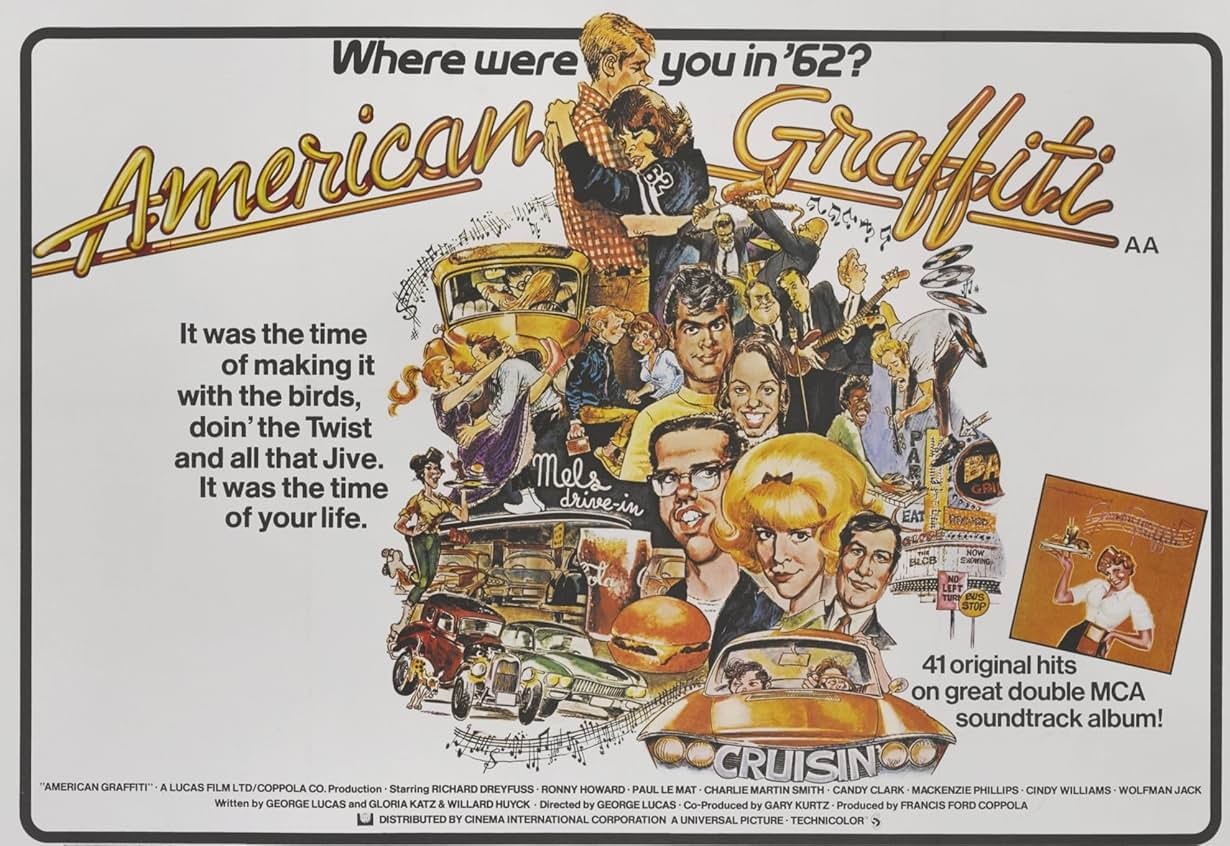
Today’s Reel Classic begins with the question “Where were you in ’62?” I know some of you reading this weren’t even born yet. Some of you may have been toddling about the house or yard chasing siblings or playmates. But there will be some who remember 1962 as part of their teenage years and will remember listening to the music from the local radio station on the car radio or on their transistor radio. American Graffiti addresses one evening in the lives of friends recently graduated from high school and about to step into the next phase of their lives.
The setting is a summer evening in 1962 in Modesto, California. Curt Henderson (Richard Dreyfuss) and his friend Steve Bolander (Ron Howard) are flying out the next day to attend college in the East so this is the last night of their summer vacation. They plan to meet up at Mel’s Diner with friends John Milner (Paul Le Mat), a drag racer, and Terry “Toad” Fields (Charles Martin Smith) who is awkward and not very popular. Steve has been dating Curt’s sister Laurie (Cindy Williams) and she is saddened by his impending departure. Steve suggests it may be best to see other people but Laurie is hurt by this suggestion. The friends take off to go to the sock hop at the local high school.
On the way to the dance, Curt sees a lovely young blonde woman in a Ford Thunderbird who, seeing him, mouths the words “I love you.” Curt’s mission for the rest of the night is to find and connect with this lovely woman (Suzanne Somers). He gets roped into hanging with a gang of “greasers” who steal money from a local arcade and get involved with the local police. Curt manages to get away from the gang and goes to the local radio station to ask the disc jockey “Wolfman Jack” to read a message to the unknown blonde on the air, asking her to contact him at Mel’s Diner.
Meanwhile, “Toad” has been given the honor of caring for Steve’s car while Steve is away at college. This is a big deal to him as he does not have a car but rides a Vespa scooter. “Toad” decides to cruise the strip and picks up a young girl named Debbie (Candy Clark). Trying to impress her he tells her that his friends call him “Terry the Tiger” and that the car is his. He also manages to get some alcohol with no ID and drinks with her in his efforts to impress her. His ventures lead to a night of a stolen vehicle, a beating, and a blossoming relationship.
In the meantime John has gone out cruising himself and ends up picking up a young 12 year old, Carol (Mackenzie Phillips), who manipulates him into driving her around all night. He tries to explain her presence to friends that she is his cousin and he is babysitting. He later ends up in a drag race with a competitor and learns that the competitor, Bob (Harrison Ford), is accompanied by Laurie who has picked her up after she and Steve argued. She is upset over Steve’s leaving her.
All of this and more occur during the course of one summer’s evening and, as is usual, the sun eventually begins to appear in the sky and a new day is about to begin. Did John get away from the manipulating 12 year old Carol? Did “Toad” find romance? Did Curt find his mysterious blonde? Did Steve and Laurie reconcile? As usual, no spoilers.
George Lucas was both director and writer for American Graffiti. The story was based on his own experiences growing up in Modesto, California and participating in cruising the streets and attending the high school dances, or sock hops as they were called. He stated, “Cruising was gone, and I felt compelled to document the whole experience and what my generation used as a way of meeting girls.” He also wanted to include “Wolfman Jack,” as listening to the popular disc jockey on the radio was a big part of life in those times. Lucas said that the characters of Curt, John, and “Toad” were based on different stages of his own life as a young man. Curt was based on his life during the years he attended college while John was based on his teenage years of street racing and his fascination with hot rods. “Toad” was Lucas as a freshman in high school—a bit of a nerd and awkward at dating.

American Graffiti took a page from the playbook Of Easy Rider (1969) with regard to the soundtrack. Rather than having music composed for the film, Lucas chose popular songs from that era and wrote the scenes to fit with the music. He picked many from his own personal record collection. The soundtrack has 41 songs and at first the studios were not interested in paying out all the licensing fees involved. But eventually they struck a deal for a flat rate with the identified recording companies. One company, RCA, refused the deal and that is why there is no Elvis Presley on the soundtrack.
After negotiating with multiple film studios an agreement was reached with Universal Pictures but it was a low budget of $600,000. The studio added another $75,000 to the budget after Francis Ford Coppola signed on as producer. The studio saw that as an opportunity to market the film with the phrase “From the man who gave you The Godfather.” Filming was completed in four weeks. Interestingly, and to the surprise of the studio, American Graffiti earned more than $55 million at the box office.
Though many of the cast members were new to the big screen at the time, we will recognize many familiar faces. Almost everyone would recognize Ron Howard from his days as Opie on The Andy Griffith Show.” Suzanne Somers would become famous in Three’s Company, Cindy Williams in Laverne & Shirley, Mackenzie Phillips in One Day at a Time, Harrison Ford in Star Wars, and Richard Dreyfuss in multiple films including Jaws and Close Encounters of the Third Kind. “Wolfman Jack” appeared as himself at the insistence of George Lucas, who had such fond memories of listening to him on the radio while in high school.

Not only was the film a success at the box office, but critics loved it as well. Roger Ebert was glowing in his praise, giving the film a four of four star rating and describing it as “...not only a great movie, but a brilliant work of historical fiction; no sociological treatise could duplicate the movie’s success in remembering exactly how it was to be alive at that cultural instant.” Gene Siskel described it as “well-made...and does provide a sock (hop) full of memories.” The critic for Variety wrote that American Graffiti was a “recall of teenage attitudes and morals, told with outstanding empathy and compassion through an exceptionally talented cast of unknown actors.” The critic for Time magazine wrote that the film “reveals a new and welcome depth of feeling. Few films have shown quite so well the eagerness, the sadness, the ambitions and small defeats of a generation of young Americans.”
The Critics consensus at Rotten Tomatoes states: “One of the most influential of all teen films, American Graffiti is a funny, nostalgic, and bittersweet look at a group of recent high school grads’ last days of innocence.”
American Graffiti was nominated for five Oscars, including Best Picture, Best Director, Best Story and Screenplay and Best Supporting Actress (Candy Clark).
Many folks think that the popular TV show Happy Days came about as a result of American Graffiti. To some degree that is true but maybe not in the way you might imagine. Ron Howard appeared as Richie Cunningham in a pilot for the series in 1972. The pilot was not picked up by the networks and instead the episode appeared as part of the ABC series Love, American Style. George Lucas picked Ron Howard to play the role of Steve in his movie after watching that episode. The success of the film spurred ABC to agree to air the TV series. The film also led to the addition of a “greaser” character to the cast of Happy Days. The series debuted in 1974 and Richie and Fonzie continue to entertain folks today.

In 1979 a sequel was made called More American Graffiti. It reunited much of the original cast and focused on their lives from 1964–67. The original film, set in 1962, was set prior to the Cuban Missile Crisis, the assassination of President Kennedy, and the Vietnam War. The sequel reflected the turmoil of the times. It was a failure at the box office.
Mel’s Drive-in was a real drive-in located in San Francisco (and reportedly a favorite of George Lucas). Though the film was set in Modesto, several northern California locations were used, with Petaluma leading the list. Sadly, Mel’s Drive-in was torn down after the movie was completed. The owner’s son later re-opened a chain of restaurants in Los Angeles and San Francisco and George Lucas continued to dine occasionally at one of the San Francisco locations.
In 1995 American Graffiti was selected by the Library of Congress for preservation in the National Film Registry.
The Internet Movie Database (IMDb) rates American Graffiti at 7.4 of 10. Rotten Tomatoes gives it a Critics Score of 95% and an Audience Score of 84%.
In searching my Roku device, I found the film streaming for free on the sites Freebie TV and Cineplex. Though it is not free, I know many people have Netflix and it is also available there. I also found that the Clark County Public Library has a copy of the DVD on the shelf that also has the sequel More American Graffiti.
Never miss a thing with our FREE weekly newsletter.
So, I go back to the question at the beginning—”Where were you in ’62?” I’ll tell you where I was.
I was a teenager in Baltimore, a sophomore in high school and a big fan of my transistor radio and the wonderful music coming out of it then. Now in 2025 I am no longer in Baltimore and no longer a teenager, but I still have a love of the music (though it no longer comes from a transistor radio, but from a Bluetooth speaker instead).
Information for this Reel Classic review was gathered from Internet Movie Data Base (IMDb), Rotten Tomatoes, Turner Classic Movies (TCM) and Wikipedia.
Let me remind you that if you enjoy these classic movies please join me on the second Tuesday of each month at 6 PM at the Clark County Public Library for “Ron Kibbey’s Comedy Classics.” I present a classic comedy film usually accompanied by a vintage cartoon. Popcorn and drinks are provided. More information about the next film is available on the library’s website and Facebook page, as well as WinCity Voices Facebook page.
