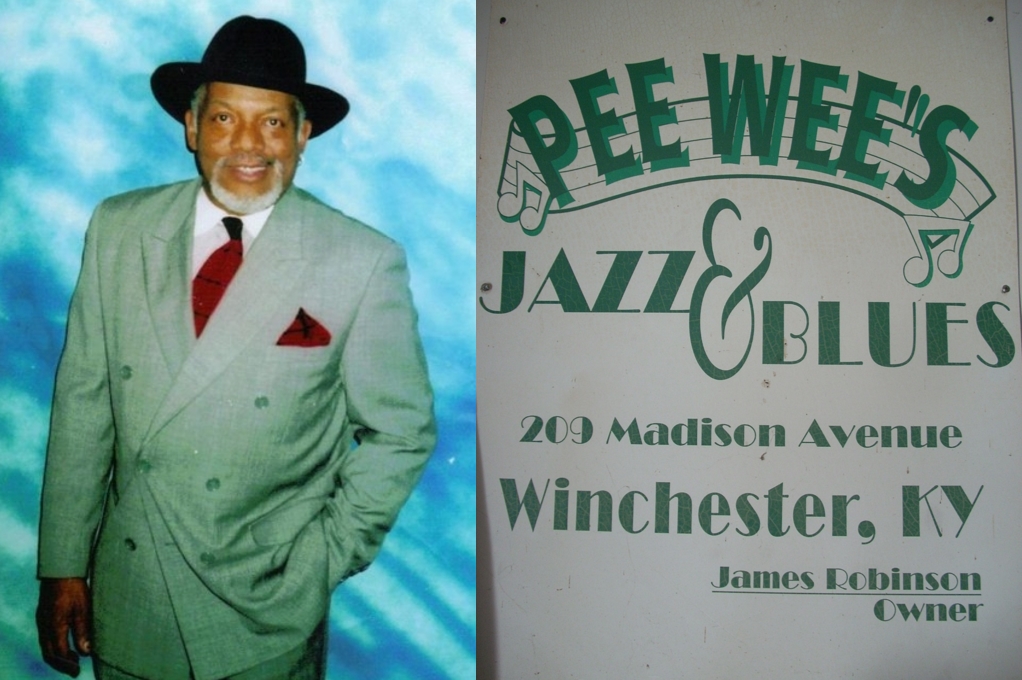
PeeWee’s Jazz and Blues
In 1995, James F. Robinson, known to all as “PeeWee,” purchased a building at the corner of Madison Avenue and Third Street for a night club. He worked on the building for a year to get it in shape, performing much of the labor himself. Nicholasville artist Damian Blanton decorated the interior with music-themed murals. Finally, PeeWee had to jump through regulatory hoops to procure a zone change and beer license.
PeeWee’s Jazz and Blues featured some of the best African American musicians in the region. Well-known performers like George Gentry, R. C. Smith, Mike Allen Trio, Sweet Rock Band, Greg Figgs Jazz Band, and many more performed at the club. One of the best, Tee Dee Young, also played at PeeWee’s. Tee Dee, blues guitar legend and Kentucky Music Hall of Fame artist, still plays in Lexington.
On nights with no band booked, deejays, Russell Gipson or Walter Lee Hampton played recorded music. In addition to the main bartender, Larry Skinner, the club employed several waitresses. During the day, PeeWee’s daughter Tasha kept a beauty salon in a small room at the back of the building.

PeeWee’s place became an important part of the Labor Day celebrations and reunions, with the day’s festivities ending in a dance at the club. PeeWee’s also hosted Prom Night, a parent-chaperoned, all-night party at the club following the school prom.
PeeWee Robinson kept the club going until around 2013 when he retired. The building now houses a Pentecostal church.
Appaloosa Night Club
In 1987 Orville Shouse Jr. opened the Appaloosa Night Club at 43 North Maple Street, where the famous Blue Grass Restaurant (site of the giant bull) had operated in the 1960s and 70s. (In 1967, the restaurant advertised its steak dinners for $1.55; hamburgers were 35 cents.)
One of Shouse’s innovations was Teen Night. In trying to provide Sunday evening entertainment for teenagers when the club was closed, Shouse ran afoul of some of the city fathers. They claimed the club was grooming future drinkers. Then someone dug up an old ordinance that prohibited dancing on Sundays, and that ended Teen Night soon after it began, in spite of protests by local teens.
While it bore the appellation, Appaloosa did not function as a night club, according to my definition. They served food and alcohol, but I could not find any mention of live music. By the late 1980s, the club had become a rowdy place regularly mentioned in police reports. By 1991, it had closed.
Old Silo
Lewis B. Flynn opened the Old Silo at the corner of Sycamore and Cherry in 1949 near an old silo. By the following year, it was just “The Silo.” The entertainment destination, styled as Flynn’s City Heights, offered a driving range, fishing lake, restaurant, and dance venue. They served “steak and chicken dinners and beer with atmosphere.” Several nights a week, The Silo held dances with live music by the Blue Grass Rhythmaires, Bob Eckler and the Mel-O-Tones, Tag Vail Trio, and others.
In 1954, Tony Noe took over management of the club from Ernest and Bettie Wright. In 1962 the club reopened as Pat’s Silo Club under the new manager, Pat Manis. While still hosting live music events, the club saw frequent disturbances involving law enforcement. The most serious of these came in 1972, starting in February when three men were wounded in a shootout. In April, Bill Manis, Pat’s husband, shot a former Winchester deputy sheriff. In September, a patron was shot to death in the club. That December, the club was gutted by a fire and never reopened.
Never miss a thing with our FREE weekly newsletter.
Dixie Inn
Hubbard Spencer’s Dixie Inn at the northeast corner of Wainscott Avenue and Dixie Street began as a café serving sandwiches, ice cream, beer, and soft drinks. In 1936, citing a long illness, Spencer put the business up for rent. When it reopened that November under Russell Wright and Wilmer Griggs, it functioned, for a time, as a night club. The restaurant and bar, open daily from 6 AM till midnight, advertised “dancing every night.”

In 1937 Dixie Inn offered live music and dancing only one or two nights a week. Their first advertisements mentioned a five-piece band or six-piece orchestra. That soon gave way to announcements for groups like Claude Hanners and his Rhythm Ramblers, Kentucky Woodchoppers, Prairie Vagabonds, and Scott’s Night Hawks.
Starting in 1945, Dixie Inn focused on food service, no longer featuring live music. In the 1960s they focused more on the bar business. That decade saw many incidents of public intoxication and brawls at the inn. They managed to stay in business until 1983, when the Dixie became the site of an undercover operation by the Kentucky State Police. Twenty-three individuals were eventually convicted of crimes for selling controlled substances and unlawful trafficking in food stamps. Those arrested had used food stamps to buy or sell drugs, appliances, handguns and rifles.
Thanks to James “PeeWee” Robinson for information on the Jazz & Blues club.