
Editor’s note: This story initially ran three years ago, in April 2022. Some of the information may be dated, but as we focus on downtown businesses this year, we thought it might be useful to revisit this one.
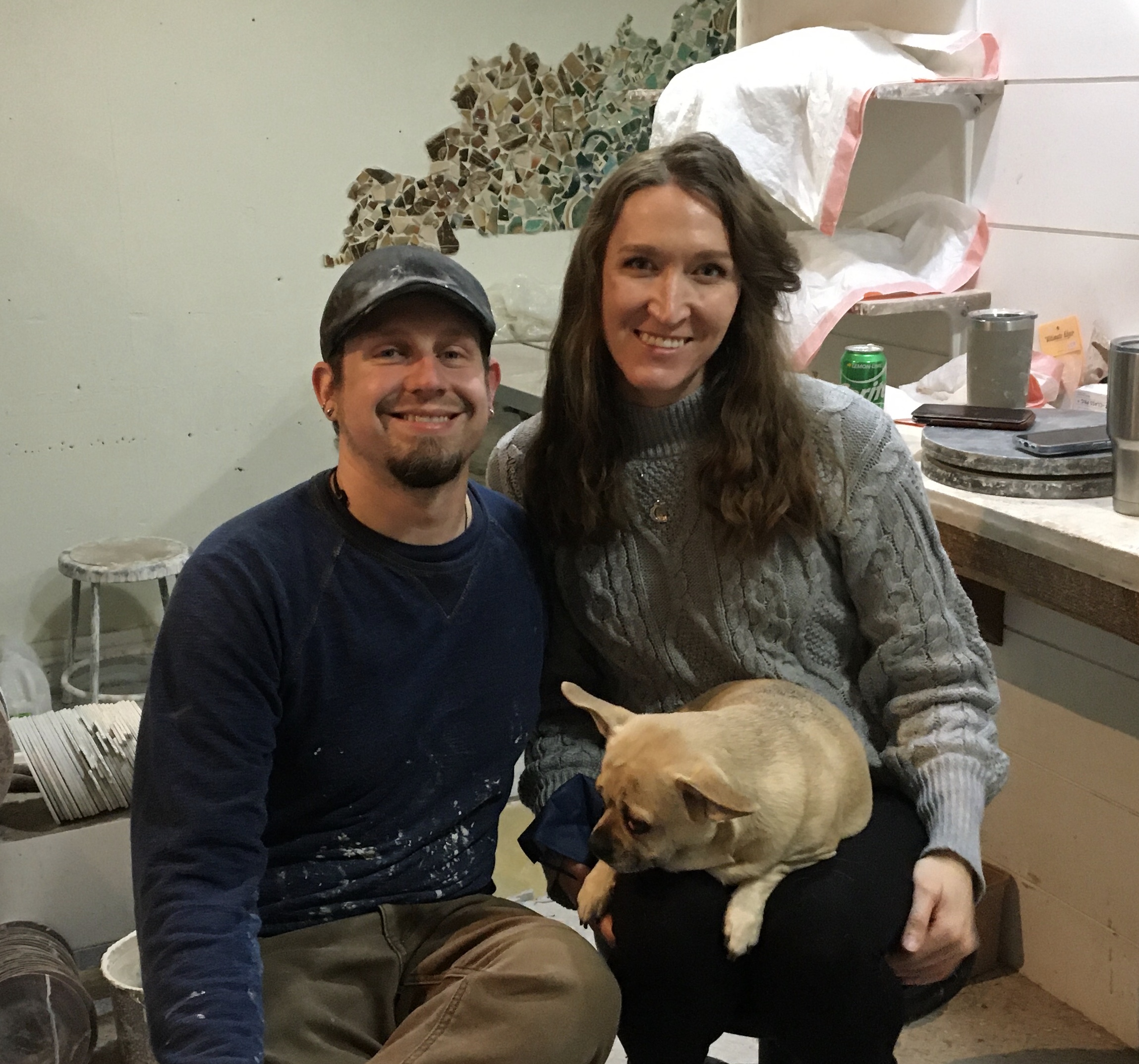
On February 24th, Chuck Witt interviewed Ashley and Carvel Norman, owners of Dirty South Pottery, located at 38 North Main Street in downtown Winchester. On entering the storefront, one notices the unusual aroma of clay and the shelves clustered with the finished products of mugs, plates, platters, and bowls, all illustrative of the artwork of pottery. The two young entrepreneurs were waiting, along with their small tan dog and Carvel’s cap liberally covered with light clay dust.
CW: Hi. Good to see you both again. It’s been a while.

A&C: Hi. Welcome.
CW: (After settling in and getting the recorder going) Well, let’s get right to it. Ashley, I understand that you are a Winchester native.
A: Yes, born and raised here. My parents are Wayne and Karen Combs.
CW: But you, Carvel, are not originally from Winchester?
C: Right. I’m from Glasgow originally.
CW: And you two met how?
C: At college. I graduated from Brescia and then transferred to EKU, which is where we met.
CW: And you were both majoring in what?
C: I was majoring in ceramics.
A: I received my BFA in photography.
CW: Do you still do much photography?
A: Not so much. I take digitals of our work and photos that we put on the website.
CW: So, how did you come by this property?
A: I was at the Beer Cheese Festival in 2014 and noticed this building and there were signs in the front window advertising that it would be auctioned shortly. We were doing pottery out of a home a couple of blocks away and I just couldn’t get the building out of my mind so I went to the auction and got the winning bid.
CW: Do you enjoy living downtown or would you rather be in the suburbs? (their home is above the studio).
C: Every place has its ups and downs. There’s a lot we enjoy about being downtown, especially the walkability, having a restaurant so close, being able to walk over to the hardware store if I need something. It’s nice not having to get into the car and be running out somewhere.
A: I love the buildings here.
CW: Well, it doesn’t sound like the suburbs are much a draw to you.
A: I think if we had kids that would change.
CW: You got an award for all the work you did on the building. What year was that and what was that award?
A&C: 2016. It was the Historic Preservation Award.

CW: I guess it was a work in progress at that point?
A: It still is. We still make changes in the store area and, of course, a home is always undergoing change.
CW: Did you have many difficulties in trying to set up the store and your home? Codes issues?
C: Not so much. Signage was probably the biggest issue but nothing major. We had heard such horror stories about dealing with code enforcement. Somebody said ‘no’ was their favorite word. But I went in with several binders and made my case and the entire meeting was a case of them asking what resources we needed, how could they help. It was fantastic.
We did have some issues but they were mostly related to foundation work.
C: Dealing with code issues related to kilns was something new for code enforcement. We know that our kilns are much safer than most residential stoves, just because of the way they’re built and register heat.
CW: You’re not conducting classes now. Do you expect those to start again?
C: We made the decision to stop doing classes in December of 2019. I hurt my back pretty bad in October of that year and we decided that we needed to make a change from the sit-down wheels to stand-up type and had to re-evaluate the studio layout. Plus we were spending a lot of time preparing for the classes and then cleaning up afterward and it was taking too much time. We had our last class in February of 2020.
A: People probably think we stopped the classes because of COVID, but we had already made that decision and we won’t be doing classes in the future.
CW: North Main Street seems to be becoming an “arts center.” Is that a good thing?
A: Having an arts district is a wonderful thing and wonderful for a community. A lot of communities have benefitted from having a strong arts area. Paducah comes to mind. I’d like to see something like that for Winchester, but it’s harder because of the cost of establishing a business is higher than it was when we started.
CW: Do you do a lot of your sales online?
C: A good deal. And it depends on the time of the year but on a yearly basis, we do more business in-store.
A: On average, our online sales are about 30%. And a lot of people will buy online and pick up at the store.
CW: What do you think distinguishes your type of pottery?
C: I want to feel good about what I put out. I put a lot of focus on materials, the way we fire, the glazes we use. We make sure we use the safest materials and processes and that gives me more confidence in the product we sell. If I don’t believe in a product, I don’t sell it. We don’t make products that we don’t use ourselves.
We duplicate what we enjoy and what we use the most because we know it’s functional and comfortable.
CW: Are you familiar with Raku? I used to see that at the Berea Arts Fair and was always impressed with the uniqueness of it.
C: Very much so. Ironically Raku was virtually all of my senior thesis work. I taught a lesson on the process. We don’t have the facilities to do it here because of the special firing technique required.

CW: Would you classify your pottery as more utilitarian than decorative?
C: It was stressed to me that “form follows function.” We focus on the utilitarian portion of it first, but once those questions are answered we then ask what is going to set this apart.
CW: When we were setting this interview up you mentioned that you had done interviews with other sources. What were some of those?
A&C: We’ve done a couple with the Winchester Sun. We did an article for the magazine that the Sun published for a while, been on the radio with Tim Smith several times, WLEX.
Never miss a thing with our FREE weekly newsletter.
CW: As downtown business owners, what would you like to see happen to make the area grow?
A: I’d like to see more innovative ideas about the community and how we run our community. I’d like to see trees and crosswalks and more public artwork.
CW: Well, that’s all the questions I had. Thanks for taking the time to answer. It was good to be with you again and I wish you much success here.
A&C: Thanks. Good to be with you.
