
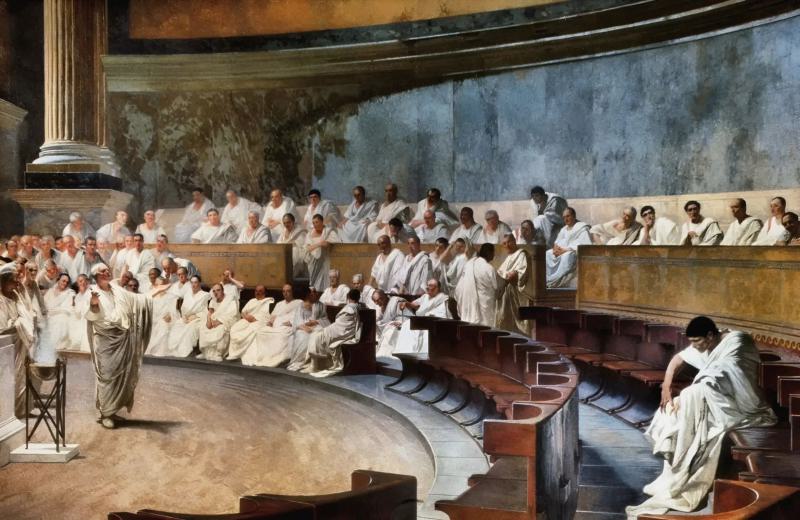
While reading a book titled The Twelve Caesars recently, it became apparent that the Roman Senate exercised great influence over the affairs of the Roman Empire and over how its members were placed in office, kept there, or removed from office.
The many characters enumerated and described in the book illustrate a unique consistency among Romans, that of their names, most of which end in us or ius or ious.
Thus began a diligent and thorough search of the archives of the Roman Senate to identify some of the key players at the height of the Roman Empire, and possibly how they fared as members of that Senate or afterward.
As one might expect, the names of many of these Senators have fostered words which have come down to us through the English language and which characterize, to some extent, the actions and activities associated with those Senators and of those who followed.
Herein are listed some of the most notable characters of that era, the very beginning of the first millennium CE. Though many of the individuals listed here did not provide useful information during their lifetimes, we must rely on the observations of ancient historians, many of whom may not have had intimate contact with those they memorialized, either favorably or unfavorably.
Hector Fractious Vexatious was a senior member of the Senate and bore his given name, bestowed by a family that idolized Greek culture. He was fussy and troublesome, constantly proposing schemes which would produce no useful outcome or glory for the Senate. He died by accident, having choked to death on a pomegranate as he tried to orate and eat at the same time.
Inept Specious Languorous came from a middle-class family and was elevated to his position in the Senate by those who were close to Claudius at the time. However, he was without special skills in dealing with people and preferred listening to talking, and so was deemed sluggish and uninterested. He was stoned to death by an angry crowd when he loudly insulted a gathering, referring to them as stupid, dirty Gauls. Unfortunately for him at the time, the crowd was mostly made up of Gauls who took unkindly to his remarks.
Three brothers were serving the Senate at the same time during a brief period: Satyr Lascivious, Concupiscent Licentious, and Priapic Salacious. All three were fathered by the same woman with three husbands, two of whom mysteriously died. All three were also more interested in the trappings of high office and of the lustful and lusty nighttime frolics so easily available to someone with money. Their most important piece of law to be considered by the Senate during their tenure was a proposal to expand the area of Rome dedicated to brothels. However, most other Senators had stock in various brothels already in business and so were disinclined to expand an enterprise that would compete with their own interests. The three survived their terms in the Senate, but all succumbed to various venereal diseases.
Pompous Ignominious Contumacious considered himself better than most of his colleagues and refused to abide by long-established rules of the Senate governing conduct and behavior. Being disobedient to those who were of higher stature than he, he was censured by the body and spent his remaining days ignored and diminished and assigned a seat where he could be little seen or heard. He eventually decided to simply retain his seat, but never show up for forums, and was not missed. There is no record of what happened to him afterward.
Vulgar Obsequious Gregarious undoubtedly had some innate talent at governance but frittered it away with undue flattery and obeisance to other members of the Senate, who eventually came to resent such overtures. He, too, came to be reduced in importance and received a seat next to Contumacious, but never took note of the latter’s absences either. Upon retiring from the Senate, he became a promoter at the Coliseum, betting on outcomes. He accidentally fell into the arena when lightly armed prisoners of war were harrying bulls and was seriously gored, but survived with a noticeable limp. His former colleagues commented that a goring was appropriate for the years they had to endure him.
Laconic Capricious Animus, like Vexatious before him, also received his given name from Greek-loving parents and, also like Vexatious, proved that he could not work cooperatively with his fellow Senators. Having never produced any proposals worthy of consideration, he was removed from office after only one year. He sequestered himself in Capua for a life of leisure and reading of Greek poetry.
Fetid Detritus was sent to the Senate to represent one of the poorer sections of Rome during the reign of Caligula. He gloried in the excesses of that Caesar and, like Caligula, met his end at the wrong end of a Roman sword, though thankfully not in the Senate chamber, which would have been unseemly, even though many members of that august body had conspired to his demise. He was noted for the voluminous farts he expelled during important debates. As he lay dying, he exuded one last gaseous riposte as a salute to his fellow Senators.
Banal Rapacious Diaphanous, who served while Julius Caesar held the throne, had been appointed by that great personage himself, but, like so many men who attained their seats in the Senate simply through familiarity with persons of high rank, he showed himself to be incapable of attending well to the business of the people. He was easily bribed, but squandered his ill-gotten gains on women, wine, and gambling. On the death of Julius, Diaphanous yielded his seat and became a used chariot salesman, though not a very good one, as most people could see right through his sales pitches. He died in poverty in Brundisium at the age of 51...or 52...or 53. No one knows for sure.
Arrogant Pallid Amorphous, a Gaul, was a man of boundless energy, but was unable to focus that energy into meaningful enterprises or works which would benefit the populace. The most fantastic idea he proposed was to enlarge the Circus Maximus (even after it had been renovated) to allow the chariot races to extend into the seating areas of the arena, rather than be limited to the circuitous track below. Of course, such a change would have endangered huge numbers of people assembled to watch the races, many of whom were his fellow Senators. Such foolish notions quickly earned him approbation from his fellows, and he was summarily removed from the Senate by petition to the Emperor. He died in a fall from a chariot...during a race...in the Circus Maximus.
Acerbic Oenophile Unctuous proved to be too smug in his own importance, ignoring the entreaties of other Senators to involve himself in the workings of the body. He died by accident in a fall from the highest point of the Flavian Amphitheater (though some historians suggest he was lured to the locale by a hired woman of some lackluster reputation, Callow Beauteous, who “helped” him over the side). Some Senators suggested that his smugness had convinced him that he could fly. Obviously, at least on that day, he could not.
Fastian Vinous was a registered Bacchanalian and, as such, cared for little more than savoring the many varieties of wine that were available in Rome due to the widening trade with Spain, Egypt, and Judaea. In a later life, Vinous would have made an excellent sommelier. As it was, he was little more than a perpetual drunkard and even, on occasion, brought large quantities to be imbibed during Senatorial sessions. Most other Senators felt that more was accomplished while he was in a drunken stupor than when he was aware of events. His exuberant consumption of wine proved his downfall in more ways than one as he died from a fall down the steps to the Senate while obviously drunk.
Dyspeptic Taciturn Moribund Uncongruous seemed to be constantly on the verge of self-immolation. His morose demeanor was perpetually inhibiting the work of the Senate, even when great games and celebrations were announced. During the games in the coliseum, when Christians were being devoured by wild beasts, Uncongruous lamented on the quality of the meat being served to the poor animals. He died quietly in his seat at the Senate during a session, but his death was not noticed for at least four days until the eau de morte alerted those nearby that he was not just wallowing in his own grief by being silent.
Lacrymal Pianissimo Euphonious, whose term was under Emperor Claudius, was a noted and able speaker, his speeches often tinged with humor, incitement, excitement, and even song. He is reputed to have had a melodious voice that could penetrate the vast hall of the Senate as no other. Many times his speeches so moved the body that many were seen wiping tears from their eyes with the hems of their togas. Euphonious himself was not one to hold back the tears if it suited his perorations. He died at the end of one of his lengthy speeches before the Senate and sank unceremoniously to the tiled floor. It was said that his fellow Senators wept so profusely over his lifeless body that the floor of the Senate became slippery from the tears. However, others have claimed that the tears were the result of uncontrollable laughter by a less-than-doting crowd.
Nabob Dysphasia Parsimonious was the only member of the Senate who was a naturalized Roman citizen from Egypt. Noted for his immense wealth (which bought his way into the Senate) and for his concurrent frugality and stinginess, he was able to pull the strings of many of his cohorts, even going so far as to negotiate the prices of their obeisance to his requirements, most of which were to provide some largesse to Cleopatra. He secretly loved Cleopatra and hoped to share her bed — and kingdom — but eventually realized that he had no chance against the likes of Julius Caesar and Mark Anthony. Upon Cleopatra’s death and the announcement that she had taken her own life by an asp, Parsimonious, who was somewhat hard of hearing, thought she had been killed by an ass. In his extreme grief, and wishing to end his life as she did, he allowed himself to be kicked to death by an ass. More than one of his fellow Senators is alleged to have commented that it was a case of “one ass being done in by another one.”
Flippant Meticulist Polemic Loquacious was undoubtedly one of the greatest speakers of the Senate for over a hundred years, even surpassing the reputation of Euphonious, though without song. His most famous speech was a lengthy harangue calling for the censure of Caligula for his many excesses. Unfortunately for Loquacious, Caligula was not one to countenance such tirades against his royal person and had Loquacious killed by stuffing his mouth with soil taken from the floor of the Senate and allowing him to suffocate. The remainder of the Senate body duly noted the method of his demise.
Hubris Pompous Vainglorious had once been the head of Julius Caesar’s legions and had distinguished himself as a fearless leader on several frontiers of the empire, notably Gaul and Britannia. When given a Senate seat in honor of his military prowess, he continued to consider himself a leader and imposed himself on the Senate and on many of its members with far more seniority than his own. After a year of being essentially ignored by his fellow Senators, he resigned and returned to lead a legion in Western Spain where he was killed by the Praetorian Guard on orders from Tiberius, who saw Vainglorious as a possible usurper of the throne.
Obdurate Truculent Obstreperous, elected to the Senate in 61 CE, proved to be so combative of anyone and anything that a violent end was inevitable. After insulting virtually every individual member of the Senate, the Emperor, the Emperor’s wife and children and mother, he was evicted from the Senate on a trumped-up charge of seducing the Emperor’s wife (it was the other way round) and then publicly announcing that she wasn’t worth the effort. He was sentenced to die in the arena where he proved that he was not the least bit proficient with a sword. The Emperor’s wife was heard to remark that his lack of skill with the sword matched that of his deeds in the bedroom.
Never miss a thing with our FREE weekly newsletter.
Venal Iniquitous Perfidious was, by nearly all accounts, so completely evil that his deeds surpassed even those of Caligula and Nero (who were only the most noted of the many Caesars with less than sterling qualities). He was among those who wielded daggers against Julius on the Ides of March. By June, he had become the largest owner of baths in Rome, where he continued his abhorrent behavior by manipulating the water temperatures to be either scalding hot or freezing cold, as his daily temperament dictated. Needless to say, these cruel jests quickly curtailed his business as patrons would refuse to expose themselves more than once. He mysteriously drowned in one of his own bath houses in a mere three feet of water. When found, his body was ruby-red as the water temperature was near boiling.
And so it has come to pass that many of the names of these popular and unpopular, known and not-so-well-known leaders of the ancient Roman world have passed down to modern usage through nearly two thousand years, names that have assumed definitions related to the characters who possessed them in that time long ago.
And oddly enough, if one looks at the members of today’s United States Congress, one is likely to find it populated by men and women who exhibit many — if not most — of the same characteristics as those described above.
The more things change, the more they stay the same.
