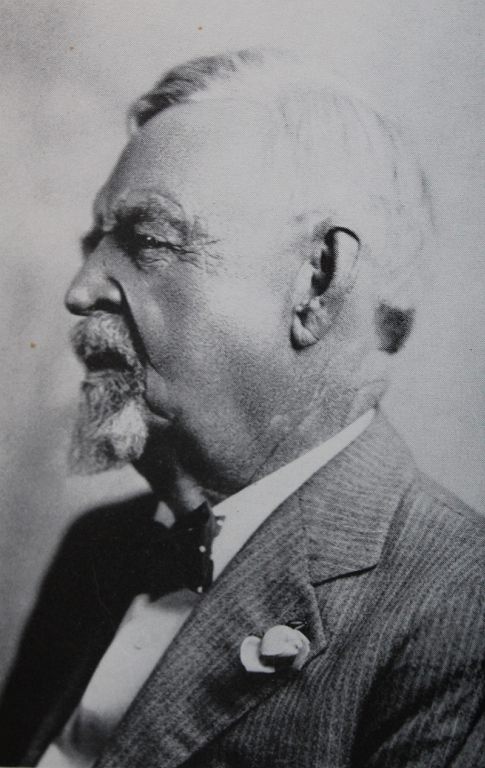
In 1950, while he was editor of the Winchester Sun, William C. Caywood Jr. published a book entitled Kentucky Mayor. His subject was John Garner, Winchester’s second and most famous mayor. Caywood focused on Garner’s humor and philosophy.
Winchester’s favorite son, John Edwin Garner (1851−1941), was a son of William and Rachel Foster Garner, one of thirteen children. As a youth, he lost sight in his right eye after being struck by a hurled stone, but it never proved a handicap and remained unknown to many of his colleagues. Garner married Mary Elizabeth Gordon, and they resided at the corner of Maple Street and Lexington Avenue (now the site of CVS Pharmacy).
At age twenty-one, Garner became the co-publisher of the Clark County Democrat. Caywood writes, “That experience provided an outlet for his writing talents, while the demands upon his time for speaking programs a few years later opened the floodgates for his oratorical supremacy.”
Much of his writing and speeches were humorous, and the subjects he touched on were vast. He became a renowned banquet speaker throughout the nation. Caywood quotes from dozens of Garner’s speeches and articles. I can only include a few here.
Speaking to a group about the state’s need to improve education, he said, “The people of Kentucky educate their cattle and turn their boys out on grass. We pay two dollars a day to train our horses and four cents a day to educate our children.”
In another speech, he said that people who recognize the excellence of living in Clark County reminded him “of the man who became dissatisfied with his home in the country and put it in the hands of a real estate agent to sell. When he read the agent’s description of the farm, he said, ‘That’s the very kind of a farm I have been looking for all my life,’ and he took it off the market.”
Never miss a thing with our FREE weekly newsletter.
In several instances, his humor extended to letters he wrote that were quoted for years afterward. In 1909, a disastrous fire destroyed the 50-room Court View Hotel. Three years before the fire, Garner & Fitch insurance agency had transferred the hotel account to Poynter’s Big Four agency. After the fire, the insurance home office wanted to know why Garner & Fitch transferred a very bad risk to another company. Garner was called upon to respond.
My dear Sir,
Mr. J. W. Poynter this morning handed us a letter in which you in substance ask why Garner & Fitch did not write the Court View Hotel risk themselves instead of placing it with you, and why, when we controlled the hotel interests, none of our companies were on the loss.
We could more nearly answer your question if we know what purpose you wanted to serve; whether you wanted to find out how we did business, or how you did. You will pardon us for suggesting that your agent was the proper source of information, and the question to him should have been “Why did you accept it?” and not of us, “Why did you offer it?” It may have been that we made a mistake in shifting business from our companies to yours. Assuming that to be true, our accountability is to them and not to you.
It may have been that your agent was new in the business and an orphan, and we wanted to do him a kindness to encourage him. We may have been misled into believing that your agent had done business within the block of the burned building for sixty years. It may have been that we were under the impression that if you concluded the risk was not desirable, you would enter complaint on receipt of the premium, and not wait until after notice of the loss.
The veiled intimation in your inquiry is that we knew three years ago that this building would burn at this time, and that we unloaded on your company and stood from under. Let me assure you on the honor of a gentleman that we did not. We never claimed to be able to tell more than sixty days ahead what buildings would burn, and had not dared to exercise this power for fear of destroying the insurance business. Were we to notify the companies of those that will burn, common fairness would demand that we tell the people of those that would not burn. If the companies would not insure those that would burn, and the owners would not insure those that would not burn, the insurance business would stop.
Trusting that this explanation will be satisfactory, we remain
Respectfully, John E. Garner
In 1924, Garner received two letters from the freight agent of the Pennsylvania Railroad demanding payment for a shipment by Garner’s lumber company.
Dear Sir,
In your letters you state that in 1917 Winchester Lumber and Manufacturing Company consigned P.R.R. Car No. 510,742 to Gassinger Bros., Baltimore, Md.; that by some mistake it was shunted to some other road and delivered at some point other than that designated in the bill of lading; and when finally returned to the proper destination you failed to collect $116.18 freight due from Gassinger Bros. You are further informed that the Winchester Lumber and Manufacturing Company has dissolved and been out of business for six or seven years, and that unless I, who was president of the company, remit the $116.18 it will be turned over to the legal department for adjustment.
My reasoning for not answering your two previous letters was that I attributed your writing them to some phase of the moon which seems to affect certain individuals peculiarly. Possibly they were the result of a long forgotten blow on the head. Inasmuch as you are so convenient to Johns Hopkins Hospital I feel that it is due to the people you have probably annoyed heretofore, those you are annoying now, and those you may annoy in the future to go over there and have your skull examined.
If I were so astute a reasoner as you seem to be, I would have concluded that to have sent this car to a point other than that designated in the bill of lading was negligence; to have failed to collect the freight due on delivery was carelessness; and to expect me to pay the freight is damn foolishness.
In the event the head of the legal department of your road considers the claim seriously, have him come down. Our federal judge is a fine fellow with a good funny bone, and he would doubtless enjoy a comic opera in his court.
Trusting that a minor operation or the running of time will restore you to normalcy, I remain
Sympathetically yours, John E. Garner
Twenty years later, President Franklin D. Roosevelt asked an aide to bring him a copy of the famous letter.
I count Kentucky Mayor a good read — it’s in the library.