
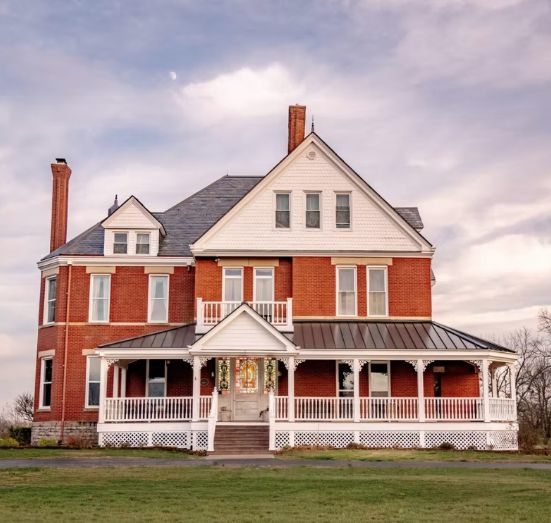

On May 26, the Bluegrass Heritage Museum held its summer trolley tour at historic Rotherwood, Asa Sphar’s home about three miles north of Winchester. Our hosts, Aaron and Holly Kuster, are the current owners of Rotherwood. After a box supper in their event barn and a talk about the old home by Gary Witt, we were given a guided tour of the house by Mrs. Kuster. All can attest that the home has been beautifully furnished and lovingly restored, a process that continues today.
A Swiss immigrant family, the Sphars, settled in Clark County in 1779. Three brothers came to Strode’s Station: Jacob, Mathias and Theodorus. Two were killed by Indians — Jacob at Strode’s Station in 1781 and Mathias on Grassy Lick Creek in 1784 — after which Theodorus returned to Virginia. Mathias’ son Daniel settled north of Winchester on land he inherited from his father. He built his home near the old Hood’s Road on the east side of Woodruff Creek, about a half mile east of today’s Paris Road (Route 627).
Daniel’s son, William Rogers Sphar (1815−1885), married Elizabeth Gay and resided on his father’s homeplace, where he became a prosperous farmer. William and Elizabeth are buried in a family graveyard near their home.

Their son Asa Rogers Sphar (1861−1929) married Emily French and built the showplace home they called “Rotherwood.” In 1886, Asa purchased 41 acres fronting Paris Road and commenced construction of his manor house. An unknown builder put up the three-story Queen Anne-style brick mansion, completed in 1887. Bricks were fired in the yard.
Asa’s estate also included a smokehouse, two chicken houses, a buggy house, a horse barn, a milking barn and two pigeon houses that provided squabs for the table. He engaged in general farming, raising tobacco, cattle, sheep, hogs, horses, and mules. Asa also kept a stable of trotting horses that achieved some success on the local circuit; the best known were “The Wanderer” and “Maggie F.”
The extensive gardens had a grape arbor, gooseberry and currant bushes, an asparagus bed, a strawberry patch, a large kitchen garden, and numerous flower beds. From their orchards, they harvested a variety of apples, peaches, pears, plums, and cherries. A sugar maple grove provided sap for maple syrup.
Never miss a thing with our FREE weekly newsletter.
The Sphars entertained lavishly with frequent dinners for family and friends, a large July 4th picnic, an annual stag dinner in the fall, and a big Halloween Party. The family took in the waters at Olympia Springs (Bath County) for a few weeks in the summer. Winters were often spent in Florida or sometimes in rooms at the Brown-Proctor Hotel.
Asa passed away from cancer, and Emily’s death followed in 1951. Both are buried in Winchester Cemetery. Their daughter Margaret Sphar Reeves remained at Rotherwood, where she had lived for some years, looking after her parents. After Margaret’s death in 1977, her daughter Emily moved into the house, where she passed in 1983.
In 1988, Rotherwood passed out of the Sphar family for the first time in a bit over one hundred years. The buyer was Maurice “Washie” Miller, who owned Dear Lawn Farm (now part of Royal Oak Estates) on Paris Road.

I was curious where the name Rotherwood came from. According to an article in the Winchester Democrat, it was “named for the home of the Saxon King.” Family lore has it that Emily was an inveterate reader, and Sir Walter Scott was one of her favorites. In Scott’s novel Ivanhoe, the protagonist “Wilfred of Ivanhoe” is disinherited by his father, “Cedric the Saxon of Rotherwood,” for supporting the Norman King Richard the Lionheart and for falling in love with the Lady Rowena, a ward of Cedric and descendant of the Saxon Kings of England.
Thanks to Bobbi Newell for information cited in this article.