
“What did he say to you to get you to take this gig?” A tall man with dark skin questioned in a hushed voice that still rumbled with baritone.
“Who, Tony?” Godiya returned without looking up from her book.
“Yeah, what’s the pitch that sells a young nurse on a lifetime of seclusion dedicated to a single client?” Remy leaned back against the doorframe, hands folded atop his mop.
“I could find myself equally curious about what would sell MIT’s golden boy in the computer science department, a twenty-five-year-old certified philomath, on a lifetime of seclusion that included giving up finishing his degree, and all the lucrative career options, and the yachts, mansions, super-cars, and super-models it would come with for a career pushing a mop in a place that doesn’t exist.” Godiya glanced up, winking, lips pursed in a poorly mocked frown.
“They told me I’d get to see the real ones.” Remy fixed on the ceiling, eyes unfocused, lost in the memory of the intoxicant that led him there.
“The real ones?”
“The Gibsons. When Dr. Metzinger read my proposal for my master’s thesis, he took me aside. He said I would need better computers than the school had access to. He set me up a meeting with Barb. Barb told me that if I would be willing to let them manage the project, they’d guarantee me an advisory position and the equipment to complete the project.
“The Gibsons; AI with hardware sets the commercial market will never even see. Topographical q‑bit matrices, multi-dimensional probability arrays stored in quantum-lattice, crystalline data towers with the capacity to store not only the entire history of humankind and the Earth on which they lived but every potential history in our future. That was it for me. I had been dreaming of computers like that since I was a little boy, watching sci-fi on a tablet in my gramma’s trailer. I would, and did, give up everything to lay hands on a lady like that.”
“And then there was that thing with the mop,” Godiya grinned up at him.
“What happened?” She continued.
“As soon as they got my signature on that NDA of theirs, they told me that my project would have to be shelved because they, “did not currently have system resources adequate to manage that many data sets with that many interactions over that period of time.” Truth is, they just wanted this research out of public development before it got started. They said they had a position as a maintenance engineer that I could hold until the project was ready to come online, and that they would graciously continue my administrative pay and benefits; hence, I inherited this mop and no alternative employment options.”
“What was the project?”
“I developed some algorithms to teach deep learning models to tell the difference between environmental stimulus behaviors and hive-mind directives in ant colonies. It required tagging and watching every ant in a single nest for the life of the structure. Oh, and, ah, all of their progeny within a mile.”
“Ah. That does seem like a lot.” Godiya stood from the recliner that faced Max’s bed and stretched.
“Can we take this outside? He can hear us.” She squeezed past Remy and his mop into the hall, easing him out behind her.
“Do you like to read, Mr. Ramirez?”
“That depends, Miss Lambro. I don’t tend to spend much time on romance novels… yet.” Remy chuckled.
“You really didn’t notice the books in my stack, did you? Not what I meant anyway. Follow me.”
Godiya led Remy through a maze of retro-future passageways that leaned more toward Lucas than Scott in design. Long halls of curved walls covered in a beige textile surface that dampened any echo not absorbed by the plush merlot runner covering the corridor floor. Veins and arteries branched to the left and right. Nests of complex touchscreens embedded in alcoves of the curved corridors left Roddenberry’s fingerprint on the architecture.
After executing a complex series of turns, Godiya stopped at an intersection ending in a T. Corridors to the left and right continued as far as Remy could see, unbroken but by the double doors they faced at the intersection. A tiny metal placard riveted into the surface of the curve beside the tall stainless doors was stamped with the word “Transcription.” Godiya licked her palm and wiped a huge smudge across the surface of the windowless doors. It erased itself in a line behind her hand and was gone by the time she lifted her fingertips from the surface.
“Fingerprint-proof stainless. Pretty cool, huh? Uses N^2‑KLN nano-cleaners baked into the surface. The little bots are attracted to anything that’s not stainless steel. They drop whatever they catch at the bottom of the surface where the particles are vaporized by a decompiler.” Godiya wrapped her fingers around the stainless horseshoe handle of the door. There was a short humming vibration followed by a beep, and she swung the monolithic barrier open without effort.
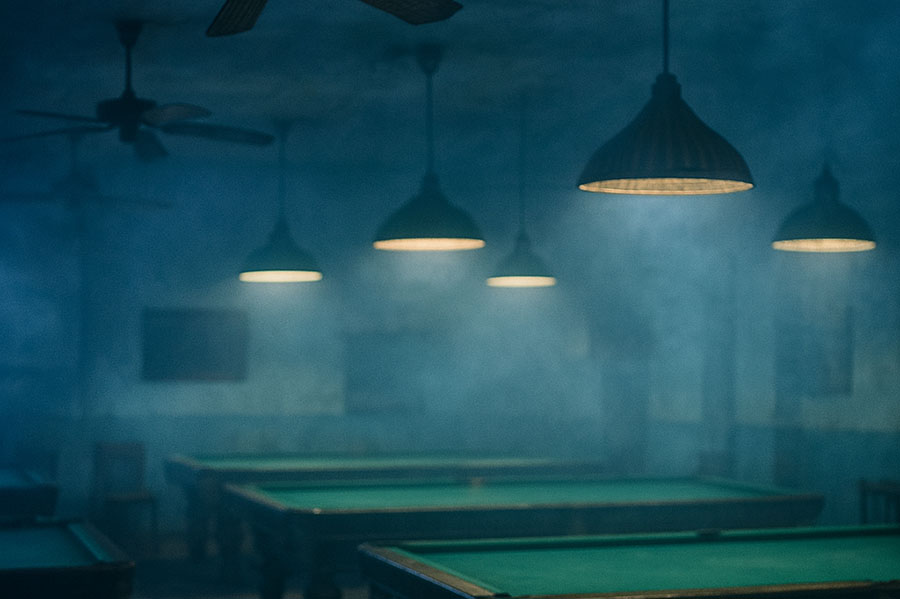
“Do you think we really need a mop guy? Come on.” With a sweep of her arm, she ushered Remy into a billiard hall with a haze of blue smoke. It was being driven down by a corkscrew of bamboo ceiling fans onto green felt tables that looked to have been ancient when his grandfather had slipped a stick. Mysteriously, the only scent was of autumn leaves and kernel corn with the faint undertone of cold diesel, and gravel with yesterday’s bubblegum embedded.
“The smoke is called smartMizt. It’s one of Max’s creations. Purely for ambiance. Designed for those nostalgic for the haze-strangled noir of memory without the actual strangulation of tobacco smoke. In fact, the vapor is made up of programmable nano-rotors carrying microscopic water droplets. The patterns of the “smoke” are programable. The drift and swirl patterns you see now come from Harrison Ford’s apartment in Blade Runner. Many of those droplets carry the scents that you’re detecting here. It’s a profile of Max’s favorites blended from his memories. I think he calls it October at The Farm.
Godiya flopped back onto a strange lobed couch built into the stucco-surfaced wall. She was holding a ream of tractor feed paper with dot-matrix typeface tattooed into both sides of the green and white spool. Cones of illumination from the industrial pendant lights played spotlights, making the swirling mist into exotic dancers; all calling for attention. Remy found them hard to take his eyes off.
“Hey Remy. Pull up a stool. You ever read the transcripts?”
“Transcripts?”
“Yes, transcripts. Every word Max says in SIM on paper, plus all the generated responses, as well as general information about the scenario. Reads like a screenplay, mostly.
“You do read, don’t you? Things other than monster truck rags, or Bubble Yo-Ho’s fanzine translated from Japanese?”
“Yeah, I read. I saw a copy of Idoru on the arm of your chair when you got up to ah… show me around? I was just giving you grief.” Remy returned flatly.
“I thought so. Only way someone your age would know to call them Gibsons.” Godiya noted.
“But why would anyone want to read the text of some sixteen-year-old kid’s perpetual fever dream?” He grinned when he said it, eyes far away.
“I don’t know, Remy. What would yours have looked like, had you had such a fever dream? You haven’t asked about Max’s inventions.”
“That’s true. I’m taking in a lot here. Pardon the oversight.”
“The inventions are why people read Max’s transcripts. Most of the technologies you are witnessing were just emerging when Max went under. Because Max’s imagination has not been confined by how the world actually developed, but by how he imagines it developing, Max has a talent for putting these ideas together in unexpected ways. Like using nano-rotors to carry infinitely small water droplets to make programable smoke dancers. Also, a good way to make a magnifying lens out of water in the sky to focus sunlight. Max didn’t think of that part.
“Another great thing about these transcripts, for the wise and intrepid government engineer, is that they are an excellent way to get to know the people you work for. Read last night’s. I’ll make you some tea.”
“Tea?”
Godiya stuffed the ream into Remy’s hands and slipped behind the bar adjacent to the double doors. She grabbed two mugs from an overhead cabinet and set about drawing water.
“Uhm… Coffee?” Remy requested.
“Read now. Tea now. Beer after. Is that too many words at once?”
“Hush! I’m reading!”
“Good thing I’m a fan of simple operating systems.” Godiya mocked.
The pot on the polished glass counter began to squeal. She poured a steaming fountain over the strainer atop the serving pot. After a few minutes, she decanted the tea, with unhurried respect, into delicate Asian porcelain, ancient or an excellent facsimile. She handed him the tea, returning to her seat on the sofa. Sipping her tea, Godiya played her fingers through the trails of steam hovering above the cup.
“He designed a hive of nanoparticles carrying microscopic droplets of bergamot oil. They swarm to hot tea. They dissipate once the liquid is below one hundred degrees Fahrenheit. Did you read the part where Gina tells Max some evil people have infiltrated his net? That they are causing him hallucinations to manipulate him by remote control?”
Remy flipped through the spool, folding it neatly at its perforations onto the billiards table until he reached a statement indicating Max discovering Gina reclining in his downstairs apartment. His brows furrowed and he grimaced when he tasted the tea but swallowed it anyway.
“Oh, that’s heavy. Then she put him out. Just like that.” Remy remarked.
“Used to make me cry. Every time she did that to him. Now I just hate it, but I understand it for what it is.” Godiya’s tone was somber, but she met his eyes.
“And what is it?”
“The thing I hate, the thing I really hate most, I think, is that she’s not actually lying to him. There is some big nasty force infiltrating his net and causing him delusions for the purpose of manipulating him by remote control.
It’s her. And it pisses me off.” Her voice had an edge that years had worn off leaving it mostly tired.
“I can see how it would. I’m sure there’s more.” His voice was smooth, unaffected.
“She has to, because Max must agree to let her take him off-line. In fact, it’s preferable if it’s ‘his idea.’ They’re going to do a hardware upgrade on Max’s primary systems. So Gina puts Max under increasing levels of perceived threat until he asks her to bring him in. He knows coming back to “the hospital” requires black-site level sedation. Permission granted.”
“And why does Gina need Max’s permission to ‘power him down’?” Remy’s question is dry, tone flat, eyes unwavering.
“Because of what Sidney did.” Godiya’s gaze slipped from Remy’s face to her shoes. She set her cold cup of tea onto the polished counter of the bar where the finger smudges and evidence of use erased themselves leaving the China gleaming. Approaching the table Remy was using as a desk, Godiya beckoned.
“Bring that with you. Remember that what you’re holding is a single day’s transcript. Roughly one hundred fifty pages, depending on the day’s activities.”
Godiya pointed at the transcript Remy had laid out on the table. She weaved through the offset rows of pool tables and flagged Remy to follow her, stopping in front of a window to the glowing courtyard outside. A thick plate of glass, long and rectangular with beveled corners set deep into the wall of the transcription room cantina. Outside, tall oaks and willows surrounded a half-acre gazing pool as still as glass. Tufts of cotton from dogwood tress floated in irregular frenzies, always narrowly missing the water’s surface.
“Ever wonder how you build a courtyard this far under a mountain?” Godiya quizzed.
“I’ve never seen one since I onboarded. But now that I have, the question does come to mind.”
“Occam’s Razor, Remy. What’s the simplest answer?”
“Simplest answer, you don’t. Remember, G, I came here for the tech. It’s not a window. It’s a monitor. Fairly miraculous in its clarity, color, and definition. What is it, 16K?”
“You’re half-right. It’s a luminescent bio-matrix; that’s why the “glass” media is so thick. You can’t define the resolution in pixels. The number of lumineers is variable. They replicate and disassemble on demand, depending on the requirements for what they’re displaying. However…” Godiya placed three fingers on the glass and spread them. An oval emerged on the surface, replacing the scenic pond with another view.
“It is also a window.” Godiya finished.
Remy approached the glass. Beyond the inch-thick surface was a flat expanse of concrete as large as Chicago’s O’Hare airfield. Freeway sodium lamps stood at what must have been one-block intervals for as far as Remy could see in any direction. He sucked in his breath.
“Holy… Coulda been a courtyard. Coulda been a forest!” Remy whistled.
“It started as a legal thing. Max was eighteen before the original procedure was finished. Mrs. Veihl’s consent was no longer valid. We had to get Max’s consent to perform upgrades without ever queuing Max for his simulated existence. So, we set up a scenario involving a sequence of maintenance surgeries in SIM as Max’s doctors. After the first few, he started becoming resistant to ‘his doctor’s’ suggestions. He said he felt fine and didn’t want any more trips to the hospital. His transcripts indicated he was losing cohesion, psychologically.
“Gina had a different idea. She wrote some goons into the SIM to chase Max back to the hospital. When they brought him back, cohesion was great. No gaps in time-stream. No continuity errors. All green. We learned that when it was Max’s idea to come in, everything worked.”
“Five by five. Got it. Then what?”
“Then Sidney took over. He decided that since Max did not legally exist anymore, he no longer bore the rights of an American citizen, and we didn’t need his permission for anything. So he took Gina’s idea and enhanced it. He sent goons in to terrorize Max and then kill him.”
Godiya put her three fingers back on the glass. With her center finger, she made a corkscrew motion while spreading the other two in an expanding spiral. A circle appeared in the center of the surface, again spreading to reveal a new vista.
The concrete expanse with its matrix of sodium lamps remained, but now under the glow of each lamp was a silo, each several stories tall, and each containing stacks of six-foot diameter industrial rolls of the same paper Remy was holding. In the space surrounding each silo were grids of old industrial computer printers spewing transcripts while small warehouse robots loaded new rolls and others unloaded completed rolls, moving them into the silos.
“When Sidney killed Max in SIM, Max’s printers went crazy. Started producing reams and reams a day. Nobody could figure out how. His brain was producing no signal at all, other than the output to the printers. That’s when they built the first silo. Sidney started bringing in more printers. He collected them from everywhere, banks and airlines, everything commercial was moving to inkjets. Sidney started wondering if he could change the flavor of the output transcripts, so he booted Max back up and ran a new and more horrifying scenario in SIM, then killed Max again. More reams. Different transcripts.”
“You can’t be serious.” Remy looked over the field of concrete and silos again. He couldn’t even find a way to estimate how many there were.
“Sidney loved it. Most efficient way to produce new outputs. So he wrote new scenarios. Hundreds of them. And he killed Max, over and over again, for years until he finally died.”
“That is the most horrifying thing I’ve ever heard. I’m so glad I came to work here.” Remy just stared at Godiya, face slack.
Never miss a thing with our FREE weekly newsletter.
“The thing is, Remy, the density of the transcripts never changed. It stayed at about 150 pages representing a day of Max’s time in SIM.”
Godiya put her hand to the glass and stared out.
“How long was Max dead when we killed him?
“I never answered your question. What Tony said when he recruited me. He said, ‘We never give up on them. We’ll never let one of our kids die.’
“Then Sidney made me wish he’d been lying.”
