
There’s a particular kind of noise that doesn’t come from sound.
It comes from the constant pull to pay attention.
From headlines that never stop breaking.
From opinions that don’t ask to be heard so much as they demand it.
From the quiet pressure that if you look away—even for a moment—you might miss something important. Or worse… be seen as not caring at all.
Lately, it feels like the whole world is talking at once.
And none of it is quiet.
I’ve caught myself holding my breath without meaning to.
Scrolling longer than I should.
Carrying things that don’t belong to me—conversations, conflicts, worries about places and people I’ve never even met.
And I know I’m not the only one.
There’s a heaviness settling into people these days. You can hear it in the pauses between words. See it in the way folks look just a little more tired than they used to. It’s not just disagreement—it’s something deeper. A kind of unraveling. A sense that the ground we thought was steady isn’t as solid as we believed.
And when everything starts to feel uncertain, the instinct is to grip tighter.
To consume more.
To stay plugged in.
To try and make sense of it all.
But I’ve been learning something different.
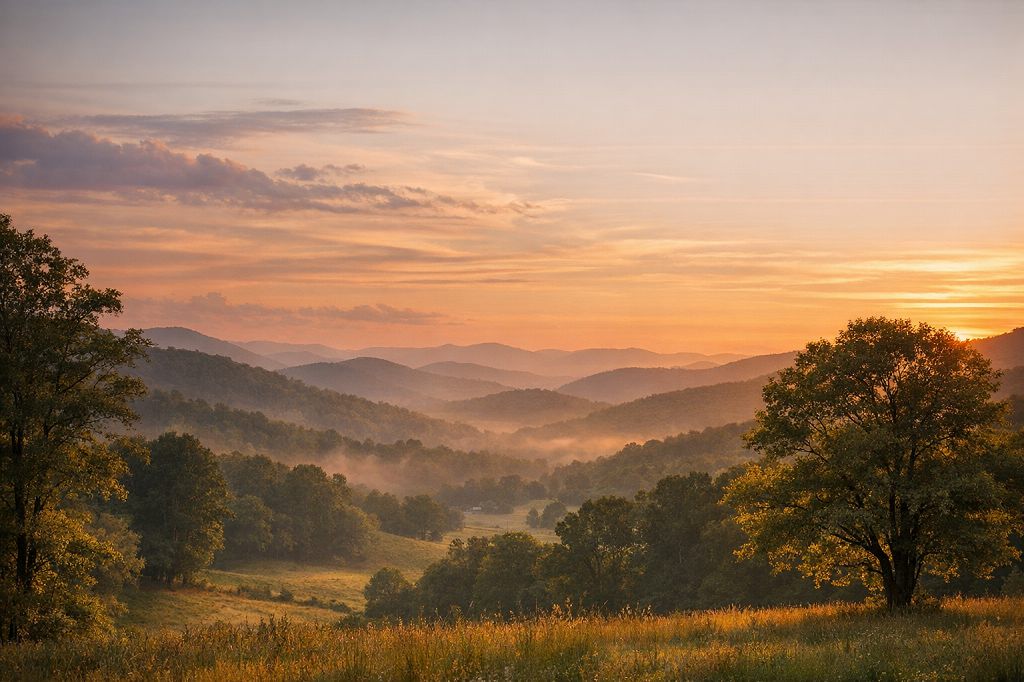
The other evening, I stepped outside just before dusk. No phone. No noise. Just that soft Appalachian quiet settling in—the kind that comes slow, like it’s got nowhere else to be.
The hills don’t rush.
They don’t argue.
They don’t react to every headline.
They just… remain.
The same way they have through hard winters, hard years, and generations of people who carried their own versions of fear and uncertainty—and somehow kept going anyway.
Standing there, I realized something that felt almost rebellious in its simplicity:
Everything that matters doesn’t live inside the noise.
There are still birds calling in the trees.
Still supper being made in kitchens.
Still hands reaching for each other across tables and front porches.
Still small, ordinary moments that don’t ask for attention—but hold more truth than anything flashing across a screen.
I used to think the way through overwhelm was to understand it.
To think harder.
To analyze it better.
To follow every thread until I could make it make sense.
But there are days when my mind won’t settle—
when it circles the same thoughts over and over,
reaching for answers that don’t come.
And the harder I try to think my way out of it, the tighter everything feels.
What I’ve come to realize is this:
My mind isn’t always where the peace lives.
Sometimes… my hands know the way back.
It starts simple.
A sink full of dishes.
Pulling weeds from a garden bed.
Cutting vegetables for supper.
Nothing profound. Just something to do.
But somewhere in the repetition—in the rhythm of it—something shifts.
My breathing slows.
My shoulders drop.
The noise softens.
My hands remember what calm feels like,
even when my mind has forgotten.
They remind me that not everything needs to be solved.
Some things just need to be tended.
And then there are the conversations.
The ones that don’t happen online.
The ones that don’t turn into debates or arguments or carefully constructed responses.
The kind that happens sitting side by side—on a porch, at a kitchen table, in the quiet spaces where no one is trying to win anything.
Just… be heard.
We don’t make enough room for that anymore.
We’re so used to fixing, responding, reacting. Filling silence before it has a chance to do what it’s meant to do.
But there’s a kind of healing that doesn’t come from advice.
It comes from being witnessed.
From someone listening without interrupting.
Without correcting.
Without trying to turn your experience into something more comfortable for them to hold.
I’ve sat across from people and felt it—that moment when their shoulders drop just a little. When whatever they’ve been carrying finally has somewhere to land.
Not because anything was fixed.
But because they didn’t have to carry it alone for a while.
And I’ve needed that too.
Moments where I didn’t have to explain it perfectly.
Didn’t have to make it make sense.
Just say it… and let it be enough.
But maybe the hardest thing to learn in all of this—
is that you don’t have to carry everything.
Somewhere along the way, we started believing that staying informed meant staying responsible for it all.
Every headline.
Every crisis.
Every possible outcome.
Like if we just paid enough attention, we could somehow keep things from falling apart.
But the truth is—
most of us are carrying more than we were ever meant to hold.
There’s a difference between caring about the world and trying to contain it.
And right now, a lot of people are doing the second without even realizing it.
You are allowed to set something down.
Not because it doesn’t matter.
Not because you don’t care.
But because you are human.
You were never meant to process the weight of the entire world in real time.
Never meant to absorb everything, all at once, without rest.
That’s not strength.
That’s exhaustion.
I think about the way people used to live—how their worlds were smaller, yes, but also more tangible.
They knew what was in front of them.
What needed tending.
What belonged to them in a real, immediate way.
And they gave their energy there.
To the meal that needed cooking.
To the neighbor who needed checking on.
To the conversation happening right in front of them.
Not to everything.
Not to everywhere.
Just to what was theirs to hold.
Maybe that’s where we come back to.
Not by fixing everything.
Not by figuring it all out.
But by stepping outside the noise long enough to remember what steady feels like.
By putting our hands to something real.
By sitting with someone long enough to truly hear them.
By choosing, gently and without guilt, what we carry—and what we don’t.
The world may be loud right now.
But we don’t have to be.
Never miss a thing with our FREE weekly newsletter.
There are still quieter things telling the truth.
Still steady places to return to.
Still ways to come back to ourselves when everything else feels too far gone.
You don’t have to hold it all.
You don’t have to solve it all.
You don’t even have to understand it all.
You just have to find your way back—
to what is real,
to what is yours,
to what remains steady beneath it all.
And start there.
