
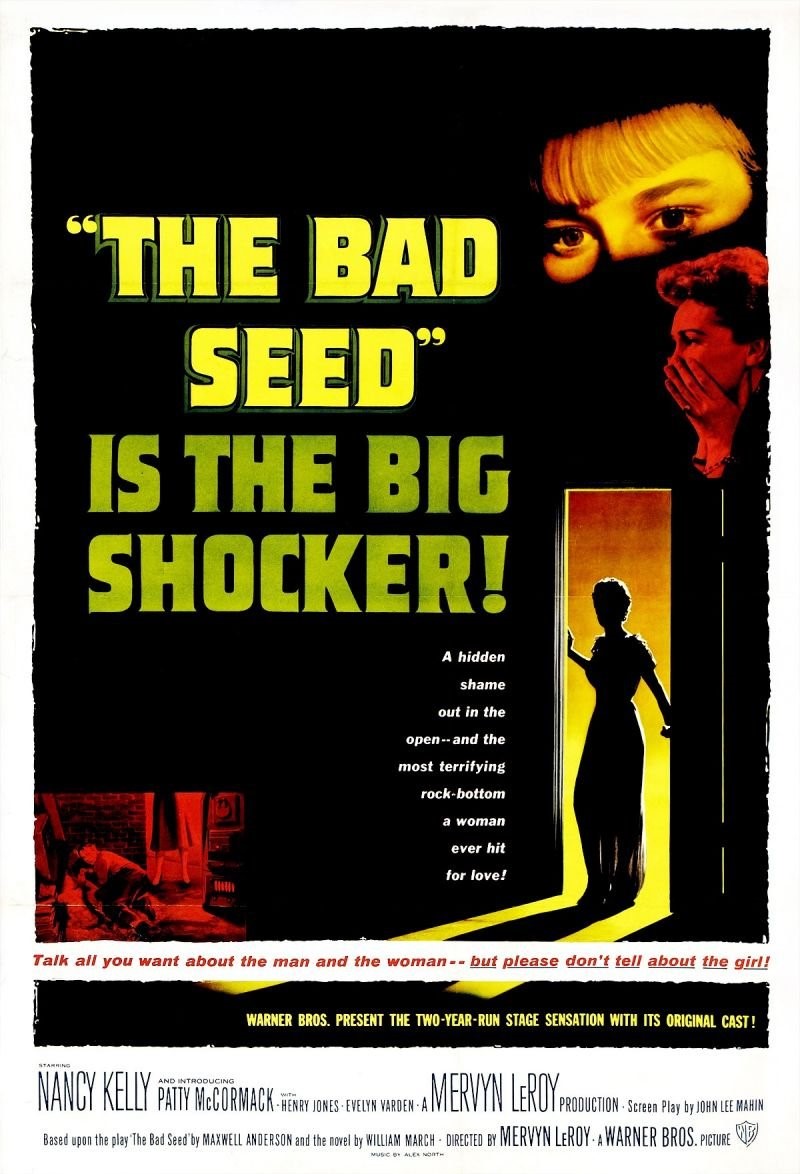
To begin today’s Reel Classic, I will quote from a description of the movie from the magazine Paste: “The Bad Seed is one of the most disturbing American portraits of pure psychopathy or sociopathy, coming from the least suspected of all sources: an 8‑year-old girl. The piercing eyes of little blonde, pigtailed Rhoda (Patty McCormack) are terrifying to behold, more so once we begin to suspect what lays behind her façade.”
Yes, we are talking about a young girl who by all appearances is mannerly and the “perfect” daughter. However, below the surface what we come to see appears to be pure evil. The Bad Seed was released in 1956 and was based on a successful Broadway play of the same name. The play opened in 1954 and ran for 334 performances, with Nancy Kelly (who plays Rhoda’s mom, Christine) winning a Tony Award for Best Actress.
Many of the cast from the original play reprised their roles in the screen adaptation, including Nancy Kelly, Patty McCormack, Eileen Heckart (Hortense Daigle), Evelyn Varden (Monica), Henry Jones (Leroy), and Joan Croydon (Miss Fern). Others in the film include William Hopper (Paul Drake in the Perry Mason TV series) as Rhoda’s father Col. Kenneth Penmark, Jesse White (Emory), Paul Fix (Richard Bravo), and Frank Cady (Henry Daigle). You may recognize Fix as the sheriff in The Rifleman and Cady from Petticoat Junction and Green Acres. The play was based on the novel of the same name written by William March.
The story begins with Rhoda preparing to attend a school picnic on the lake. Her father is preparing to go to Washington where he has been summoned for military duty. We learn rather quickly that mother and father dote on their daughter. The landlady of the building in which the family resides, Monica, pays a visit. Rhoda tells Monica about how she lost a penmanship contest to a classmate, Claude Daigle, and that she should have won the medal given to the winner. She obviously is angry about not winning the contest, and we begin to see a hint of what lies beneath the sweet and pristine Rhoda in her pinafore dress, tap shoes and pigtails.

Rhoda’s mom, Christine, is having lunch with friends when a report comes over the radio that a child has drowned at the school picnic. Christine immediately heads for the lake to check on her daughter—fearing she is traumatized by this terrible event. We learn that Claude Daigle was found in the lake drowned with odd marks on his head and hands—and the medal he won is missing. Not only is Rhoda not traumatized, she appears to be completely unfazed by her classmate’s death and asks for a sandwich as she didn’t get to eat at the picnic.
It is not long after they have returned home before Miss Fern, Rhoda’s teacher, appears at the door expressing concern about Rhoda. It turns out that Rhoda was seen with Claude right before his death and she was grabbing at the medal he had won in the contest. She implies that Rhoda may have had some part in the death of Claude and is no longer welcome to return to the school. About this time there is a banging at the door, and it is Claude’s parents. Mr. Daigle is humble and apologetic, but Hortense Daigle is angry and drunk. She accuses Miss Fern of withholding information and demands to know what happened to her son. They all finally leave, and Christine is obviously distressed by what she has heard. She later finds the medal hidden away in Rhoda’s bedroom and is uncertain as to what is the truth.
Christine’s father, Richard Bravo, comes for a visit and Christine shares with him a recurring nightmare she has had for years relating to her own childhood. Her father admits to her that she was adopted and her biological mother was a serial killer. She expresses the fear that her own biological roots may have something to do with Rhoda’s behaviors. Her father tries to assure her that it is nurture, not nature, that influences behavior. Christine’s fears about her daughter continue to grow as she learns more about past behaviors.
As usual, I won’t provide any spoilers, but as the story progresses it becomes more tense and even more disturbing. We learn more about Rhoda’s behaviors and her mother’s response to what she learns about her daughter that she had never before suspected.

The Bad Seed was one of the biggest hits of 1956 and finished the year in the top 20 in earnings in the United States, and in the top 10 in Britain. It received four Academy Award nominations including Best Actress (Nancy Kelly as Christine), Best Actress in a Supporting Role (Eileen Heckart as Hortense Daigle and Patty McCormack as Rhoda) and Best Cinematography. Patty McCormack was ten years old at the time and was nominated for an Oscar. Prior to the 1950’s child and teenage actors such as Mickey Rooney and Judy Garland would receive an honorary juvenile Oscar. Reportedly her nomination initiated a trend where young actors would be nominated for the Oscar. (Note: Patty Duke was the first “child” actor to win an Oscar for her 1962 role in The Miracle Worker.)
As mentioned above, Nancy Kelly reprised her role from the Broadway production. Also initially considered for the role of Rhoda’s mother were Rosalind Russell and Bette Davis. However, the director, Mervyn LeRoy, wanted to bring the cast from the play. Another interesting note—Alfred Hitchcock turned down the opportunity to direct this film. Billy Wilder had wanted to direct the film but had difficulties with the Production Code Administration (another censoring organization) regarding the behaviors depicted by the eight-year-old Rhoda. He threw in the towel.
The title of the film apparently stems from a conversation Christine has with a friend, Reggie Tasker (who is involved in research on the topic of “nature vs. nurture”):
Christine: “Do you really mean to say that nice family surroundings and advantages could make no difference at all?”
Reggie: “Yes. It’s as if these children were born blind permanently and you just couldn’t expect to teach them to see.”
Christine: “Well, would you notice any brutish expressions on their faces?”
Reggie: “Sometimes. But more often they present a more convincing picture of virtue than normal folk.”
Christine: “But that’s horrible!”
Reggie: “It’s just that they are bad seeds. Plain bad from the beginning. And nothing can change them.”
Though the film was very popular, some critics took note of the “staginess” of the acting. In watching it there is a feel of a stage production. However, we must keep in mind that it was previously a stage production and many of the actors were from that production. Another thing to keep in mind is that three of these “stage actors” were nominated for an Academy Award.

The Bad Seed also has an unusual ending with the screen credits. As on the stage, where actors are brought before the audience and introduced, the credits bring each actor before the camera as an announcer proceeds to introduce them. When Nancy Kelly is introduced at the end of the credits, she walks into the living room where Patty McCormack is and motions her to lay on her lap as she proceeds to laughingly spank McCormack for her misdeeds. The Los Angeles Times wrote in May 1956 that this segment was added at the end to “remove some of the bad taste . . . led by this horrific shocker.” Warner Bros. also had an “adults only” warning in the advertising—efforts to appease the censors at the time.
There have been two remakes of the film. In 1985 a made-for-TV version starred Lynn Redgrave and David Carradine. A second remake was made for Lifetime TV in 2018 with Rob Lowe as director and starring in the film. This film also featured Patty McCormack playing the role of a psychiatrist.
Never miss a thing with our FREE weekly newsletter.
The Bad Seed was included in the list of films nominated by the American Film Institute’s 2001 for the top 100 Most Heart-Pounding Movies.
The Internet Movie Database rates the film at 7.4 of 10. Rotten Tomatoes gives it a critics score of 63% and an audience score of 82%. Today The Bad Seed is often identified as a “cult film.”
Checking my Roku I found the film available to stream for free on Tubi. Also, the Clark County Public Library has a copy of the DVD on the shelf.
Information for this Reel Classic review was gathered from Internet Movie Data Base (IMDb), Rotten Tomatoes, Turner Classic Movies (TCM) and Wikipedia.
I’ll be back soon with the next Reel Classic, but before I leave you with the trailer below let me remind you that if you enjoy these classic movies, please join me on the second Tuesday of each month at 6 p.m. at the Clark County Public Library for “Ron Kibbey’s Comedy Classics.” I present a classic comedy film usually accompanied by a vintage cartoon. Popcorn and drinks are provided. More information about the next film is available on the library’s website and Facebook page, as well as WinCity Voices Facebook page.
