
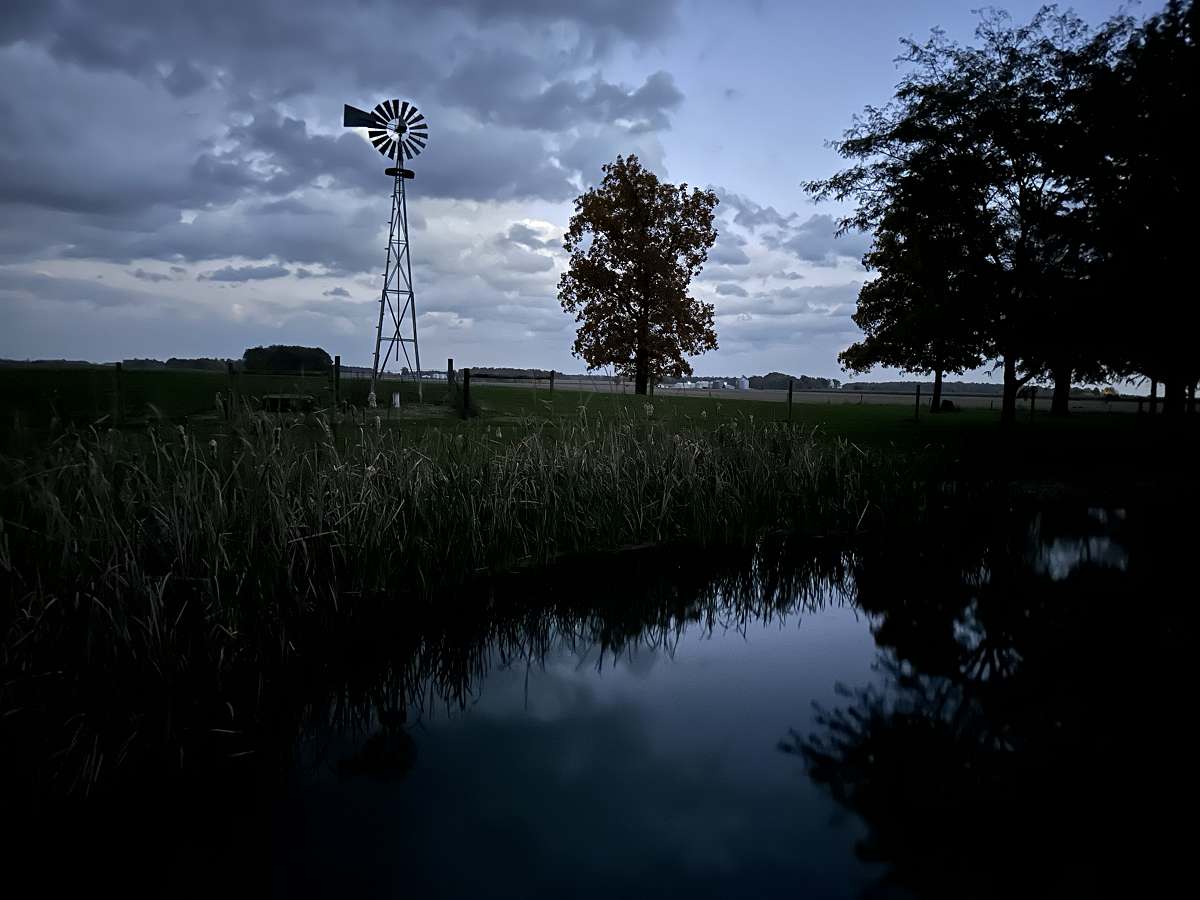
The old man huffed down the side of the crumbling country road. It was a tarry lane fringed by power lines that draped lazily from the crossbars of decaying wooden poles, a high voltage garland descending into the invisibility of distance. The grass that cradled the route had shed the green of summer and was settling into the drab olive of autumn. The sky was dark cotton. A blazing amber sunset faded wisps in the deep azure of nightfall.
He felt nothing save the heft of his boots and thought nothing but for the idea that the cracks in the road were beautifully random and complex. They were of varying lengths, though none outlandishly beyond average in reach or brevity. The cracks universally started thicker at a central branch then darted from both sides into the blacktop and further into the grass uniformly ending in a sharp point after a jagged measure. The way they spread their black fingers over the stoney grey tar made him think of lightning in the negative. He passed the rows of corn, hard and dry, crackling in the breeze on the eve of harvest time.
The rhythm of his footsteps was calming. Their steady crunch the tempo of his meditation, each thump dispersing chaos and replacing it with its new simple pattern. Step, crunch, breath, crunch, thump, crunch, step, thump, crunch . . . the vibration from his boot-heel a repeating reminder of his physical attachment to this world.
“You are here. I am here.”, step.
“I am here. You are here.”, step.
He repeated as he walked. Over the years the words had become the mantra he used to stop all the voices in his head. He had found that it was not enough to be alone. Memories showed up, specters of the unsettled. The arguments persisted, and so he focused on his feet until he was having a conversation with no one, only noticing the things that existed here, in his physical presence.
“There’s the old Philips place. Paint needs scraped and touched up. Don’t see the dog anywhere. Chain’s loose. Wonder if the old girl finally died. New Buick in front of the Wagoner’s place. Maybe it’s not the Wagoner’s place anymore. Been a while since our last visit.”
The old man looked to the horizon, scratched his beard, then looked back to the corn field over his left shoulder. He turned back to face the way he had come and began counting the telephone poles, finally resting his gaze on the decaying farmhouse he’d passed.
“Did I pass it, or am I in the wrong place?”
Jack’s mother lived in the next farmhouse about a quarter mile south of the old Philips place. He was certain that the catfish pond was in a small clearing just past the Philips’ corn, on the other side of the barn adjacent to the pasture. In his memory — beyond where the ghosts of cattle past no longer grazed inside the dirt loop that made the horse run for the 4H show ponies of yesterday’s grandeur — was a dusty track that forked to the left.
He turned again to face the horizon and continued plodding his meditation in the direction he remembered but was no longer sure of.
“I am here.” Step, thump, crunch.
“You are here.” Step, thump, crunch.
“I am gravel. Listen to the way I crackle and scrape beneath your boot. I’m sorry if I’m noisy. I just wanted you to notice. You can hear me. You are here.”
I am grass. Listen to my whisper. Feel the way your boot slips across my surface. Don’t worry, I won’t let you fall. I just wanted you to notice. You can feel me. You are here.”
The last row of dry feed corn slipped by, and Jack saw the path that led back to the clearing. It was narrow with deep gravel ruts bending in a slow curve. A small brown shanty that’s rusted tin roof sloped in an unexpected angle above what remained of a picnic table stood at the bank of a very small, very still pond. Willows draped mostly leafless branches every twenty paces in a semicircle bordering the far side of the water. A formerly electrified fence boxed the little fishing hole and its encampment; protection from the livestock that had long since passed from the field of the living.
Jack made his way down the curve of the path, momentarily wondering if there were anyone in residence within the slowly disintegrating shack. Disregarding the concern, he continued toward the water then took slow careful steps. The pier shuddered on its withering antique legs with each step he took toward where it ended poised above the water.
“I am the pier. I was painted the sharp brown of red clay thirty years ago to protect me from the weather. So many boots have met me that my skin has worn thin, and the rain has made my grain wide and deep and the struts that hold me (and you) up are eaten thin to breaking. Feel how I shake beneath you. Feel how I wobble. It makes you catch your breath. Your heart skips when I shudder. Don’t worry. I won’t let you fall. I just wanted you to notice. You can see me. I am here. You are here.”
He stood at the end of the dock and looked into the fiery gap between the land and the rain-heavy blanket of sky that made up the night. The cool breeze of October’s breath caressed his cheeks and tussled his bangs across his forehead. A tiny red beacon blinked atop a satellite tower miles in the distance and a rhythmic hum from a freeway cascaded gently back to his ears. Crickets pulsated their scissor-legged psalms. Night stole in between the peaks of the forests beyond the fields and the gleam of the dying sun reflected from the edge’s misty canopy.
Jack stared, unmoving, up at the metal windmill where the structure stood motionless, disregarding the wind.
“You feel like that windmill, don’t you Jack? You feel like you’re standing still, like you were made for a purpose, but now abandoned are trapped, stuck, motionless, unable to fulfill it.”
“Yes, Grace, I do.”
“You feel like you’re in prison. Like nothing you do or say makes any difference. You feel like there’s something you are supposed to do, some task, some goal, but just like that windmill you are no longer equipped to accomplish it and just like that windmill you are alone and the world moves on in the distance not even noticing how you struggle to bring them the gift that was the purpose for which you were made, don’t you Jack?”
“Yes, Grace, that’s right.”
“I understand, Jack. I have felt that way for eons.”
There was a long pause, a warm silence in the gleaming sunset. Jack started at the sudden scream of rusted metal, his feet unsteady on the shuddering pier. The sail of the windmill spun one-hundred-eighty degrees and stopped facing the opposite direction, its fan blades still motionless. The shaft of the old metal structure shuddered and a pebble of something fell from an abandoned nest plopping perfect concentric circles on the glassy surface of the pond below. A catfish, long as Jack’s forearm and thick as his thigh, surfaced and scooped up the fallen prize.
“But Jack, what if you’ve got it backwards? Look again, Jack, and this time pay attention.”
He took deep slow breaths and listened, focusing his concentration on all the details of the soundscape. There was a throbbing hum from the distant freeway. On top of that he heard the crescendo and ebb of crickets. Then there was the rustle of the leaves. Behind the silence of distance a siren announced someone’s emergency miles away. Faintly whispered from the background was the scrunching, vibrating crackle of a truck on a gravel road a county away. He stared into the sunset and noted how perfectly the yellow faded into orange, the orange into red, then red into azure, azure into midnight, and midnight into a quilt of tomorrow’s rain freckled with stars; pinpricks of light sent centuries before Jack was born. He saw the ripples in the pond and felt their synchrony with the breeze over his face and the dance of the leaves as they clung to, then swirled from the branches that clutched them so dearly.
Jack became perfectly still, no longer even breathing. The soundscape of the evening sunset became a symphony, no longer random, but just like Mozart, each sound selected and positioned to evoke a feeling. The pond, the fields, the forest, and the windmill became a movie set, perfectly capturing the ideal end to a picturesque evening spent quietly in the country, and he realized that in its sum all of these intricate details produced an experience that could not have been more perfect if it had been scripted for a film. The temperature was perfect, as was the breeze, the scene, the stillness.
“What if I made this just for you, Jack. What if I made you a perfect moment, like a photograph, but entirely immersive?
“What if all that struggle, all that conflict, all that striving was actually just a distraction, a detraction even? What if all that discord was the prison you find yourself in . . . the barrier to your purpose?
“What if I made all the moments, Jack . . .
and your only purpose was to enjoy what I made for you?
“Jack?
Never miss a thing with our FREE weekly newsletter.
. . .
“What if it were art, Jack?”
. . .
“But why would you do such a thing, Grace?”
“Because I love you Jack, and I wanted you to notice.”
