Long before telescopes and rockets, before maps of planets and moons, humans looked up at the night sky and saw stories. Not just shining dots in the sky, but heroes, monsters, and gods. Among them is Perseus, whose story begins with a prophecy. His grandfather, King Acrisius of Argos, was warned that his daughter Danaë’s son would one day kill him. In a desperate attempt to outrun fate, Acrisius chained Danaë in a chamber deep underground.
But high above, reigning over Olympus, Zeus watched. Moved by her beauty and solitude, he came to her in the form of golden light. From that mysterious union, Perseus was born.
Terrified, Acrisius locked Danaë and the infant Perseus in a wooden coffin, which he cast into the sea. The sea-worthy coffin drifted all the way to the island of Seriphos, where a kind fisherman took them in. Perseus grew up strong, honest, and brave, but danger found him again. The king Polydectes wanted Danaë for himself. To get rid of her son, he challenged Perseus to slay the Gorgon Medusa, a monster with snakes for hair whose gaze could turn any man to stone. Perseus accepted.
The gods saw his loving heart and sent divine aid. Athena gave him a polished shield, Hermes a winged helmet and sandals. From nymphs, he received a magic sword and a pouch to carry Medusa’s head. Perseus flew to the edge of the world, where Medusa slept. Using the shield as a mirror so he would not meet her eyes, Perseus crept close and, with one swift blow, cut off her head. From her bloody neck sprang Pegasus, the winged horse, a reminder that even monsters may give birth to beauty.
It’s almost too poetic to believe. Flecks of cosmic dust, centuries old, igniting in the atmosphere to inspire awe in a middle-aged woman with her head turned heavenward.
He returned with Medusa’s head and used it to defeat Polydectes. Upon his death, the gods placed Perseus among the stars, honoring his story in the night sky. There he remains, a light that others can follow.
Every August, those same gods offer me a birthday gift. You see, I was born on August 10, just before the Perseid meteor showers peak each year, clearly as a celebration of my birth. Some years, I’ve enjoyed more than a hundred shooting stars per hour.
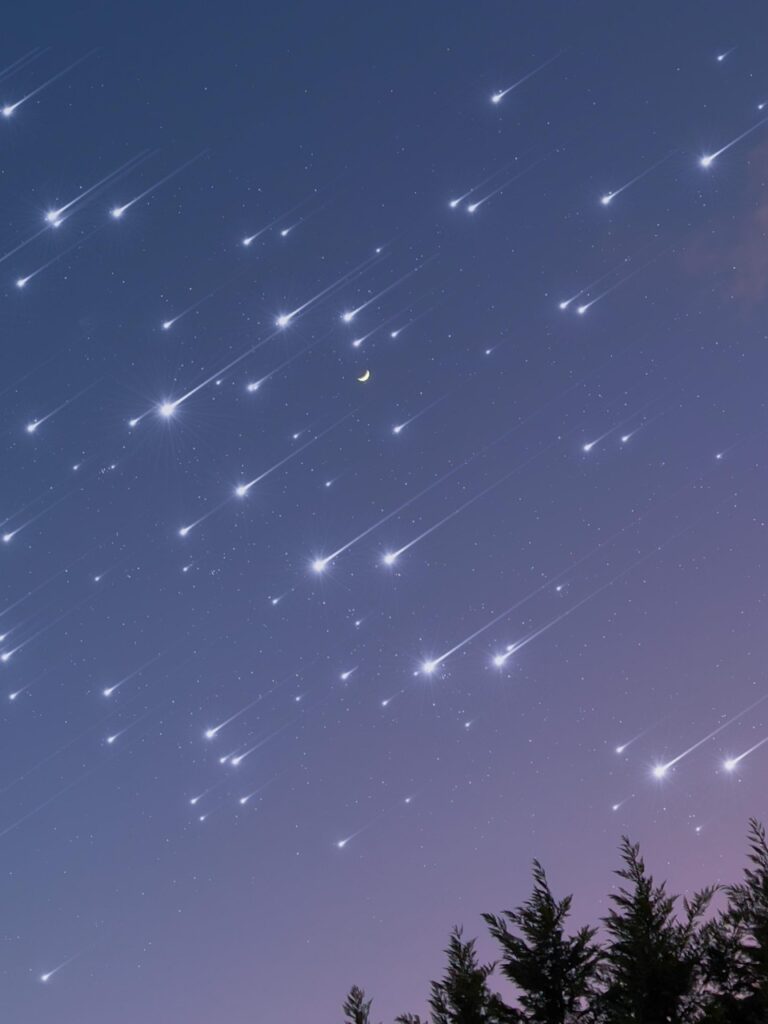
Every year at this time, our planet barrels through a trail of debris shed by an ancient comet. These tiny pieces of comet fragments, many no larger than a grain of sand, collide with the Earth’s atmosphere at incredible speeds. The resulting friction swiftly vaporizes the debris, creating those bright, fiery flashes we call shooting stars.
When we observe a meteor shower from Earth, the streaks of light appear to radiate from a single point in the sky, like spokes from a wheel. Astronomers call this point the radiant. For the Perseids, the radiant lies in the direction of the constellation Perseus. So, even though the meteors are actually burning up high in our atmosphere after entering from space, they seem to emerge from Perseus’s corner of the sky. So, we call them the Perseid meteors. Literally, of Perseus.
Never miss a thing with our FREE weekly newsletter.
It’s almost too poetic to believe. Flecks of cosmic dust, centuries old, igniting in the atmosphere to inspire awe in a middle-aged woman with her head turned heavenward. So much of my life is scrolling, worrying, planning, doubting. And then a flash crosses the sky, and I remember that we once looked to the stars to understand. We might chart the cosmos with calculations, but we name it with wonder.
Like an old friend making a long-awaited return, I eagerly anticipate the Perseids. But this year I might be thwarted by another old friend: the moon. The full Sturgeon moon hits on August 9. That much light might make it hard to see the shooting stars. Hopefully, the moon will have waned enough to still catch the show, when it peaks in the early morning of August 13.
We have always looked up to dream. The Perseids are one of the last remaining communal miracles that cost nothing and demand only our attention. So this week, step outside. Find a place away from the noise. Let your eyes—and heart—adjust.
And when the sky begins to fall, let it lift you instead.