
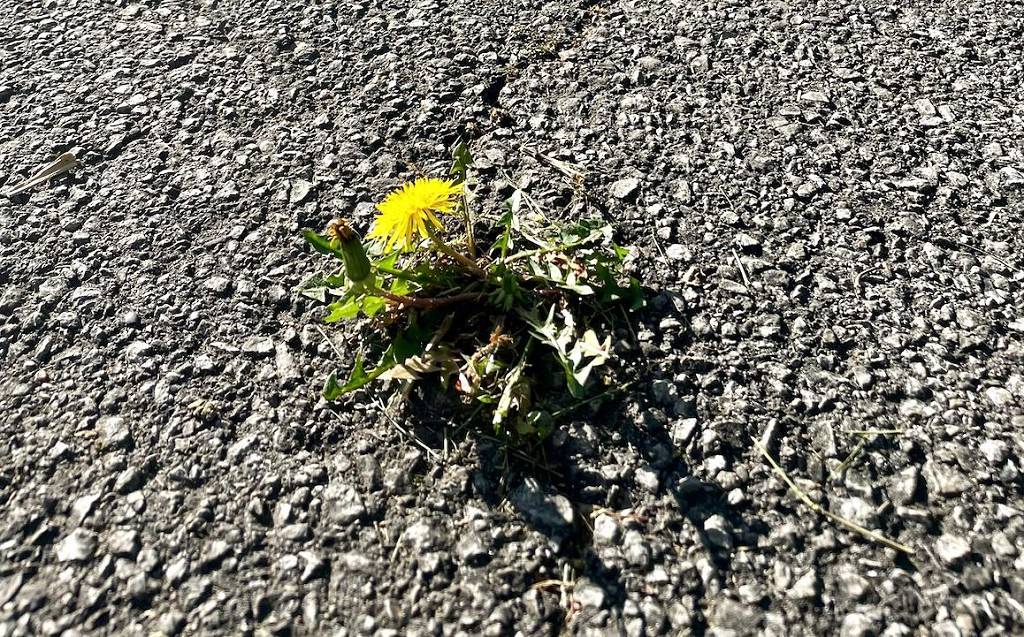
After the ice and snow finally melted off our driveway this February — after the terrible winter storm — we noticed a new crack in the asphalt. Today, I noticed the most adorable dandelion poking its little lion mane up through that crack. Dandelions are a meditation in resilience.
In a world often dominated by roses and lilies, the dandelion is easily overlooked. To many, it is an invasive weed, nothing more than an unwelcome guest in a perfectly manicured lawn. Of all the bizarre and inexplicable rigid conformities of mainstream American culture, one of the most puzzling to me is a hatred of dandelions. If I see another commercial for herbicide to “kill those pesky dandelions,” I am going to scream.
Why is a uniform green lawn the ideal? Not to mention that weed killers like glyphosate harm soil health, pollinators, and waterways.
From the Old French dent de lion, the word dandelion literally means lion’s tooth, because of its toothed leaves. Bees love them. So do salads.
Otherwise known as Taraxacum officinale, the dandelion is not native to North America. They were brought over from France by early settlers who valued them as a food source. The entire plant — leaves, roots, and flowers — is considered edible. Over time, dandelions naturalized in the U.S., spreading easily due to their wind-dispersed seeds.
Never miss a thing with our FREE weekly newsletter.
Despite the assertive spread, dandelions are not officially classified as invasive. They don’t displace native plants or significantly disrupt ecosystems. However, they also don’t provide much value to our local wildlife. Unlike native wildflowers that have co-evolved with pollinators and herbivores, dandelions are simply there, neither highly beneficial nor particularly harmful.
Until we notice how well they model resilience and transformation, that is. Their roots can sink more than 15 feet underground. And if they are far away from soil, they will make a home in concrete, forgotten alleyways, sand, or drought-stricken fields, and asphalt. They do not wait for ideal conditions or the approval of gardeners.
Their presence is a gentle reminder that strength lies in the ability to endure, adapt, and grow where no one expects anything to survive.
The life cycle of a dandelion is a lesson in transformation. From a bright yellow flower to a globe of delicate white seeds, the dandelion changes form completely, embracing each new phase with quiet dignity. First, it’s the sun. Then a round, full moon. Then, if you blow gently, stars shoot across the galaxy to begin again, far from their origin, full of promise. How magical is that?
Children understand the magic of dandelions better than most adults. They gather them into bouquets, make wishes on their seeds, and see beauty where others see weeds. What if we all chose to see opportunity in difficulty, to find worth in the overlooked, and to honor growth in all its forms? The dandelion may not be the flower we choose to plant, but it is the one that reminds us that our real, messy, beautiful life will always find a way.