
A tour of places no longer there
This is part one of a three-part series.
As you walk or drive around Winchester, you will notice we have many parking lots, drive-thru lanes and other paved areas downtown. Some of these were once occupied by architecturally significant or historically important homes and businesses. Some of the structures simply outlived their usefulness and could not be economically repurposed. Other buildings, however, fell victim to neglect as owners failed to provide needed structural repairs and maintenance. There were also a number of perfectly good buildings that were razed specifically to provide parking lots. I picked out 17 parking lots to include here. There are many more, of course, but I only used those for which we have pictures of the buildings that once stood on them.
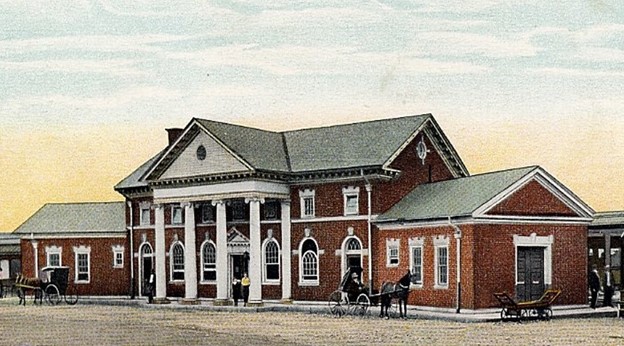
C&O and L&N Passenger Depot
The building that caused the greatest uproar in Winchester when it was razed was the old railroad station on Depot Street. The depot was built in 1907 as a joint passenger station for the C&O and L&N railroads. The Kentucky Heritage Commission declared that the station “is one of the richest and most authentic in detail in addition to being the earliest of its type in Kentucky.”

By 1981, the old depot sat unused, and the city was negotiating with L&N officials about acquiring the building. A developer had expressed interest in converting the station into a restaurant. The front page story in the Winchester Sun for Monday, July 27, 1981, reported that “an L&N crew, beginning before daylight on a foggy Saturday morning, leveled the building.” The depot was destroyed without notice and “came as a complete surprise to citizens and officials alike.” The site now provides parking for the Winchester/Clark County Farmers’ Market.
Jones & Gay Warehouse

W. M. Jones and David S. Gay were proprietors of the three-story brick warehouse shown here (1889). This warehouse stood on Main Street on a siding of the Newport News and Mississippi Valley Railway (later the C&O Railroad).
The facility stored hemp seed, bluegrass seed, and grain (capacity of 80,000 bushels) and was also equipped for cleaning seed.
“Jones & Gay have a very complete warehouse for storage of hemp, wheat, and other produce. They have connected with their establishment a hackling house where their hemp is cleaned and prepared for market. They do an immense business.”
The warehouse burned in 1905, destroying the machinery and $15,000 worth of bluegrass seed. The site now serves as the parking lot for WMU. David S. Gay lived on an estate on Lexington Road. His lovely home on the place, Breeze Hill, was razed a few years ago.
G. L. Wainscott Bottling House

In 1899, G. Lee Wainscott purchased a storehouse and lot on Main Street, just south of the C&O Railroad. Here in 1902, Wainscott started making candy and bottling soda water. He soon introduced a number of fruit-flavored drinks.
In 1906, he began bottling and selling Roxa Kola, supposedly named after his first wife Roxanne. After the drink became popular in the area, Wainscott started selling syrup to other bottlers. There were Roxa Kola plants in Lexington, Irvine, Beattyville, Georgetown, Cynthiana, and Carlisle, each with its own licensed territory.
Wainscott achieved his greatest success marketing another soft drink, Ale-8-One, launched in 1926. In 1935 he moved his factory to a two-story brick building on Broadway. This flourishing local business, owned and operated by the Rogers family, now has a modern bottling plant on Carol Road.
The site on Main Street is the parking lot for the U.S. Post Office.
St. George Hotel

When it opened on the evening of February 3, 1904, the St. George Hotel was proclaimed “the finest hotel in Winchester.” Just one block from the train station, the St. George prospered from the growing number of railroad travelers coming through Winchester at that time.
Ground floor businesses included a drugstore, café, billiard parlor, barber shop, cigar stand, and bar. The St. George was remodeled and renovated numerous times. In later years, however, it was allowed to deteriorate and became run down.

The end finally came on June 26, 1987, when the handsome old hotel was torn down to make room for the new post office building and its parking lot.
Never miss a thing with our FREE weekly newsletter.
J. W. Hollar’s Grocery — Dr. O. R. Venable’s Office

A pair of buildings stood at Main and Washington where the Dairy Queen parking lot is located now.
The white building on the left was the Hollar Grocery. J. W. Hollar came to Winchester from Nicholas County in 1889 and opened a grocery on this corner five years later. After his death in 1936, his son William and two spinster daughters, Cora and Klein, carried on the business until 1968, making Hollar’s an institution on North Main for nearly 75 years. According to the late Kathryn Owen, the building had been erected in 1812, placing it among the oldest in the city.
The red brick building on the right housed the practice of Dr. O. R. Venable from 1889 until his death in 1920. Doctor Venable, a Georgia native with a medical degree from the University of Michigan, was an eye, ear, nose, and throat specialist.
Be sure to check back next week for the second installment of this series.