
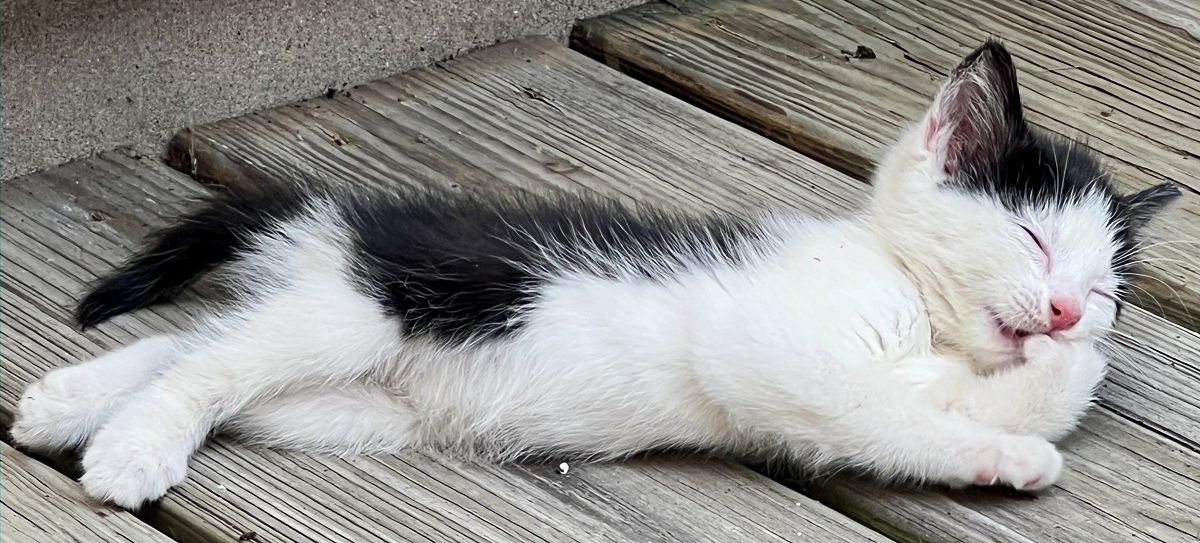
Do we ever get enough of baby animals and happy endings? If you’ve met your weekly quota, stop reading now because this cat tale features both — and maybe even a life lesson or two (but I’ll leave that up to you).
Our story begins around mid-morning on Saturday, July 8. Jeff and I are polishing off the last of the coffee, thinking about heading to Berea for the annual craft festival. The many windows in our small frame house are wide open, bathing us in birdsong and the final wisps of night-cooled air.
On this particular morning — and several leading up to it — when the man-made sounds of summer fall silent and we tilt our heads at precisely the right angle, faint sporadic mewling filters in from behind the yard barn boxwoods. It’s kitten season on Manor Drive — again — and the neighborhood cats were doing what they do best: multiplying exponentially.
In the nearly 17 years that we’ve lived here, the population of this persistent colony has fluctuated but never bottomed out — in part because a well-intentioned neighbor regularly feeds it. As a result, waves of wild and woolly kittens appear annually (some of whom actually survive the elements, predators, and numerous pathogens that are their unfortunate birthright) and go on to produce litters of their own.
But life among the boxwoods is no bed of roses for these feral felines — even in lush suburbia. Battle-scarred toms limp around with tattered ears and crusted-shut eyes, occasionally holding tense standoffs on our deck. (They rarely actually fight anymore, instead performing what looks like an excruciatingly slow tai chi routine that generally concludes when one slinks off as the other shifts his attention to his latest abscess.) The most-often-seen female, who is literally a hot mess, cycles reliably between states of obvious pregnancy and nursing-mom depletion. At times she looks relatively robust, save for the balding hotspot currently scabbing the base of her slender black tail.

Because we have educated ourselves extensively about feral cat colonies — and observed this one on a daily basis for years — our feelings about these resilient animals are complicated. We care deeply about their welfare always, making the question of how (and whether) to effectively and humanely intervene never-ending.
Some years we get more involved than others, and outcomes vary. One summer, for example, we spent months gaining the trust of five skittish kittens, the plan being to get them fixed and settled into a safer environment. We succeeded, but similar attempts to aid their wary parents failed miserably. As a result, we’ve had little overall success stemming the annual tide of kittens.
Which brings us to the heroine of our story and our hands-down favorite candidate for Kitten of the Year. The bravest and most unusual feral cat we’ve ever encountered, Chloe seemed determined to not only survive but to thrive — a goal she apparently knew she could not accomplish alone.
While most feral kittens keep quiet and out of sight, she announced her presence loudly and incessantly beneath our bedroom window on that fateful July morning — a gutsy move that immediately grabbed our attention. When we raised the screen to get a better look, her tiny tail shot skyward, and she tried frantically to climb the wall to reach us. We were simultaneously stunned and smitten.
Was she sick, we wondered. She certainly didn’t look sick. Skinny, yes, but with that much lung power and motivation to engage, it seemed more likely that she was hungry. Canned tuna was all we had on hand and, as it turned out, she was very hungry — starving, actually — not only for food but for attention. Over the next two days when she wasn’t devouring everything we put in front of her, she relentlessly pursued caresses, cuddles, and play.
On day three we secured her in her pet taxi/sleeping quarters and took her to meet the kind and gentle Dr. Jaclyn Brogli at Boonesboro Animal Clinic. She weighed in at exactly one pound, and was estimated to be 6–7 weeks old. She was wormed, vaccinated, checked for fleas, and tested for feline immunodeficiency virus (FIV) and leukemia. She had fleas and FIV antibodies. The fleas were unsurprising (and easily treated with a bath), but the FIV result was distressing — until Dr. Brogli compassionately explained that FIV is in no way a death sentence and that young weanlings of infected mothers sometimes test positive until their immune systems mature.*
Never miss a thing with our FREE weekly newsletter.
Throughout the vet visit and during transport to and from it, Chloe exhibited the same sweet and surprising sociability that won us over initially. Her courageous bid to transcend the rough-and-tumble life she was born into appeared to be paying off. It was time to up the ante: enter our longtime friend Susan and her endearing dog Nina.
Susan and Nina lost their beloved cat Shell Belle over a year ago, leaving a kitty-shaped void in their otherwise happy home. Upon meeting Chloe, they too were smitten — and decided it was time to take in another cat.
The transition has been seamless, and already Chloe has taken two road trips with her new family (the most recent in a fantastic new backpack carrier that looks like a space capsule/cat playground). Jeff and I visit regularly and enjoy frequent videos, photos, and progress reports.

While it’s unlikely that Chloe will remember her brief time with us, we will never forget it. Happily-ever-afters are so rare in the world of feral cats, but Chloe is no ordinary feral. At her latest checkup, her weight had doubled: proof positive that she is truly thriving. This brave little cat with the great big heart (and lungs) appears to have accomplished exactly what she set out to do — and that’s a tale worth telling.
*Chloe’s prognosis, according to Dr. Brogli and Dr. Alice Mills of Lexington Hospital for Cats, is excellent — even if she does wind up permanently positive for FIV. Since the virus affects only felines and is primarily spread via deep bite wounds generally acquired through fighting, FIV-positive cats are best kept indoors and in single-cat households. Regular checkups and timely immunizations make living a normal and long life with FIV not only possible, but highly probable.
