
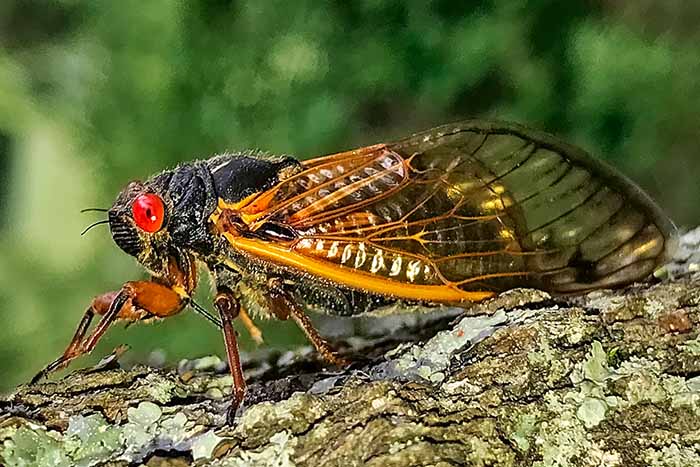

Mass gatherings are taking place all over these days, and Winchester will be at the epicenter of a big one in just a few weeks as throngs of hormonal 17-year-olds begin literally climbing the walls (and tree trunks) of Clark County.
This year’s emergence of periodical cicada Brood XIV is expected to be a high-decibel spectacle the likes of which hasn’t been seen—or heard—in these parts since 2008.
If you don’t remember the 2008 emergence, here’s a quick recap of how it went down at my house: It was late May, our second spring in Winchester, and the first time in our married life that we lived in a neighborhood with mature trees. Jeff and I were thrilled to have landed in such an arboreal setting. In addition to two big ash trees and a little dogwood out front, we had a decent-sized redbud and a couple of maples in our side yards. Behind the privacy fence out back, a majestic sweet gum ruled the sky.
A typical morning involved one of us getting the newspaper from the driveway while the other took a shower. I don’t recall who did the honors that particular morning, but what I do remember is standing gobsmacked in the front yard with Jeff, staring at the furrowed trunk of our old ash tree. The entire length of it was surreally alive, crawling with molting cicadas. Thumb-sized and ghostly white with dark markings behind red eyes, some had completed their molt, others were in the middle of it, bursting out of their skins like movie director Ridley Scott’s famous alien.
Here’s what to expect in the coming weeks: Sometime in May, possibly around the time bearded iris blooms, the first of this year’s Brood XIV will exit the soil in which they’ve been living since 2008.
The following weeks were loud—we heard the cicadas more than we saw them—but eventually the din died down. When it was finally over, all that remained were lifeless piles of split brown husks . . . and the invisible next generation burrowing deep underground.
Experts are predicting this year’s emergence to be equally impressive, so much so that Gene Kritsky, a professor at Cincinnati’s Mount St. Joseph University, has written a book about it (The Pilgrims’ Promise: The 2025 Emergence of Periodical Cicada Brood XIV), and University of Kentucky entomologist Jonathan Larson has dubbed it the “Bourbon Brood.”
Never miss a thing with our FREE weekly newsletter.
Here’s what to expect in the coming weeks: Sometime in May, possibly around the time bearded iris blooms, the first of this year’s Brood XIV will exit the soil in which they’ve been living since 2008. Telltale round holes will mark their portals. They’ll scale the nearest vertical surface and molt into adulthood. By the time we notice them, they’ll have maybe 4–6 weeks left to live—if they’re lucky. All kinds of critters (including culinarily adventurous humans) eat cicadas, so many of the first arrivals will not survive long enough to complete their bucket lists. Those who do will be in a mad scramble to make babies before they die. This is where the hordes and racket come in, because when time is short, long engagements are not an option.
Lusty males will gather quickly to broadcast their availability—sometimes at volumes in the 90-decibel range (think your average gas-powered lawn mower)—by activating membranes called tymbals on the sides of their bodies. Receptive females will respond with relatively soft clicking sounds, and when the deed is done, take off in search of soft wood—usually young tree branches—into which they can deposit their eggs. Six to 10 weeks later, the eggs will hatch, and the nymphs will tunnel underground. They’ll live in darkness and feed on plant root sap until the spring of 2042, when it’s their time, at last, to rise up and fulfill their destinies.
So there you have it: a brief primer on periodical cicada Brood XIV. If you’d like to learn more, there are lots of great online resources, including Dr. Kritsky’s free app, Cicada Safari, on which you can help scientists map this year’s brood by uploading your own photos and sound recordings of Clark County cicadas. The app is supported by his fantastic website, cicadasafari.org, which features loads of information, photos, and fun activities, as well as links to other cicada-centric sites.
I’m well aware that not everyone shares my enthusiasm for cicadas, but there’s a lot to like about these amazing creatures. Consider the following, gleaned from Dr. Kritsky’s Cicada Safari website:
- Brood XIV comes around just 4–5 times in a lifetime and is only found in northeastern North America. It was first documented in 1634 at Plymouth Harbor, although experts believe it existed for centuries before then. It’s a completely different species from the annual “dog day” cicadas we see every July.
- There are two categories of periodical cicadas: the 13-year cicada and the 17-year cicada. All periodical cicadas are of the genus Magicicada. They live most of their lives underground and “count” the annual ebb and flow of plant sap to know when it’s time to emerge. Sometimes individuals miscount and surface a year or more earlier or later than their brood.
- Contrary to popular belief, cicadas are not crop-decimating “locusts”—those are grasshoppers —but their egg-laying behaviors can damage young trees, causing a condition called flagging. If you have such trees and want to protect them, experts recommend covering them with fine-gauge netting or cloth rather than using pesticides, since cicadas are more beneficial than harmful. They don’t bite or sting, and they’re not poisonous. Their burrowing aerates our lawns, and their low-fat, protein-rich bodies nourish their many predators—and feed the soil.
- There are two ways to pronounce cicada: suh-kay-duh is more common in America, but the Brits say suh-kaa-duh. Either is correct.
So, what do you say? I say let’s celebrate this year’s Brood XIV by giving it the admiration and respect it deserves. Let’s acknowledge its rareness, appreciate its music, and thank it for bringing a few weeks of wonder—and buzz—to Winchester.
More photos (click to enlarge/view gallery)


