
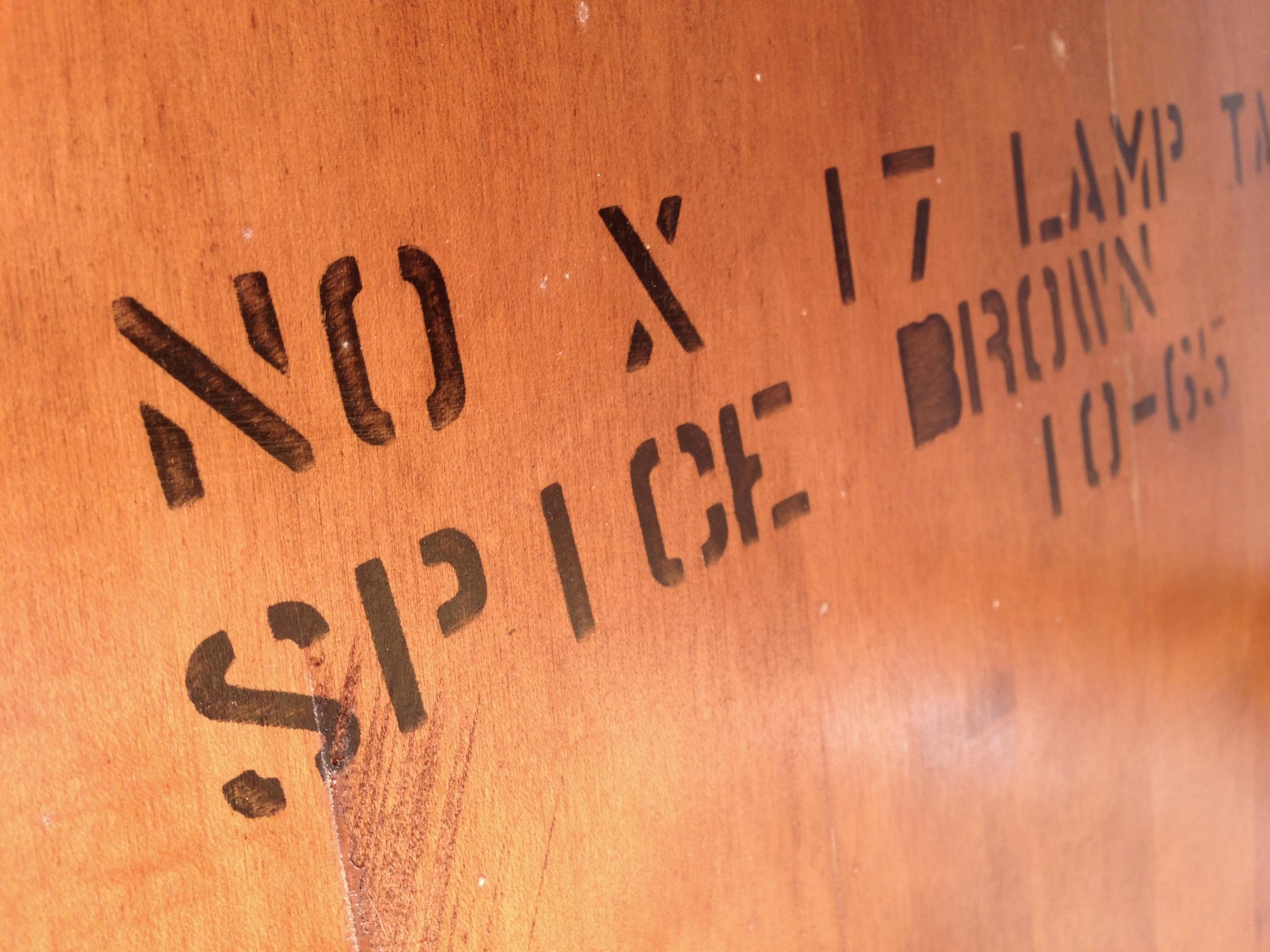
While lying on the floor recently working out some kinks, I noticed something I had never seen before. On the underside of a bedside table that’s been in our home for at least two decades, there was writing. Intrigued, I scooted closer to read the black stamped lettering: NO X 17 LAMP TABLE SPICE BROWN 10–65.
The discovery of this very pedestrian factory marking was oddly thrilling. Here I was thinking I knew everything there was to know about this little table. I had carried it from house to house and dusted it a thousand times. And suddenly, today, it looked different. As I studied it in wonderment, I noticed something else. Scrawled in pencil on the inside of each wooden leg was a three-digit number: 169, 170, 171, 172. How on earth had I never seen this before? And why those particular numbers on the legs? Seems my familiar old table was not so familiar after all. Who knew?
I spend a lot of time lying on floors. (I’m also skilled at looking out windows.) Floors, unlike those people-pleasing couches and beds, don’t concern themselves with our comfort. They’re like cats in that way. But this particular floor was not the one on which I usually recline. I had chosen it on this chilly fall morning because an intense beam of sunlight had warmed it to golden perfection. (Another useful lesson learned from many cats over the years, may they all rest in peace.)
I just finished reading Ross Gay’s bestseller, The Book of Delights, (available at our fantastic public library, once I return it). This may be at least partially responsible for my recent bedside table revelation. Gay’s collection of 101 super-short musings — “essayettes”, he calls them — resonates deeply with me because, I, too, delight in noticing, but don’t always make it a priority.
So why do we notice so little? Why do we stay in our comfortable ruts, lying day after day on the same familiar floor, missing out on the details that might ignite our creativity, change our lives for the better — or at least make them a little more fun?
A catalyst for creativity (in art-making, in life) is noticing — the significant, certainly, but maybe even more importantly, that which seems insignificant: the jet contrail overhead dissolving slowly into blue... the sounds in a silent room... the unrequited love song in a cricket’s midnight chirp... that churning, burning grief masquerading as rage.
At this point, you might be asking yourself, who has time for such nonsense? How could indulging in unproductive, self-absorbed navel-gazing possibly help? Why am I even reading this?
Never miss a thing with our FREE weekly newsletter.
Good questions, all (especially that last one).
What we’re really talking about here is... what, exactly? Artsy-fartsy bullshit? New-age woo-woo? Not in my book. And not in Ross Gay’s book, either.
Gay had a simple idea: every day, for one year, he would notice something delightful. He would jot it down quickly. He would keep it short. He had other things to do, just like us.
So here’s my idea, sparked by his: let’s notice how we’re spending our time. And more importantly, let’s pay attention to how that’s working for us. If we’re happy with the results, let’s go with god. If we’re not, let’s make something — a change. (If you’re pragmatic, make it an experiment.)
Just for a minute, let’s stop. Let’s breathe. Let’s look around and listen. If our knees aren’t shot, and we can get up without help, let’s lie on the floor and see what we’ve been missing. We might just be delighted.
