
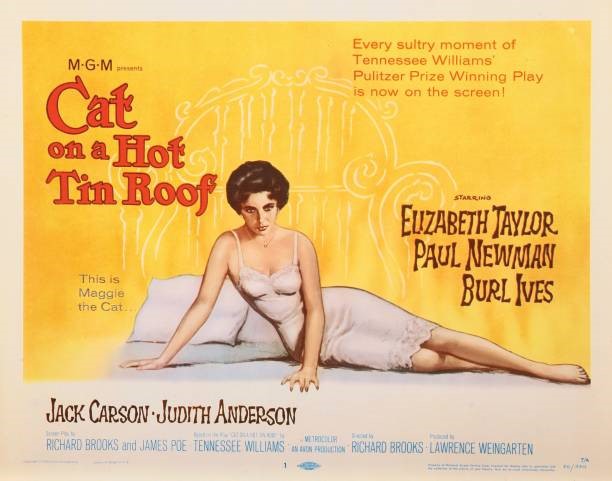
Today Reel Classics brings you the film based on the Tennessee Williams play Cat on a Hot Tin Roof. As the poster above states, the play won a Pulitzer Prize and was highly acclaimed. The play opened on Broadway in 1955 and was directed by Elia Kazan. It had been adapted from a Williams’ short story entitled “Three Players of a Summer Game.”
The film starred Elizabeth Taylor as Maggie Pollitt, Paul Newman as her husband Brick Pollitt and Burl Ives as Brick’s father, known as “Big Daddy” Pollitt. The cast also included Jack Carson as Brick’s brother Gooper, Madeleine Sherwood as the sister Mae Pollitt and Judith Anderson as Ida “Big Mama” Pollitt. Burl Ives and Madeleine Sherwood reprised their roles from the Broadway production.
The setting is a hot and sultry day at the luxurious Mississippi estate of “Big Daddy” where the family has gathered to celebrate his 65th birthday, but also to acknowledge his declining health. A doctor informs the family that “Big Daddy” has inoperable cancer and is likely to die within the next year.
Brick was a star high school football player in his younger days and often finds himself dreaming of those glory days. He is currently on a crutch after injuring himself the day before on the local track field trying to relive those glory days. These days he is depressed and has been drinking heavily for the past few years. He also shows little interest in his lustful wife Maggie, also known as “The Cat,” and they have no children as a result. His brother Gooper, on the other hand, has five children. This is a matter of concern for “Big Daddy” who is fed up with Brick’s drinking and behaviors.
As the evening winds down “Big Daddy” meets privately with Brick to make him aware of his dislike of his son’s behaviors and attitudes. Maggie joins them and discloses Brick’s behavior stems from an incident where a few years ago his best friend, Skipper, committed suicide. Maggie was jealous of the relationship between her husband and Skipper, and attempted to sabotage it by trying to seduce Skipper and drive a wedge between the two friends. Brick blames Maggie for the death of his friend and resents her.
Tensions begin to grow amongst the other family members and concerns about how the inheritance will go down is a source of the conflicts. “Big Mama” steps up to try to be strong and bring the family together.

In the play the feelings between Brick and Skipper were spelled out much more explicitly. However, the Hollywood censors would not allow that in the film and the homosexual relationship was downplayed (or merely implied). These changes to the story line did not sit well with Tennessee Williams. The ending of the play was also changed and Williams was openly critical of these changes. Williams saw the play as a critique of homophobia. Reportedly he was so upset that he went to a theater showing the film and said to the people standing in line, “This movie will set the industry back 50 years. Go home!”
They didn’t go home, and the film was immensely successful. It was liked by critics and audiences alike and was the third highest grossing movie of 1958. The New York Times critic wrote “Mr. Williams’ original stage play has been altered considerably, especially in offering explanation of why the son is as he is.” He went on to say that the film was “a ferocious and fascinating show” and described Paul Newman’s performance as “an ingratiating picture of a tortured and tested young man.”
Variety described Cat on a Hot Tin Roof as “a powerful, well-seasoned film produced within the bounds of good, if ‘adults only,’ taste.” The Washington Post critic wrote “Cat On A Hot Tin Roof has been transposed to the screen with almost astonishing skill... Paul Newman does his finest work in the rich role of Brick...”
Cat on a Hot Tin Roof was nominated for six Oscars, including Best Picture, Best Director (Richard Brooks), Best Actor (Paul Newman), Best Actress (Elizabeth Taylor) and Best Screenplay.

The title of the film comes from a scene where Maggie (“The Cat”) talks openly with her husband about her sexual longings for him. She pleads with him and asks why he won’t make love to her, and how long must this punishment go on?
“This punishment? Haven’t I served my term? Can’t I apply for a pardon?”
He essentially blows her off and she comes back with “You know what I feel like? I feel all the time like a cat on a hot tin roof.”
Brick then states, “Then jump off the roof, Maggie.”
He goes on to say, “You’ll make out fine. Your kind always does.”
Maggie responds, “Oh, I’m more determined than you think. I’ll win alright.”
Brick: “Win what? What is, uh, the victory of a cat on a hot tin roof?”
Maggie: “Just stayin’ on it, I guess. As long as she can.”
Reportedly the role of “Big Daddy” was written by Tennessee Williams with Burl Ives in mind. Burl Ives was a well known folk singer at the time and many people questioned him getting that role in the play. However, reviews for both the stage production and film roles were very positive and led to Burl Ives appearing in many film roles over the years.
Other actors considered for the role of Brick included Ben Gazzara, who had that role in the Broadway play. Also considered were Montgomery Clift, Robert Mitchum, Elvis Presley, and James Dean. Reportedly James Dean was the first choice for the role, but the writers had difficulty adapting a story line that was acceptable to the censors. This caused a delay and during that time James Dean was killed in the tragic auto accident.
Ironically the delays also cost the opportunity for the first choice for the role of Maggie, Grace Kelly. She left Hollywood to marry and become the Princess of Monaco. Others considered for the role of Maggie included Lana Turner and Marilyn Monroe.
For Elizabeth Taylor there was a sad and tragic event during the filming of the movie. At the time she was married to her third husband, Mike Todd. He helped negotiate the contract with the studio. During the filming Mike Todd was to fly to New York to accept an award and wanted his wife, Elizabeth, and the director Richard Brooks, to accompany him.
However, Elizabeth Taylor was sick with a virus, and Brooks was too busy with the film to go. The airplane on which he was flying to New York crashed and all on board were killed. She was devastated and unable to perform for weeks. She finally returned and worked very hard, giving what many say is one of her best performances.

Most of us know that Elizabeth Taylor went on to marry several more times. During the post production and before the release of Cat on a Hot Tin Roof, it came to light that she was having an affair with her late husband’s close friend Eddie Fisher. Fisher, at the time, was married to Debbie Reynolds and the scandal was devastating to Debbie. It impacted her career and she ended up filing for divorce.
Never miss a thing with our FREE weekly newsletter.
There have been remakes of Cat on a Hot Tin Roof. In 1976 NBC broadcast a British version starring Laurence Olivier as “Big Daddy,” Natalie Wood as Maggie, and Robert Wagner as Brick. In 1985 American Playhouse broadcast a filmed version of a stage revival starring Jessica Lange as Maggie, Tommy Lee Jones as Brick, and Rip Torn as “Big Daddy.”
The Internet Movie Database (IMDb) rates Cat on a Hot Tin Roof at 7.9 of 10. Rotten Tomatoes gives it a critics’ score of 97% and an audience score of 92%. I could not find any sites that stream the film for free, but the Clark County Public Library has a copy on the shelf.
Information for this Reel Classic review was gathered from Internet Movie Data Base (IMDb), Rotten Tomatoes, Turner Classic Movies (TCM), and Wikipedia.
Though the film version of Cat on a Hot Tin Roof does not address the issues of the characters as directly as does the play, the film version does portray the angst, the pain and the emotions of the characters through fine acting. Viewers can feel the desperation and desire exhibited and that is one of the factors that makes Cat on a Hot Roof a Reel Classic.
Until next time, I leave you with the trailer below.
