
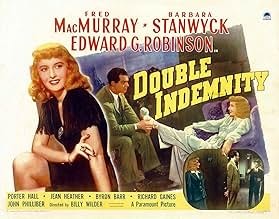
Film noir was a very popular film genre in Hollywood during the 1940s and 1950s. Many films considered classics of that period are noir, including The Maltese Falcon, Laura, and The Night of the Hunter. Critics view today’s Reel Classic as one of the best of that genre—Double Indemnity. In fact, Rotten Tomatoes lists it at #11 on their list of 100 Best Film Noir Movies.
For those who may not be as familiar with the genre, the Film Noir Foundation suggests the following ingredients: lost innocence, doomed romanticism, hard‑edged cynicism, desperate desire, and shadowy sexuality. Mix these items and film it in black and white, and you have classic noir.
Double Indemnity stars Fred MacMurray as insurance agent Walter Neff and Barbara Stanwyck as Phyllis Dietrichson. She is married to businessman Mr. Dietrichson (played by Tom Powers) and lives in a very nice house with her husband and his daughter, Lola (Jean Heather), from his first marriage. Rounding out the cast is Edward G. Robinson as Barton Keyes—Neff’s supervisor at the insurance agency and also his good friend.
The film begins in an unusual way, as the end is the beginning. It opens with Neff driving recklessly to his office building late at night, wounded and desperate, and then stumbling into his office with blood coming from a gunshot wound. He sinks into his chair, pulls out the dictaphone, and begins to record a confession. The story then unfolds in flashback.
Walter Neff, on a routine visit regarding insurance policies, stops by the Dietrichson home to meet with Mr. Dietrichson about renewing his auto insurance. Mr. Dietrichson is not at home, but Neff does have the opportunity to see Mrs. Dietrichson at the top of the stairs wrapped in a towel, and he is quite taken by her beauty. Phyllis uses the opportunity to inquire about a life insurance policy for her husband, but doesn’t want him to know about it. Neff suspects her motives but is drawn in by her charm.
Phyllis later visits Neff at his apartment, and he develops a plan to arrange a policy with a double indemnity clause for accidental death. But he must find a way to have Dietrichson sign the policy without realizing it. He and Phyllis devise a plan for Neff to visit the Dietrichson home one evening to have her husband sign the car insurance renewal, with Neff slipping the life insurance policy into the paperwork.
Neff and Phyllis then begin to develop a plan for her husband to suffer an “accidental death” while on a train ride for a business meeting. The plan is elaborate: the couple will murder Dietrichson, have Neff disguise himself as Dietrichson and board the train, and then appear to fall from the train in an accidental death. What Neff doesn’t expect is another gentleman at the rear of the train where he plans to jump off. He manages to distract the man by asking him to fetch a cigar, then jumps from the train. Phyllis meets him as planned, and they place the dead body next to the tracks. All seems to go well.

Barton Keyes is an experienced insurance manager who prides himself on ferreting out fraud. He is suspicious of the claim, but Neff assures him that Dietrichson signed the policy. Neff is then visited by Dietrichson’s daughter, Lola, who reveals that Phyllis had been serving as a nurse to Lola’s ill mother and is convinced Phyllis killed her mother to get to her father and his money. Lola also reports seeing Phyllis trying on mourning clothing several days before her father’s death.
Keyes continues his investigation and finds the witness from the train. The witness states that the photos of Dietrichson do not match the man he saw on the train, confirming Keyes’s suspicions that a hoax has been perpetrated. As Keyes digs deeper, Neff becomes increasingly suspicious of Phyllis. No spoilers here, but as mentioned earlier, the film begins with the end. Neff dictates into the machine: “Yes, I killed him. I killed him for money—and a woman—and I didn’t get the money and I didn’t get the woman. Pretty, isn’t it?”
Double Indemnity was adapted from a novel by James M. Cain, published in 1943. It originally appeared as an eight‑part serial in Liberty magazine in 1936. The screenplay was co‑written by director Billy Wilder and author Raymond Chandler (The Big Sleep, Farewell, My Lovely), who created the famous detective Philip Marlowe. Cain based his novel on an actual murder trial he covered as a journalist in 1927, in which a woman from Queens convinced her lover to kill her husband after he had taken out a life insurance policy with a double indemnity clause.
Working together on the screenplay proved challenging for Wilder and Chandler. They did not get along, and at one point Chandler walked out, refusing to return unless his demands were met. The studio gave in, and he returned. Wilder later described Chandler as “a kook, a crazy man—but he had a wonderful flair.” Their efforts paid off, as the film received significant critical acclaim.
Edward G. Robinson was initially hesitant to take the role of Barton Keyes because he would be billed third. He was used to top billing. However, he accepted that with age his roles would change, and he ultimately agreed—helped by the fact that he was being paid the same as Stanwyck and MacMurray.
Fred MacMurray was not the first choice for Walter Neff. Other actors considered included Alan Ladd, James Cagney, George Raft, and Gregory Peck. The role was not a typical Hollywood hero, and many actors were hesitant. MacMurray, known mostly for playing “nice guys” in comedies, seemed an unlikely choice, but Wilder convinced him to take the part.
At the time, Barbara Stanwyck was Hollywood’s highest‑paid actress, and Wilder wanted her for Phyllis Dietrichson. She worried that playing a femme fatale might damage her career, saying she was “a little afraid after all these years of playing heroines to go into an out‑and‑out killer.” Wilder famously replied, “Well, are you a mouse or an actress?” She took the role.

Upon its release, critics praised the film. The New York Herald Tribune called it “one of the most vital and arresting films of the year,” complimenting Wilder’s “magnificent direction and a whale of a script.” Variety stated the film “sets a new standard for screen treatment in its category.” Hearst columnist Louella Parsons wrote: “Double Indemnity is the finest picture of its kind ever made, and I make that flat statement without any fear of getting indigestion later from eating my words.”
The film was nominated for seven Academy Awards, including Best Picture, Best Director, Best Actress, and Best Screenplay. It lost to Going My Way, starring Bing Crosby and directed by Leo McCarey, which was nominated for ten Oscars and won seven. Reportedly, Wilder was so upset at losing that when McCarey walked past him to accept the Best Director Oscar, Wilder stuck out his foot and tripped him.
More recent reviews have also been glowing. Roger Ebert wrote that “the photography by John Seitz helped develop the noir style of sharp‑edged shadows and shots, strange angles and lonely Edward Hopper settings.” Pauline Kael wrote: “Every turn and twist is exactly calculated and achieves its effect with the simplest of means; this shrewd, smoothly tawdry thriller is one of the high points of ’40s films.” Rotten Tomatoes’ Critics Consensus states: “A dark, tautly constructed adaptation of James M. Cain’s novel—penned by Billy Wilder and Raymond Chandler—Double Indemnity continues to set the standard for the best in Hollywood film noir.”
Never miss a thing with our FREE weekly newsletter.
The film was adapted for Screen Guild Theater radio broadcasts twice, first in March 1945 and again in February 1950. It was also adapted for Lux Radio Theater in October 1950. In 1973 it was remade as a television movie starring Richard Crenna, Lee J. Cobb, and Samantha Eggar.
In 1992 the Library of Congress selected the film for preservation in the National Film Registry, and in 1998 the American Film Institute listed it among its Top 100 Greatest American Movies.

The Internet Movie Database (IMDb) rates Double Indemnity at 8.3 out of 10. Rotten Tomatoes gives it a Critics Score of 97% and an Audience Score of 95%. In searching my Roku device, I found only one site for free streaming—Film Noir. Not a bad site to check out if you enjoy this genre. There is also a copy of the DVD on the shelf at the Clark County Public Library.
Before I leave you with the trailer below, I will quote a passage from the Criterion site: “Has dialogue ever been more perfectly hard‑boiled? Has a femme fatale ever been as deliciously wicked as Barbara Stanwyck? And has 1940s Los Angeles ever looked so seductively sordid?... Double Indemnity is one of the most entertainingly perverse stories ever told and the standard by which all noir must be measured.”
Information for this Reel Classic review was gathered from sources including IMDb, Rotten Tomatoes, Turner Classic Movies (TCM), and Wikipedia.
