
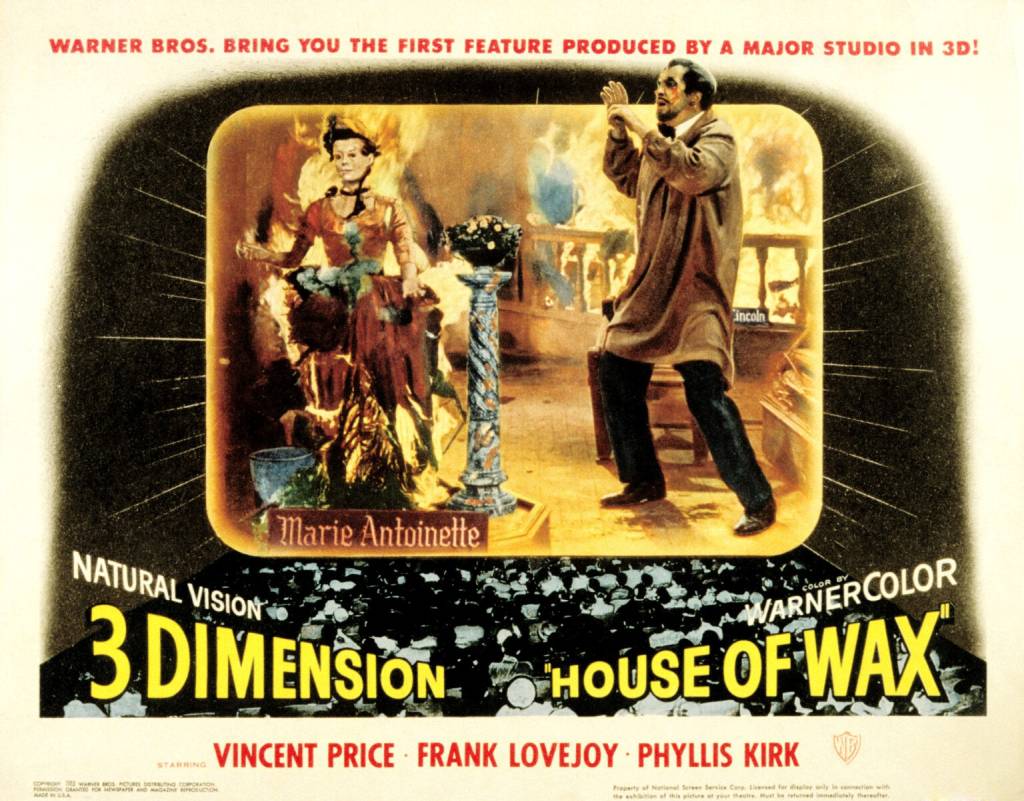
Were you aware that April marks a historic anniversary for Hollywood? I wasn’t aware until I received an email from a friend earlier this month informing me that it was the 73rd anniversary of the release of the film House of Wax. So why is that historic, you might ask?
In April 1953, House of Wax was the first major studio release of a film in 3D, color, and stereo sound — a truly immersive experience for the viewer. It was also a career-changing role for its star, Vincent Price.
The story is set in the early 1900s in New York City. Professor Henry Jarrod (Vincent Price) is a very talented sculptor who runs a wax museum featuring historical figures. He has a business partner, Matthew Burke (Roy Roberts), who feels he is not making enough money on the venture. His efforts to get Jarrod to change the exhibits to something more sensational that would draw bigger crowds is met with resistance. Burke has received an offer from a wealthy art critic, Sidney Wallace, to buy his share of the business, but Wallace is currently out of the country and won’t be back for months.
Burke decides to burn down the museum to collect the insurance money. Professor Jarrod attempts to stop him but is knocked down and left for dead.
Some time later, after Burke has received the payment from the insurance company, he is approached by a disfigured man in a long black cloak and is strangled. The murder is arranged to appear as a suicide. This mysterious figure also manages to murder Burke’s fiancée, Cathy Gray (Carolyn Jones). But before he can finish the arrangements to make it appear as a suicide, he is discovered by Gray’s roommate Sue Allen (Phyllis Kirk). She escapes to the home of her friend Scott Andrews. They later learn that the body of Cathy Gray has been stolen from the morgue.
We learn that somehow Professor Jarrod survived the fire but is permanently crippled. He is now in a wheelchair and is no longer able to sculpt, as his hands were badly damaged in the fire. Jarrod meets up with Sidney Wallace and asks Wallace to invest in a new wax museum. Unable to sculpt himself, he would oversee two assistants. His assistants are Igor (a deaf-mute) and Leon Averill (an alcoholic). To make the museum more crowd-pleasing, he agrees to include a chamber of horrors that displays acts of violence as well as the historical figures he prefers.
Wallace agrees to the venture, and we witness the grand re-opening of the wax museum. As it happens, Sue Allen is attending the opening with her friend Scott Andrews. She is quite taken and disturbed by the resemblance of the Joan of Arc figure to her former roommate and friend, Cathy Gray. Professor Jarrod states that the figure was based on newspaper photos he had seen after Gray’s death.

Jarrod then hires Scott Andrews as an assistant and asks Sue Allen to agree to pose for the sculpture of Marie Antoinette as he sees a resemblance to his most favored sculpture lost in the fire. Sue agrees and, in exploring the figure of Joan of Arc, becomes even more disturbed by seeing a very distinctive ear piercing on the figure — one that would not have been easily distinguished in a newspaper photo. She shares this information with police detective Tom Brennan (Frank Lovejoy), who agrees to investigate.
Meanwhile, Sue continues her own investigation and discovers that her friend Cathy’s corpse is indeed in the wax figure. Jarrod sees her, rises from his wheelchair, and walks toward her. Frightened, she strikes him in the face, and a wax mask cracks, revealing a disfigured face. He subdues her with the plan to make her into his new Marie Antoinette.
I will stop the storyline here, as I do not wish to spoil it for you.
House of Wax was actually a remake of a 1933 film titled Mystery of the Wax Museum. It starred Lionel Atwill (who appeared in many Universal studio’s horror films) and Fay Wray (best known for her role in King Kong). The director was the famous Michael Curtiz of Casablanca fame.
The remake opened in New York City in April 1953 and was a tremendous box-office success. The studio went all out in promoting the film, including a continuous “round-the clock” showing in Los Angeles. It was shown 12 times consecutively starting at midnight.
The midnight feature included Hollywood celebrity attendees such as Judy Garland, Rock Hudson, Ginger Rogers, and Shelley Winters. In the lobby, Bela Lugosi appeared in his Dracula attire, holding a leash attached to an actor in a gorilla costume. This was a reference to Lugosi’s film from the year before, Bela Lugosi Meets a Brooklyn Gorilla. He was paid by the studio for the publicity stunt (and, at this stage of his career, Lugosi needed the money).
House of Wax was the number one box-office hit for five weeks and was one of the biggest hits of the year. Film reviews were positive as well. Recognizing the “revolutionary” impact of combining 3D, color, and stereo sound, the critic for Variety wrote, “This picture will knock ’em dead for a ghoul. Warners’ House of Wax is the post-midcentury Jazz Singer. What ... Al Jolson did to sound, the Warners have repeated in third dimension.”
The review in Hollywood Reporter stated, “Warner Bros.’ House of Wax proves once and for all that true stereo combined with perfect color and directional sound is truly a visionary new and exciting medium.... The result has a kind of spellbinding effect on the audience, giving a feeling of realism to a completely unreal story as well as a sense of participation.”

The Critics Consensus at Rotten Tomatoes states, “House of Wax is a 3‑D horror delight that combines the atmospheric eeriness of the wax museum with the always chilling presence of Vincent Price.” In 2014, the Library of Congress selected the film for preservation in the National Film Registry.
This film was also a career changer for Vincent Price, who had been appearing in films since the 1930s, often in secondary roles or occasionally as the lead. He was seen in historical and noir films such as Laura. He was also very active on the stage and in various radio programs. But the role in House of Wax set him off on a new path, for which most of us now know him. He went on to embody the mad scientist, the fiendish villain, and other deranged characters. Most know him today for his films in the 50s, 60s, and 70s that include House on Haunted Hill, The Tingler, Return of the Fly, The Pit and the Pendulum, and The Abominable Dr. Phibes.
Price was often known to attend screenings of his films incognito. In an interview with a biographer, he recounted attending a showing of House of Wax, where he had a seat near the back of the theater. The 3D glasses and the dimly lit theater kept his identity a secret from those around him. He told of sitting behind two teenagers one evening, and after a frightening scene, he leaned forward and said, “Did you like it?”
Price said, “They went right into orbit!”
Nedrick Young portrayed the alcoholic assistant to Professor Jarrod, but was not credited. He had been a victim of the McCarthy era “red scare” and had been blacklisted in Hollywood.
The young actor who played Igor, Charles Buchinsky, went on to become famous in his own right. He changed his name to Charles Bronson and went on to act in multiple TV shows and movies until the 1990s.
And you may recognize Carolyn Jones, who later played Morticia in the TV series The Addams Family.

One of the more ironic facts involving the making of the film is the choice of director. Andre de Toth was the director, and unfortunately, he was unable to see the finished product of his efforts as others saw it. He was blind in one eye and therefore could not see the 3D effects. His focus was on creating a thrilling story.
It turned out the making of the film was more “thrilling” than expected. For the scene of the fire in the museum, de Toth had his crew set three fires before the cameras began rolling. However, the crew members quickly lost control of the fires, which burned a hole in the roof of the sound stage and even singed Vincent Price’s eyebrows. The fire department was called, but de Toth kept the cameras rolling even after the firemen arrived.
The Internet Movie Database rates House of Wax at 7 of 10. Rotten Tomatoes gives it a Critics Score of 93% and an Audience Score of 72%
Never miss a thing with our FREE weekly newsletter.
While searching my Roku device, I found the film available for free on the Movie Vault site. The DVD is available at the Clark County Public Library. Unfortunately, the experience in viewing the film will not be quite the same as it was in the theater in 1953 with 3D and stereo sound.
I mentioned earlier the film’s historical significance. Though it was the first major studio 3D production in color and in stereo, it was not the first 3D picture. In 1952, an independent film titled Bwana Devil was released in color, which depicted lions jumping out at the audience.
The success of that film is what motivated Warner Bros. to invest in 3D. However, reportedly, the very first film in 3D was released in 1922, the silent film The Power of Love. It was shown only twice to audiences wearing the special glasses provided. It was then bought by Selznick Distributing Corporation and released in 2D. Reportedly, there are no existing copies of that film.
Information for this Reel Classic review was gathered from sources including the Internet Movie Database (IMDb), Rotten Tomatoes, Turner Classic Movies (TCM), and Wikipedia.
Ron Kibbey’s Comedy Classics
If you enjoy these classic movies, please join Ron on the second Tuesday of each month at 6 PM at the Clark County Public Library for “Ron Kibbey’s Comedy Classics.” The evening features a classic comedy film, usually accompanied by a vintage cartoon. Popcorn and drinks are provided. More information about the next film is available on the library’s website and Facebook page, as well as WinCity Voices Facebook page.
