
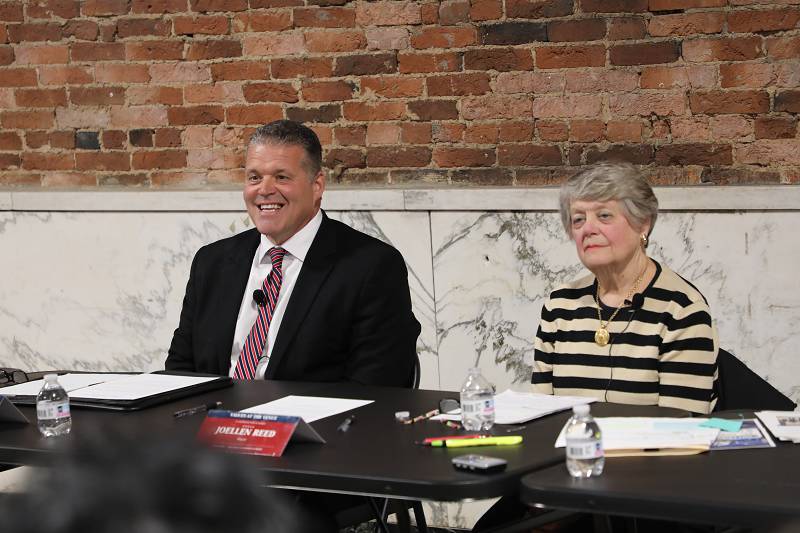

They started by pledging their friendship and ended with a big hug. But in between, Winchester Mayor JoEllen Reed and her challenger, Dr. Perry Williams, were adversaries on a few issues.
During the second night of Whiskey & Wiles’ Values at the Venue forums on Oct. 21, the mayoral candidates respectfully disagreed on taxes, borrowing, and Main Street development, but mostly agreed on data centers, Flock cameras, affordable housing, and most other matters.
The questions were submitted anonymously online by members of the community.
The downtown renovation project has been a contentious point for the two candidates. Williams, a chiropractor who owns a few old buildings on Main Street and wants to buy more, decided to run for mayor in part because of the disruption caused by the streetscape project, which involved eliminating the old steps and parallel parking on the “high side.”
Asked by the moderator whether the Main Street project had been good for Winchester, Williams said it had been overall and described the revitalized downtown as “beautiful.”
“I applaud all efforts to make our city better,” he said.
However, he added, the project had made the lack of downtown parking and handicapped accessibility worse, not better. He was also critical of the way the project was handled by city officials and its contractor, The Allen Company.
He said employees and customers would arrive at businesses to find the sidewalks broken up without advance notice, and there was one time when workers were jackhammering the sidewalk outside his gym while patrons were inside and couldn’t get out.
“We lost some businesses,” he mentioned.
People lost paychecks. Building owners lost thousands of dollars in damages.
If and when the city does its next phases of the sidewalks project, from Broadway to Depot Street and from Lexington Avenue to Boone, Williams said, there should be better communication with business owners and better planning.
“I think getting ahead of it and maybe doing it in smaller pieces” would be better, he said.
He also suggested compensating owners up front.
“There are going to be challenges” in any project, Reed said.
One challenge was the elevated sidewalks on the east side, and “that made it difficult” for the contractor, she explained.
“I hope that we take the lessons learned and apply them to new projects,” Reed said.
But in response to the question of whether the Main Street project had made the city better, the mayor answered: “Absolutely.”
In fact, she said, the night before the debate, the city had been presented another award for the project during a commission meeting.
The mayor mentioned that the city was not approved for transportation grants to complete the second and third phases of the project, but it will apply for them again next year.
On the subject of city finances, Reed started out in her opening statement defending the city’s borrowing.
There were projects that had been “on the shelf” for many years, one of them for a half century, and the money was needed for infrastructure, safety, housing and other needs.
She touted the projects the city has recently completed, including the Town Branch storm sewer, the Fulton Road extension, the splash pad for children’s recreation, the World War II and Korea veterans memorial, and the Main Street renovation.
The mayor mentioned that a large part of a multimillion-dollar loan with the Kentucky League of Cities was for the purchase of fire department equipment, including a ladder truck that was badly needed.
Part of the money from the splash pad was supposed to have come from donors, but very little private money was raised, and the city had to finish the project, so that, too, was rolled into the loan.
Williams suggested borrowing smaller amounts for specific projects.
He also noted that city payroll and utility taxes had increased, and that the insurance tax was one of the highest in the region.
“When we get in a situation fiscally where all our options are to raise taxes or borrow money, that’s not a good plan,” he said.
Reed said there are no plans to raise city property taxes.
On the question of how to provide more affordable housing, the candidates’ ideas diverged.
Reed said the city government is partnering with the Kentucky River Foothills Development Council and Habitat for Humanity to provide more low-cost housing. It has purchased and demolished derelict houses on Mutual Avenue and is going to build back apartment buildings or houses there. And it’s doing the same thing with Habitat on Lincoln Street, where old, rundown houses were razed and new ones are being built.
The city also puts liens on properties that have been allowed to run down, and it has raised more than $200,000 for more homes.
Williams said he didn’t know how much government should be involved in providing housing because the private sector usually does a better job with that. But the city can make it easier for private investors by cutting “red tape.”
For example, he said, the upper floors of big buildings downtown could be restored as nice apartments, but the structures require commercial sprinkler systems for fire. The city could instead allow residential sprinklers for those apartments.
Asked what the city could do to provide more entertainment, Reed was reminded of another question a teenager had asked her: When he graduates from high school and goes off to college, what will there be in Winchester “to bring me back?”
“That’s a powerful question,” she said.
Reed said the city is working with a company on a feasibility study to try to bring in a sports complex that would include basketball, rock climbing, an arcade and other attractions. But the indoor part alone could cost $60 million. She said she believes the city should look for “angel investors” to help with that cost.
“We are working diligently to do that,” she said.
Williams would look more to the private sector to provide activities.
“Sometimes we have those things, and they’re not supported” by the residents, he said.
He mentioned an example: the YMCA that he enjoyed when he first moved to Winchester and that later closed.
He observed that sometimes kids want to play on their “little computers” rather than go outside.
He also suggested thinking creatively. For example, he said, there is a virtual golf business right across the street from the Venue. And an upper floor of one of the old buildings downtown could be repurposed as a three-lane bowling alley.
On the controversial issues of automated license plate readers and data centers for artificial intelligence, Williams and Reed were in agreement.
Williams said he would defer to Police Chief Travis Thompson on Flock cameras. The cameras only take a still picture of a car’s license plate, don’t track people, and don’t use facial recognition technology.
But the police should make sure the data is guarded, he added.
Reed said she, too, supports the Flock ALPRs, but only for investigative purposes. Under state law, a 90-day audit is required, and on Oct. 1, the city audited its camera system and found no suspicious activity, she said. If officers use the system inappropriately, “they’re going to be in big trouble,” she promised.
The mayor said the cameras are a helpful tool to identify cars connected to Amber Alerts and crime investigations.
As for data centers, Reed said: “I am not for data centers within city limits.”
The mayor recently voted for a one-year moratorium on those facilities in the city.
Williams said the moratorium was “the right decision,” but city officials shouldn’t just sit and do nothing for a year; they should use the time to learn all they can about them.
He said he’s cautious about getting involved in things he knows little about.
“I’m not going to be the first one to go into the teleporter,” he joked, making a reference to the science fiction idea of moving humans from one point to another without traversing physical space.
It’s the same with data centers, he said, suggesting that Winchester allow other communities to go ahead first and observe how data centers affect them.
On the issue of attracting businesses, Williams said local governments can “incentivize what you want more of and go after that,” with the understanding that the tax breaks or other incentives don’t “go on forever.”
Reed agreed that incentives are important to attracting quality investment.
She mentioned that the day before the debate, she and other officials met with representatives of a company that is “strongly considering Winchester,” and if they come here, the business could bring up to 65 jobs with salaries that start at $90,000.
Never miss a thing with our FREE weekly newsletter.
In her closing statement, Reed mentioned her many years of public service and said she was passionate and excited about the future.
“I love this city with all my heart,” she said, becoming emotional.
“I know the mayor loves our town,” Williams said.
It’s just a matter of having different approaches to some things, he said.
The two then stood up and embraced.
