
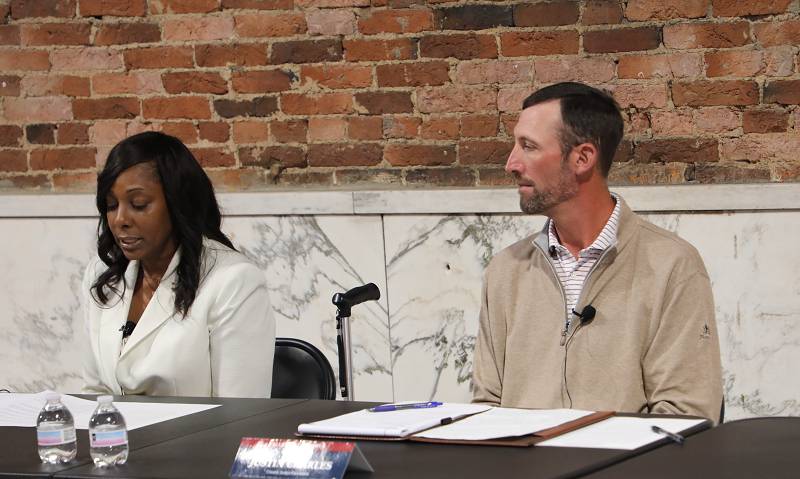

Candidates vying for seats on the Clark County Fiscal Court disagreed about how to protect their community from the adverse effects of data centers and suburban sprawl during the first of two candidate forums.
The Values at the Venue debates at Whiskey & Wiles featured candidates for county government and school board on Tuesday night and city government on Wednesday.
Questions were written by members of the public on a Facebook link to the business venue’s website.
Only two vacancies on the Fiscal Court remain to be filled by voters in the general election on Nov. 3: those for District 1 magistrate and county judge-executive, who presides over the court and is a voting member.
Who will fill the other five seats was decided in the primary election in May.
In the contest for county judge-executive, Democrat Vaché King, a program manager for an information technology company, faced off against Republican Justin Charles, a master electrician.
On the question of data centers for artificial intelligence, King pointed out that “it’s what I’ve done for the past 25 years,” and she cautioned the audience about wishful thinking.
“Data centers bring jobs in the very beginning,” but those jobs are not sustainable over time. “I just want to make sure that’s understood,” she said.
She said it’s important that residents be informed about “what is being brought into their home,” as well as what it means for the economy.
But the economic impact was what mattered to Charles.
Data centers may not require many workers, but they generate tax revenue, and Clark County needs more revenue to pay its expenses.
That’s why he’s against a one-year moratorium on the siting and development of any data centers.
“I believe a moratorium would cost us,” Charles said. “At this point, folks, I think we need to be open to any kind of business in the county.”
But King would favor a moratorium.
“Absolutely,” she said. “We should wait until we understand completely” what data centers would mean for the community.
She said the county government should use that time to have a series of public forums on the issue and “create space for people to ask hard questions.”
Some of the concerns raised about data centers is that they are often extremely large and noisy, and they use huge amounts of water and electricity. In some places, providing those resources has caused people’s utility rates to rise.
“I don’t think we know enough about data centers to make an educated decision,” said Jeannie Gwynne, the Democratic candidate for District 1 magistrate. “I would entertain the idea of a moratorium if that gives us the time to do the research that I think we should do.”
Her Republican opponent, Scott Hisle, disagreed.
“I do not support a blanket one-year moratorium on data centers,” he said. “What I do support is a process for reviewing individual proposals with public input and clear standards for utilities, capacity, noise, location, and infrastructure costs.”
All four candidates agreed that public opinion should play an important part in any decision.
“That’s our job: Bring information to the people, take their feedback, and make the best decision we can for the county,” Charles said.
The four also agreed that Clark County needs more business and residential development to grow its economy, but they differed on the details.
When asked about bringing in new businesses and providing more affordable housing in a way that protects prime farmland and limits costly suburban sprawl, Charles made it clear he’s for construction in rural areas.
Clark County has a housing shortage and needs to build more homes. If the county is going to bring in more businesses, he said, “we need places for the new workers to live.”

“I don’t know how you can stop sprawl,” he said. “If you want to have growth, there is going to be some kind of sprawl.”
“I don’t disagree with anything Justin has said,” King responded.
However, she said, she would support “the plan that is already in place,” an apparent reference to the city and county comprehensive plan.
Charles and King agreed that Veterans Memorial Parkway (the eastern bypass) is one place growth should occur, but it isn’t ready yet and needs infrastructure to be in place before construction can occur.
Asked whether Clark County should have a purchase of development rights (PDR) program like Fayette County’s to try to save farmland, Charles was against it, saying it doesn’t “make a whole lot of sense.” People keep their land, but the county government keeps the development rights, he said.
PDR is a voluntary initiative that allows a local government or land trust to buy an owner’s development rights for a permanent conservation easement.
“I’m for property owners’ rights. I do not believe that the government should be able to tell people what they can do with the land,” he said.
“I’m not sure how that would work in Clark County,” King said, but added that there might be other ways.
Asked about whether they preferred urban infill or rural development, King asked: “Why can’t we do both?”
She said there are many vacant buildings that can be repurposed for small businesses, but she would also like to see “more activity out in the rural areas.”
Charles agreed, and said he would like to see empty spaces developed first. But, he said, he would “like to see rural Clark County develop a little,” and that it would be best in the long run.
Hisle said Clark County needs growth to strengthen its tax base and provide good jobs.
“From my perspective, we should encourage investment in existing industrial areas where roads, water, and sewer can support it,” he said. “This approach will protect prime farmland and keep taxpayers from bearing unnecessary costs.”
He said some counties have grown too rapidly, others too slowly.
“We want to be somewhere in the middle,” he said.
Gwynne said the Fiscal Court should work with the industrial development authority, the chamber of commerce and tourism on the issue of economic development.
“We need to grow, but in a smart way, and we can preserve our farmland and our rural character that makes us so special. I believe we have the ability to do that,” she said.
All the candidates said they supported the Fiscal Court doing what it can to provide more resources for the county coroner’s service.
Charles said that until the county government gets back on solid fiscal ground, however, it can only do so much.
The other candidates agreed that, in Gwynne’s words, “getting our financial house in order” should be the county’s priority.
“Right now, I believe Clark County is in a financial crisis,” said Gwynne, who is a dispatcher. “In my line of work, when people are in crisis, they call 9−1−1. After decades of answering those calls, I can tell you this: When you’re in a crisis, you need someone who knows how to respond, who knows how to assess the situation, and knows how to find solutions.”
Hisle, chief financial officer for the Freeman Corporation and a former school board member, emphasized his decades of financial experience.
“I’ve spent my entire career managing multimillion-dollar budgets, making difficult financial decisions, solving problems and finding ways to make the best use of limited financial resources,” he said.
County PVA
Candidates for other county government offices and the Clark County Board of Education also had their time at the microphone Tuesday night, but there was no debate in those races because only one candidate in each race attended.
In the contest for county property valuation administrator, the incumbent, Republican Jada Brady, had the floor to herself. However, her Democratic opponent, Jason Neely, who was absent because of the death of his father, had the moderator read a statement.
Neely was Clark County’s PVA from 2018 to 2022, when he lost to Brady by eight votes. Before that, he worked as a deputy PVA in Fayette County, Kentucky’s second largest community, for nine years and eventually became chief deputy property valuation administrator there.
He emphasized his experience.
Neely said the Kentucky Department of Revenue has oversight of the PVA offices, but he didn’t work for the department; he worked for all the people of the county.
Brady said that in the four years she’s been in office, she and her staff have expanded what the office does, but “there’s still more work to be done,” she said.
One thing she wants to do is add a chatbot feature to the website so people can get automated answers to their questions in real time and not have to wait to come into the office. But she and the staff welcome people to come in or call and talk, she added.
One question submitted online asked why farmland values were raised in 2022 for the first time in 20 years.
Brady said that was the year the Department of Revenue raised their agricultural land values.
“We reached out to farmers. We sat down with them. We looked at their property. We made adjustments,” she said.
In recent years, property values have increased substantially. PVAs are required by law to assess property at 100 percent of fair market value. They have nothing to do with setting tax rates.
Brady said she added a feature on her website to allow people to look at their neighbors’ property and compare those assessments with their own.
If they disagree, owners can appeal the decision to a board, and then to the courts.
County jailer
Republican candidate for jailer Chris Grant had confirmed, but did not attend, leaving Jailer Frank Doyle, a Democrat, to answer questions alone.
Doyle compared himself to the chief executive officer of a multimillion-dollar business and said that since 2015, he has raised more than $24 million by housing state and federal inmates at the county lockup.
During his time in office, he said, he has made improvements to the Clark County Detention Center, paid off the building, installed a new HVAC unit, a new roof and kitchen, and saved taxpayers $1.5 million per year through an inmate work program. He noted that the inmates do all the maintenance on all county government property.
He houses about 260 inmates each day.
One of the questions he was asked was whether he supports a model program for treatment of inmates with substance abuse disorder.
“Not only do I support it, I have implemented the MRT program,” he said, referring to moral reconation therapy, a kind of behavioral therapy intended to break the cycle of addiction.
He also has a medication-assistance therapy program, and is working with a local group that helps women and children who are victims of domestic violence.
Doyle said that about 95 percent of the jail’s inmates have drug or alcohol problems.
School board
Valerie Frost, a write-in candidate for the school board’s District 4 seat, was the only school board candidate who attended the forum. She is one of two write-ins. The other is Katie Brashear Jones, who couldn’t attend because of other obligations, but had a statement read.
“Our children deserve a school board member who prioritizes students and families, supports teachers, and puts the best interests of our schools first,” Jones said.
As a young mother of six children and someone who isn’t a politician, she said, she would bring a “fresh perspective.”
The incumbent is Ben Dorsey, who has been charged with complicity to theft of money from the Winchester Youth Soccer League. Dorsey, who says he is “vigorously defending” himself against the accusation, remains a candidate.

Frost, a former Head Start and kindergarten teacher, is now a child welfare advocate.
Most of the questions asked by members of the community had to do with taxes and spending.
One asked whether the board should consider an occupational tax rather than relying heavily on property tax.
“Legislation was passed this year that would prevent that, starting next year,” Frost answered.
HB 757 was enacted in the 2026 session of the General Assembly and restricts school districts from establishing new occupational taxes beginning Jan. 1, 2027.
Never miss a thing with our FREE weekly newsletter.
In response to another question, Frost said school board members have a responsibility to carefully steward tax revenue in a way that benefits students and families.
“That’s not my money,” she said.
Frost said she couldn’t say whether she would lower taxes because that would be a question for the whole board and would involve listening to families, looking at what property assessments are, and seeing what the needs are.
The school tax rate of about 65 cents per $100 of assessed value is the largest tax on people’s tax bills, but the rate is typically lowered to a “compensating rate,” which generates the same amount of revenue as the year before, or a rate that brings in less than a 4 percent increase in revenue over the previous year.
