
Affordable housing. Businesses. Cameras. Data centers.
Those were some of the wide range of topics Winchester’s city commission candidates talked about during the two-hour Values at the Venue forum last week at Whiskey & Wiles.
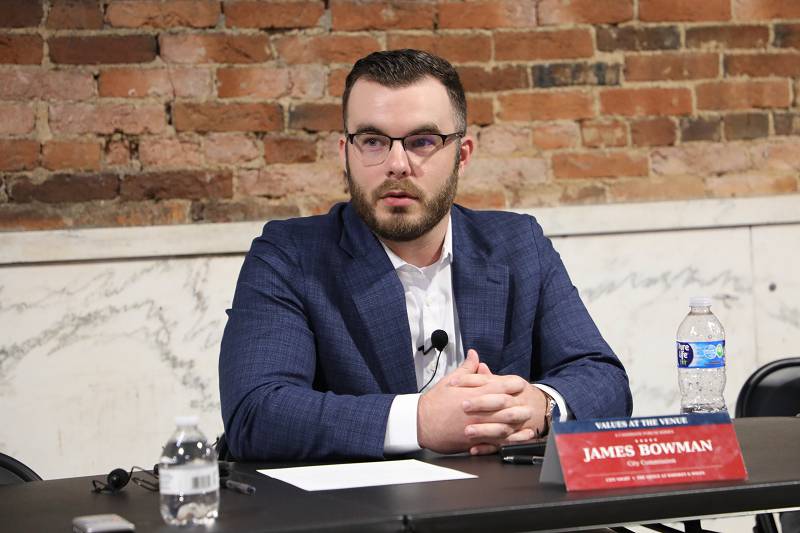
Ralph Harrison, Kenny Book, James Bowman, and incumbents Joe Chenault and Kitty Strode answered questions submitted online as an in-person audience quietly listened.
Two candidates for the Board of Commissioners, Tara Asbury and Jim Caldwell, did not attend the event.
How to provide housing for low-income people was a concern of all the candidates.

Strode said the city has been working with Habitat for Humanity to build affordable family homes on Lincoln Street and buying up and demolishing dilapidated property on Mutual Avenue and other places to build better housing.
“We’re working hard to make it possible, and it’s not easy,” because interest rates and construction costs are rising, she said.
Book said part of the problem is big corporations buying up rental properties and then raising the rents on working class families. The city needs to find out how what can be done to prevent that from happening, he said.
Chenault and Harrison said that working with the U.S. Department of Housing and Urban Development on urban renewal projects might be part of the solution. Chenault said that he had in the past been involved in HUD projects on Washington Square and 1st and 4th streets.
“We do have a grant writer, so she might be able to do the same thing as we did then,” he said.
Bowman said the city government needs to “get creative” and provide tax incentives for building new housing.
“With these interest rates, it’s very difficult for people, even with a modest salary job, to afford a home, especially with costs rising,” he said.
Attracting and keeping new businesses was another area where the candidates differed.

“We need a grocery store downtown because there’s people that don’t drive” from their apartments at the Phoenix House, the Brown-Proctor, and other places, Book said.
He added that city officials should contact Kroger and Walmart and see if one of them can locate a “mini” version of a supermarket somewhere within walking distance of downtown.
Book also suggested that Winchester shouldn’t permit restaurants to have “non-compete clauses” that keep competitors in their vicinity from selling alcoholic beverages.
Commercial development is hard in Winchester, he said, because “we are too close to Hamburg to get a lot of businesses.”
Bowman suggested the city start a “business success committee” made up of successful local business owners who can share their knowledge and experience with newcomers.
Bowman owns High Speed Collectibles, a trading card and games business that struggled in the beginning.
“The only thing that saved us was online sales,” he said, but some business owners may not know how to do that and could benefit from advice.
He also suggested start-up grants, not only for downtown businesses, but those on the bypass and other places.
“If you want to start a business, you have to reach out to other business people,” Chenault said.
That was also Harrison’s suggestion.
“I would contact businesses in other towns and see what they’re doing that works,” he said.
Harrison indicated, however, that the market can be saturated with too many of the same kind of business.
The newcomers “don’t knock out the first guy” because he’s well established, he said.
The Industrial Development Authority has done a good job of bringing in new industry, Strode said, but the downside to that is that the Winchester Industrial Park is running out of room and needs to expand, which means buying more land.
On the controversial subjects of Flock cameras and data centers, the candidates were mostly in agreement.
Book defended the Flock automated license plate recognition cameras, and said they have been helpful to police in locating vehicles used in crimes, including the recent killing of a state trooper and the robbery of a BP station in Winchester.
“If we hadn’t had that, the robber would have gotten away,” he said.

Harrison said he had “mixed” thoughts about the cameras. It’s a privacy issue for some, he said, but added, “I’m not sure that privacy overrides” public safety.
He said he was about “80 percent” in favor of them.
“I’m 100 percent for Flock cameras,” said Chenault, who works for the Sheriff’s Office.
So was Strode.
Bowman said he had concerns about privacy, but the police chief had assured him that there are strict safeguards against improper use.
“People with bad intentions are going to do bad things,” he said, but “there are heavy consequences for that, and that makes me feel better about it.”
Harrison said he was “kind of up in the air” about data centers because he didn’t know how it would affect the water supply and water pollution.
Book said the city doesn’t need them.
“If the county wants it, fine, but we don’t have land in the city,” he said.
Bowman also doesn’t want them in the city.
And, he mentioned, they don’t bring in many permanent jobs.
“Once it’s built, it’s pretty much self-operational,” he said.
“I don’t think it would be good for the city,” Chenault agreed. “I don’t think it would be good to put one in the county,” he added.
Strode mentioned that the commission had voted to impose a one-year moratorium on data centers.
“We really don’t have enough information yet,” she said.
There was some discussion during the debate about the city’s Main Street project, including plans for eventually expanding the renovation north toward Depot Street and south to Boone Avenue if the city can get more grant money.
Chenault said he would like to see better communication with property owners.
“I think that might have been one of our problems,” he said.
If the contractor is going to tear up a section of sidewalk, business owners should be told four or five days before, and the contractor should maintain access to their properties.
Strode suggested doing smaller sections of sidewalk rather than a whole block at one time.
“Don’t tear up more than you can fix back at night,” Book agreed.
“I was personally affected by this a number of times,” Bowman said. “There were at least three days I showed up in front of my building and the concrete was busted up. I had no notice of it. We had to close those days.”
Bowman suggested that there be better oversight next time, and stick to the provisions of the contract, which required that people have access to their property.
“Nothing against the people who were over it; it was just a lack of experience,” he said.
“It had to be done,” Strode said, because the old sidewalks were falling apart.
Never miss a thing with our FREE weekly newsletter.
And there are so many new businesses since the renovation.
“I think downtown is thriving right now,” she said.
Chenault agreed, saying “it was a great project.”
On the issue of taxes, all of the candidates agreed they shouldn’t be raised.
Bowman said that 60 to 70 percent of the city’s budget is made up of payroll tax revenue, and the way to expand the budget is to get more businesses to relocate here and help existing ones thrive so they can add more employees. But don’t increase the tax burden on working people. “Their lives are already hard enough. We shouldn’t make them harder,” he said.
