

Manufacturers would not have to label certain pesticides and herbicides as potentially carcinogenic under a Senate bill that passed both chambers last week and was sent to the governor for his signature.
The bill, which was amended to apply only to agricultural use of the products, states that the existing warning under federal law “shall be deemed a sufficient warning label” to fulfill a manufacturer’s obligation.
That warning does not label the products as cancer-causing.
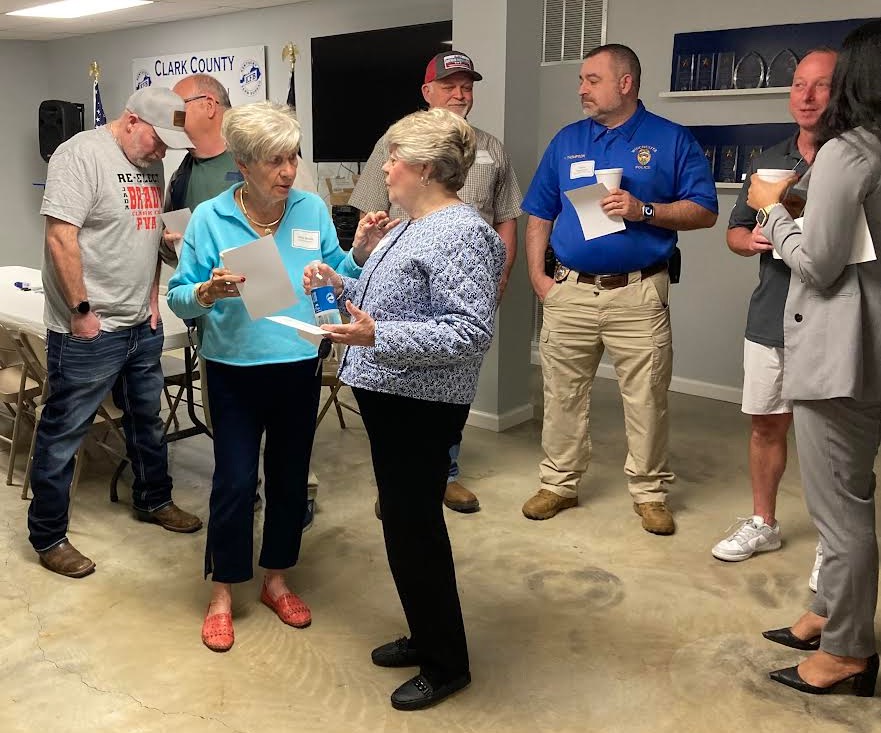
During a Clark County Farm Bureau appreciation breakfast Saturday, lobbyists and lawmakers who support SB 199 talked about why it was important.
Kyle Kelly, the Kentucky Farm Bureau Federation’s director of public affairs, explained that the federal Environmental Protection Agency mandates what goes on the labels of “crop protection tools” that farmers use regularly. In 2015, he said, a study in France found that some of those products may cause cancer.
Kelly was referring to a study by the World Health Organization’s International Agency for Research on Cancer that determined that glyphosate, marketed by Monsanto under the brand name Roundup, was “probably carcinogenic.”
“We don’t go around looking for controversial issues, as you know, but that one was something our membership said we need to act on.”
Kyle Kelly, Kentucky Farm Bureau
However, the EPA has approved the use of the product, which has been on the market for decades. Its use is allowed in the U.S., Canada, and the European Union.
Kelly said the news media described SB 199 “in a way that wasn’t a hundred percent factual,” and KFB has worked to inform legislators and the public.
He said 170,000 lawsuits have been filed across the country claiming that the chemicals were improperly labeled.
“We don’t go around looking for controversial issues, as you know, but that one was something our membership said we need to act on,” Kelly said.
He added that KFB appreciates the work that Sen. Greg Elkins and Rep. Ryan Dotson — both Republican state legislators from Winchester — did in the General Assembly to support the bill.
“We got thousands of emails … opposing bill 199,” Elkins said, and it would have been easy for legislators to vote against it. But then, he added: “We started hearing from farmers, and the farmers started telling us why it’s so important that Senate Bill 199 passes.”
There was quite a bit of “misinformation” about the legislation, he said.

“It is simply a labeling bill, but it protects pesticides and products that farmers need and must use, or else you’re going out of business,” he said.
“If you look at who voted against it on the floor, it was the trial lawyers and the Democrats,” Elkins said.
However, many Republicans voted with Democrats in opposition to it when it passed the House 53–37 on March 17, and when the amended version was approved by the Senate 24–11 two days later.
Two of those who voted against the bill were legislators who represent Jessamine and Fayette counties: Rep. Matt Lockett, a Republican and financial adviser, and Rep. Adam Moore, a Democrat and a self-employed project manager for military hospitals.
According to the Kentucky Lantern, Lockett said he could not in “good conscience” vote for the measure because it would limit the right of consumers to sue pesticide companies for failure to warn them of health risks.
“We cannot make America healthy again if we make it illegal to hold the people making us sick accountable,” said Moore, noting that Kentucky leads the nation in cancer. “We should be leading the way in consumer protection, not leading the way in corporate immunity,” he said.
Elkins said he expects Gov. Andy Beshear, a Democrat, to veto the bill.
However, Republicans have a large enough majority in the House and Senate membership that they can usually override vetoes.
Tom FitzGerald, an attorney for the Kentucky Resources Council and adjunct professor of environmental law at the University of Louisville, said in an op-ed for the Lantern that the bill would shield pesticide manufacturers from failure-to-warn liability claims and that Kentucky would be only the third state to adopt that kind of restriction.
Dotson, who is running for Congress and serving his last term in the state legislature, said that in the last budget session, he and Elkins were instrumental in obtaining “record funding” for the 73rd House District, which includes all of Clark County and part of Fayette. He expects Clark County will also receive many millions more this year.
Other bills the Farm Bureau has supported this session include House Bill 142, which would make it easier to get tags to kill deer out of season if they’re ruining a farmer’s crops, and HB 542, which requires greater transparency, proper notification, and adequate compensation when eminent domain is used to take a landowner’s property.
Anne Marie Franklin, governmental affairs director for KFB Insurance, commended Elkins for sponsoring personal injury protection legislation after a roofing company took ratepayers’ money but never put roofs on buildings.
“The federation’s main priority is to protect you, your farm and your operation, and the insurance company, our main goal every day is to protect you and your assets,” she said.
Never miss a thing with our FREE weekly newsletter.
Jeremy Jones, Clark County Farm Bureau president, welcomed the guests at the breakfast, and David Wills, the county bureau’s first vice president, introduced the officials who attended.
Other speakers included Drew Graham, KFB executive vice president, former Clark County judge-executive and former state representative, and County Attorney William Elkins, who described himself as a Farm Bureau “friend.”
“I’ve never seen a harder working organization than Kentucky Farm Bureau,” the county attorney said, noting that “they are everywhere” from ball games to the state Capitol.
“They’re so important to our community,” Elkins said.

