(If you missed it, you might want to part one before proceeding.)
G. Lee Wainscott succeeded in his business ventures, beginning with the Roxa Kola brand of soda pop. He was not always so fortunate in his personal life.
Wainscott married Sarah Bell Miller in 1895 during a sojourn in Texas and brought her to Winchester. He bought a lot in the Thomson Addition at the southwest corner of Maple and Belmont, where the couple built an elegant home, completed in the year 1899. The newspaper reported that the Wainscotts “had built a splendid home in a popular residence portion of the city.” Lee and Sarah sailed abroad for a tour of Europe and the Paris Exposition. Everyone supposed that “there was nowhere a more loving, happy and contented couple.”
The Roxa Kola factory was thriving, and Wainscott had established a reputation as one of Winchester’s leading merchants. He was investing in local real estate and was a member of the city council. Then came a family tragedy in June 1903, in which Wainscott shot and seriously wounded his sister-in-law, Margie Miller.
Wainscott described what happened in a statement released by his attorney, Edward S. Jouett. “Some time ago I invited my father-in-law, D. J. Miller of Waco, Texas, to come and make his home with me. When he came Miss Miller was with him and immediately after their arrival influences were set to work to alienate my wife’s affections.” Miss Miller was so persistent that Sarah left her husband and moved into another part of the house with her sister.
Wainscott said on the night of the tragedy he tried to embrace his wife and was attacked by Miss Miller and her father. “Miss Miller struck me on the head with a heavy cane, and Mr. Miller tried to cut my throat with a knife. In anger and excitement on account of such treatment I drew my pistol and fired without definite aim.” His bullet struck Miss Miller over the heart, passed through her lung, and exited her back. She was taken across the street to the home of John Bean and ultimately recovered. Wainscott was left with a cut over his eye and blood running down his face.
Wainscott was charged with malicious shooting. At his trial the jury returned a verdict of “shooting in sudden heat and passion” and fined him $500. Sarah was granted a divorce. By that time, Wainscott had agreed to an out of court settlement with his ex-wife and Margie Miller.
By 1906 Wainscott had recovered nicely. In February of that year he sold the house at Maple and Belmont, moved into the house he had built next door on Belmont and in April married Jane Rogers (daughter of Harvey and Nettie Rogers of Wades Mill), the second marriage for each.
In 1908 he began selling Roxa Kola. With his reputation apparently still on the uptick, that year he was the Democratic party candidate for Congress from the 10th district but withdrew from the race before the election. (Nine years later, Wainscott ran for state senator but again withdrew from the race.)
Lee and Jane moved their residence again, purchasing the large house at the southeast corner of Maple and Hickman (now the office of Michael Caudill, CPA). During World War I Wainscott was a dollar-a-year man, serving as chairman of the Clark County Fuel Board. After the war the couple sailed to Europe to visit Jane’s great-uncle, Gen. Henry Allen in Coblenz, Germany. At the special request of Governor James Black, Wainscott viewed the cemeteries where Kentucky’s World War I victims were buried. On his return, he submitted a report to the governor, was made an honorary colonel on his staff, gave a speech to the general assembly, and provided photographs of the graves to family members.
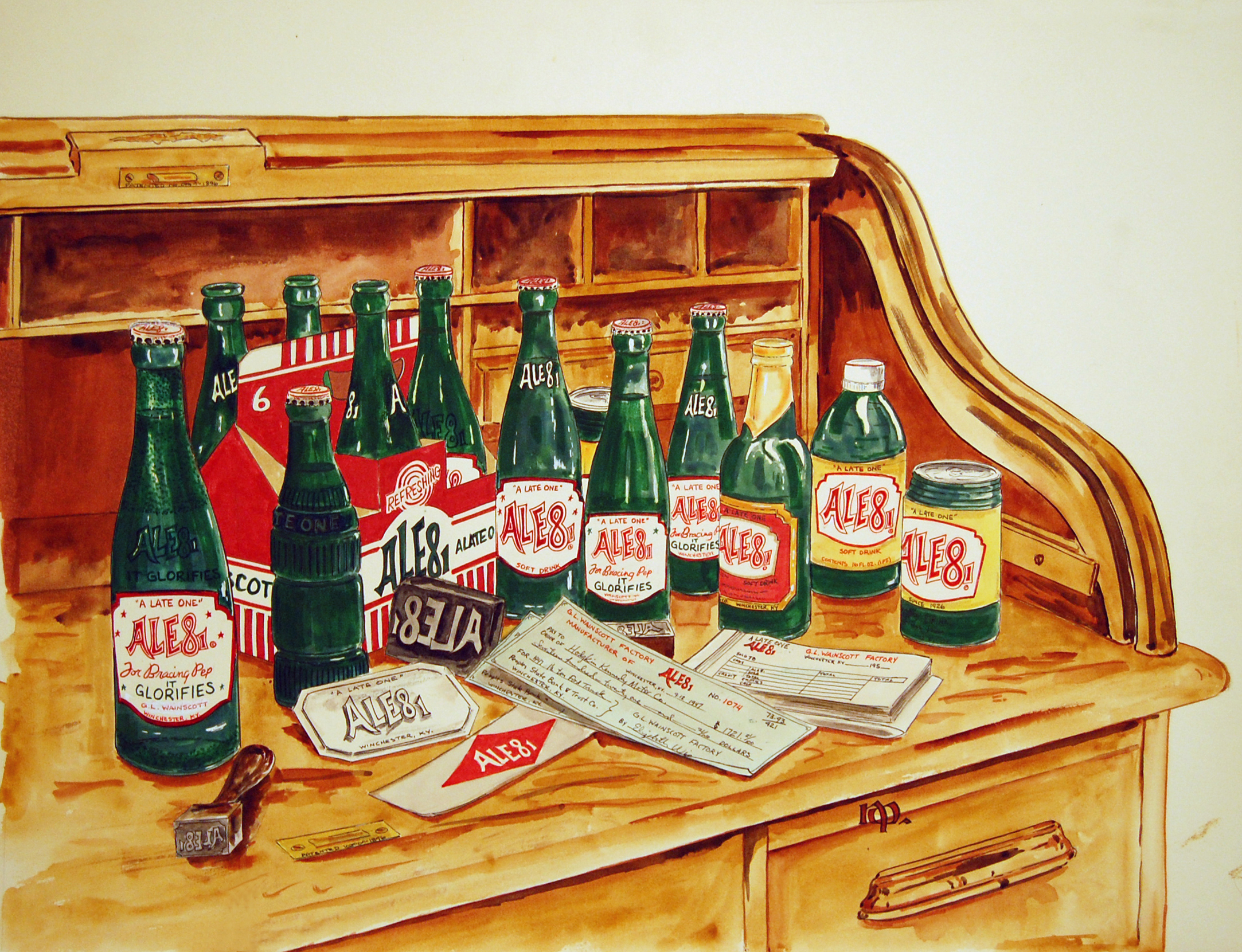
It was on this European tour that Wainscott is said to have acquired the ginger-blended recipe which he perfected as the formula for Ale-8-One. He launched this new soft drink in 1926. According to the company history, “Wainscott sponsored one of America’s first ‘slogan’ contests at the Clark County Fair. ‘A Late One,’ the winning entry, was a pun adopted for its description as the latest thing in soft drinks.”

The drink was so successful that in 1935 he moved his growing factory to a two-story brick building at the northwest corner of Broadway and Wall Alley. That year he registered a new trademark for “a non-alcoholic, maltless beverage, sold as a soft drink” with the U.S. Patent Office, stating that it had been “continuously used and applied to said goods in applicant’s business since July 13, 1926.”
Wainscott was active in the business and civic affairs of the county. He was a director of the Winchester Bank, the Clark County Warehouse Company, the Clark County Health and Welfare League (later became the Clark County Health Department), the Kentucky Baptist Children’s Home in Glendale, a trustee of the First Baptist Church, and a delegate to the Democratic National Convention in 1936.
He was a member of the Commercial Club, the Elks Club, and Winchester Country Club (he was an excellent golfer). Wainscott was one of the first to press for the erection of a county hospital, which he began advocating for in 1912. When the Clark County Hospital was built in 1933, he was on the fundraising committee, the building committee, and then served as the president of the board of directors. He donated the funds to build Wainscott Hall, the hospital’s nurses’ quarters on Wainscott Avenue.
The year the hospital opened, Wainscott was involved in an automobile accident on the way to the Century of Progress Exposition in Chicago. The car he was driving blew a tire, plunged over an embankment and down a 300-foot hillside near Covington, turning over several times on the way down. In the car were Miss Anna Gordon, Miss Katherine Lyons, Miss Lena Reeves, and her sister-in-law Mrs. Frances Reeves. Amazingly, none of the passengers was injured, and the party continued to the World’s Fair by train.
G. Lee Wainscott died in a Cincinnati hospital on May 15, 1944. He is buried in Lexington Cemetery. In his will he left half of the soft drink business to his wife Jane and the other half to his employees Marshall Jones, Elizabeth Winburn, Sherman King and Herbert Napier. At her death Jane Wainscott left her share to her brother Frank Rogers, who bought out the interest of the others. The Rogers family still operates the Ale-8-One Bottling Company.
The Kentucky Historical Society will honor the Ale‑8 Company with an historical highway marker soon to be erected near the Carol Road bottling plant.