
This is the first of four installments of this serial story. Check back on Thursday for part two.
“Blimey, will this war never end?”
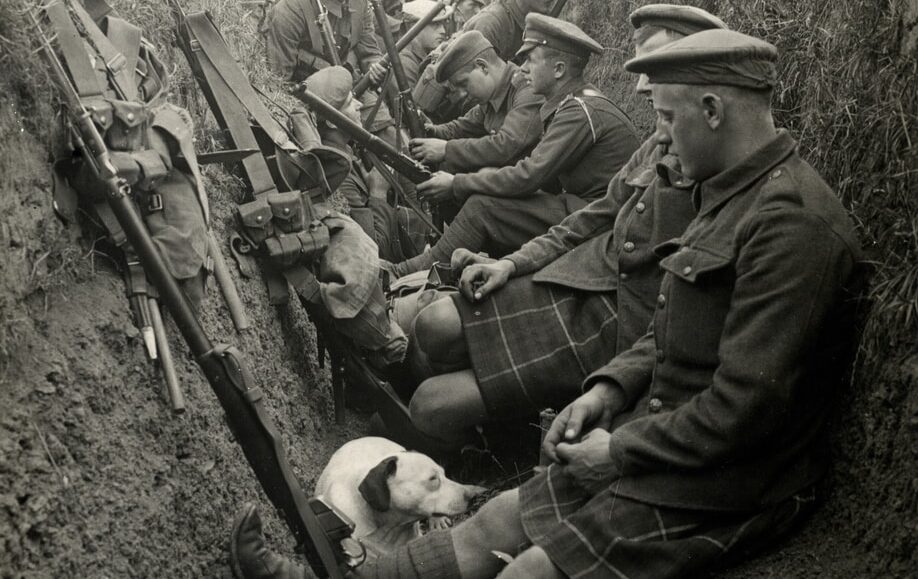
The question came from Danny Cross, a British lance corporal, as he tried desperately to light a sodden cigarette and sat partially submerged in muddy water at the bottom of a trench at Ypres, near the western border between Belgium and France.
Rain was falling, as it had since just after midnight last night, and it ran down and dripped from the perimeter of his Mk I helmet onto his neck and made the lighting of a cigarette virtually impossible.
Artie Cairncross, sitting next to Danny, was as miserable in the cold rain as was Danny as both men cradled their Enfield rifles between their knees and tried vainly to keep the rain from making the weapons useless.
Danny continued, “I’ve been in this bloody war since ’16, after Haig took over and decided that the way to win the bloody thing was to throw us ‘cannon fodder’ willy-nilly against the Huns’ machine guns. I was lucky enough to have missed the slaughter at Verdun, but I got me bloody arse thrown into the breach at Guillemont. The Somme was a real bitch.”
“I know what ya mean,” muttered Artie, his voice shivering along with his body under the cold rain. “I ain’t been in the trenches as long as you, Danno, but it still seems an eternity when you got conditions like this. ‘Course, it seems an eternity, too, when you’re bustin’ arse tryin’ to get ‘cross ‘no man’s land’ with those bloody German machine guns blowin’ the guts outta the mate runnin’ next to ya.”
“Too bloody long, Artie boy.” Danny puffed on the cigarette, barely able to keep it lit under the soggy conditions. The smoke he exhaled seemed to catch the raindrops and illuminate them and the warmth of the smoke in his lungs did nothing to assuage his misery. Before finishing his smoke, he tossed the remainder of it into the water-laden bottom of the trench, disgusted by his inability to enjoy something as simple as a leisurely smoke.
“Lots has happened since I’ve been here, Artie boy.” Danny seemed to take great pleasure in adding the word ‘boy’ whenever he addressed Artie. Perhaps it reinforced Danny’s opinion that he was now an old and tried trooper who had been through a great deal more than most of those who occupied the trench with him.
He had grown to like Artie and had taken him under his wing to try to teach him some of the things that might help keep him alive. Of course, a quick end to the war would increase the chances of both of them surviving, but no quick end was in sight despite the horrific losses that both sides had already suffered.
Danny droned on. “We heard that the Yanks had joined us back in June of ’17. Bloody good timing on their part, I’d say. We been doin’ all the fightin’ and dyin’ for three years before they came in and I guess they felt they was doin’ us a great favor at that. Still, I’m not sure how much longer jolly ol’ England could go on alone. Well, mostly alone, anyway. The damn Frenchies ain’t helpin’ much, are they, except to send their boys up to charge the Huns’ lines and get cut down?
“It’s kinda funny, really. England and France was fightin’ each other for hundreds o’ years and now, all of a sudden, it seems, here we are fightin’ on the same side.”
The conversation going on between Artie and Danny was only muted by the constant drum of the rain. Though they were surrounded by other members of their company, few words were being passed about. Most of the men in the trench were much too miserable to engage in conversation.
Trenches on both the Allies side and the German side were virtually endless fortifications, running for miles and miles across the French and Belgian and German countrysides.
Their excavation required countless hours of digging by war-weary troops who knew that they offered limited protection, except from direct fire.
A lucky high-angle shell from a howitzer or mortar could come screeching straight down into a trench and devastate anyone unfortunate enough to be near the landing zone. Even though the trenches zig-zagged along their length, an exploding shell within one could kill or maim a good many men, with shrapnel and concussion.
And if the shells contained mustard gas or nerve gas, the bottoms of the trenches could become unlivable until the gas had dissipated.
Never miss a thing with our FREE weekly newsletter.
Still, the trenches did offer some protection from the dreaded machine guns which had come to dominate the landscape since Vickers and Maxim had worked so feverishly to improve on the work of Dr. Gatling, who believed that his machine gun would actually end war.
But when the Tommies and the Huns left their trenches to throw themselves against their foes, the Vickers and the Maxims began their deadly harvest, scything down advancing troops without mercy and littering the battlefield with dead and dying.
And yet, anyone foolhardy enough to peer above the parapet of the trench to try to get a glimpse of the enemy risked being shot by a sniper in a far trench or raked by machine gunfire.
“Come on, Artie,” urged Danny. “Let’s go see if we can round up some grub at the field kitchen. Even if they ain’t got nothin’ worth eatin’, maybe we can get a cup o’ hot tea.”
The two men trudged along the trench, trying to avoid stepping on the outstretched legs of their mates and resisting the viscous mud that sucked at their boots and increased their weariness.
