
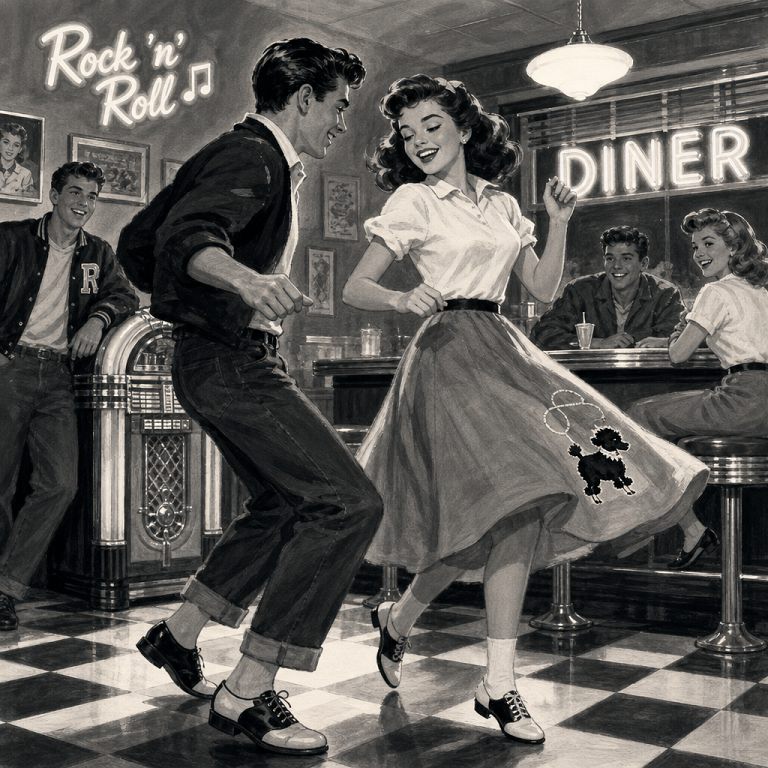

I receive a daily email called “This Day in History.” It lists a number of notable events that have taken place on that day, ranging from early Greek and Roman times to the first decades of the twenty-first century.
One of the — somewhat humorous — events that occurred on June 3, 1956, was “Rock ‘n’ roll is banned in Santa Cruz, California.”
This struck me as funny because it was right in the midst of my teenage years, when I was totally immersed in the rock ‘n’ roll craze, like everyone else.
I must say that at the time I had no inkling that the adult population held such a negative view of the trend; my parents never uttered a word of concern about my musical tastes.
Flynn’s, on Boone Avenue, was a favorite hangout for us. It had a jukebox and a dance floor where we could revel in the music of the day, purchase snacks and soft drinks, and play pinball machines.
Teen Town was another place we could frequent. It was a one-story, long, clapboard-sided building located back and to the right of what is now College Park Gym. We were overseen by Mrs. DeVary, a wonderful lady who volunteered her time to keep us in check during the evenings. At Teen Town, we were also able to dance to jukebox music, play ping-pong, and pool.
Rock ‘n’ Roll ushered in the 50s, following closely on the heels of the Big Band era, which had shepherded the country through the throes of World War II. It was flamboyant. It was loud. It was raucous. And it was probably all these things that brought it into disrepute amongst the older generation.
It’s possible that it didn’t gain any widespread acceptance until the airing of Dick Clark’s American Bandstand. Bandstand had its start as a local broadcast around Philadelphia in 1952 and became a national phenomenon in August, 1957 when it went on national TV on ABC.
Each program was notable for featuring a current rock ‘n’ roll star who lip-synced his or her hit while the dance floor filled with Philadelphia teenagers gyrating to the music.
Music of the day highlighted artists such as Elvis Presley (famous for having his hip gyrations cropped out of his TV appearance on the Ed Sullivan Show), Chuck Berry, Fats Domino, Little Richard, Jerry Lee Lewis, Frankie Avalon, Paul Anka, Connie Francis, and scores of others. We now look back and listen to the tunes of these individuals with nostalgia.
But back to the Santa Cruz ban. According to Santa Cruz police lieutenant Richard Overton, a crowd of some 200 teenagers had packed the Santa Cruz Civic Auditorium for a dance in which the teenagers were “engaged in suggestive, stimulating and tantalizing motions induced by the provocative rhythms of an all-negro band.”
Never miss a thing with our FREE weekly newsletter.
It seems obvious now that the event’s multiracial aspect may have contributed to the shutdown.
Within the next two weeks, Asbury Park, New Jersey and San Antonio, Texas instituted similar bans on public rock ‘n’ roll events, citing “undesirable elements.”
Obviously, these bans did not deter the evolution of rock ‘n’ roll as it continued into the early 1960s until overtaken by the Vietnam-era anti-war music and the likes of Woodstock.
We can now look back on the rock ‘n’ roll era as one of the great periods of American history, at least to a vast segment of people who were of the right age at the time and who reveled in the music, while their elders were concerning themselves with McCarthyism and red scares and the hydrogen bomb.
