
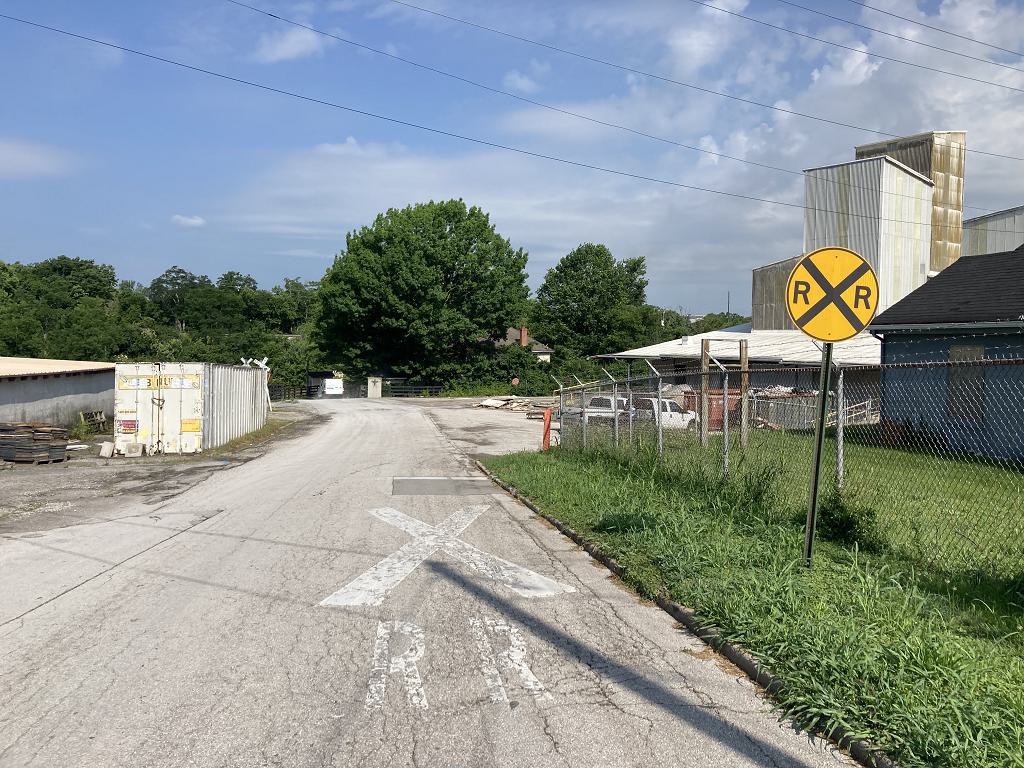

Big trucks no longer rumble down 7th Street, leaving a wake of gravel dust that settles on cars and houses in the quiet neighborhood. That’s because their destination, Gate Precast Company, closed five years ago.
However, the City of Winchester is still pursuing a street extension project that has been a priority for decades because truck traffic is still an issue along another nearby residential street.
Large trucks use Magnolia Street off Maple to access the Freeman Corporation’s plant, which manufactures hardwood veneer.
In addition to alleviating the truck traffic problem, officials believe the project would benefit the city by spurring commercial development near the intersection of Maple Street and Veterans Memorial Parkway, just south of the I‑64 interchange.
And another reason they want to continue the project is that the city and state governments have already spent too much time and money on the project not to finish it.
City Manager Mike Flynn, when asked recently about the concern of a former city official that the city needs to use the money or it will lose it, said he doesn’t think that will happen.
“We’re so far down the line now,” he said. “You never say never, but we’re at a point in the project where neither the state nor the city wants to lose the funds that have been expended on this project, and they’re going to act accordingly.”

Currently, the project is scheduled to be completed in December 2027, but Flynn said that, realistically, it will probably take at least another year.
It is also likely to end up costing more than the original $4.45 million estimate, he said.
When the project first began, the main concern was that gravel trucks had to go through the narrow 7th Street neighborhood to Gate Precast’s plant, which manufactured prefabricated concrete for structures. But in 2021, the company announced it was closing the plant at 101 N. 7th St., one of Winchester’s oldest factories, because it was consolidating its Winchester operations with those of its other nine locations, at Ashland City, Tenn.
However, funding had already been allocated for the 7th Street extension, with the city’s match expected to be $800,000. The city budgeted $300,000 but anticipated also using $500,000 from the state’s Rural and Secondary Road Program discretionary fund.
The state approved $240,000 for the original project design, which was completed on a preliminary basis.
Working with the Transportation Cabinet’s District 7 office and Palmer Engineering, officials got CSX to approve a railroad track crossing and got all the permits required from state agencies.
In early 2021, it was determined that there was a $246,500 shortfall and that the city would cover that cost.
At that time, Flynn said, it was determined that a significant part of the cost of the project was associated with relocating water and sewer lines, gas lines, and other infrastructure.
“It was well over half of the cost of the project,” he noted.
So, in 2024, the city commission asked Palmer Engineering to look at a redesign of the project to eliminate some of that relocation work, and the completion date was extended to Dec. 31, 2027.

Palmer Engineering is working to obtain the FEMA flood study information that is required, and they’re having to recreate part of that to submit to “the proper authorities,” Flynn said.
The city manager said the District 7 office has reviewed the right-of-way plans, and Palmer is continuing to work on the drainage analysis and get appraisals for the right-of-way acquisition.
Never miss a thing with our FREE weekly newsletter.
The hard part of the puzzle, Flynn said, is going through the legal process necessary to obtain the right-of-way necessary to extend the corridor.
It was made even harder, he said, by changes in the last legislative session regarding eminent domain and regulations, which lengthen the process.
“If we can get the right-of-way, I believe the project should move along expeditiously,” he said.
From the city government’s perspective, Flynn said, the extension “is still, I think, a very much needed state project.”
