

As Stephen Berry explained the purpose of the quick-build street project at Boone Avenue and College Street, a big 18-wheeler blew through the intersection and downshifted as it approached Maple Street.
Moments earlier, three motorcycles had roared past the gathering, and some big dump trucks had rumbled along.
“There’s been a lot of complaints about Boone Avenue” from residents and others, Berry said.
Most vehicles along that section of road are going 35 miles per hour, which is the speed limit, but 35 seems fast to neighbors or those walking along the street, Berry noted.
“What we decided to do was ‘traffic calming’,” he explained. “It’s to slow the traffic using physical barriers or virtual barriers.”

Berry, the city and county geographic information system coördinator, was one of the members of Smart Growth America’s Complete Streets Leadership Academy for Winchester that chose the temporary street safety project.
It is funded by a $20,000 grant from the Washington, D.C.-based nonprofit.
Among the others involved were Brandi Peacher, Brian Sewell of Winchester Public Works, Casey Smith of the Transportation Cabinet’s District 7 office, Alyshia Martin, Rob Jeffries of the Planning Commission, and Kayla Walton.
The project was completed last Thursday, June 18, when white markers were placed in the intersection. The project also includes painted crosswalks with handicap ramps, bicycle lanes, and markings that narrow the turns.
“A quick-build project means that it’s not permanent. It’s a demonstration project so that we can study the way that people behave going through this project area,” Berry explained. Berry said the group would like some of the project to become permanent, such as the crosswalks, but the white collapsible posts will be temporary.

The encroachment permit is for 90 days, so the project will be up after school starts back in late summer.
“We’re interested in what will happen when school starts, and the buses start going through here,” Berry said.
“It’s a community project to see and learn and understand how this impacts safety,” he explained.
He mentioned that some of what is learned could be used for permanent projects on city-owned streets. Boone Avenue, or Ky. 627, is a state highway that receives federal funding.
Smart Growth America funded three projects in Kentucky this year. The other two are in Bowling Green and Morehead.
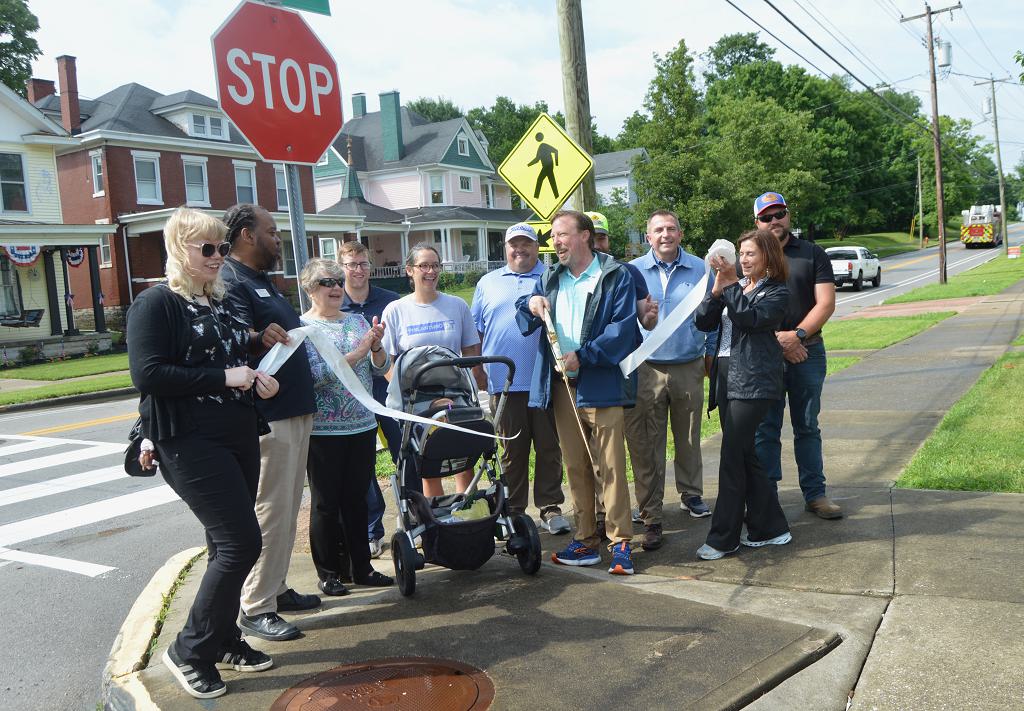
Cindy Banks, executive director of the Winchester-Clark County Chamber of Commerce, and other members held a ribbon-cutting ceremony Monday morning at the intersection to dedicate the project.

